


Child Pugh Score Calculator
Select the clinical parameters and let this calculator estimate the cirrhosis severity.
Use this child Pugh Score calculator to determine severity and estimate mortality in cirrhosis. Also, it informs you about the Child-Pugh class and the survival probability.
What Is Child-Pugh Score?
The Child–Pugh score (Child-Turcotte-Pugh CTP score) helps to evaluate the severity of cirrhosis and the need for a liver transplantation. It takes into account various clinical parameters that are:
- Bilirubin
- Albumin
- Ascites
- Encephalopathy
- Nutritional status
The resulting child score helps to put patients into one of three risk classes (A, B, and C) based on the severity of their conditions.
Child-Pugh Chart:
| Parameter | Assign 1 point | Assign 2 point | Assign 3 point |
| Ascites | Absent | Slight | Moderate |
| Bilirubin (µ/L) | < 34 (< 2) | 34–50 (2–3) | > 50 (> 3) |
| Albumin (g/L) | > 3.5 | 2.8–3.5 | < 2.8 |
| Prothrombin-time (seconds over control) or INR | <4 < 1.7 | 4 - 6 1.7 - 2.3 | >6 >2.3 |
| Encephalopathy | None | Grade 1–2 | Grade 3–4 |
Based on Preventive Strategies in Chronic Liver Disease.
What Is Cirrhosis of The Liver?
Cirrhosis is the stage of scarring (fibrosis) of the liver. At this stage, The liver tissues are replaced by the scares tissues. They prevent the liver from working normally. This condition can lead to liver failure.
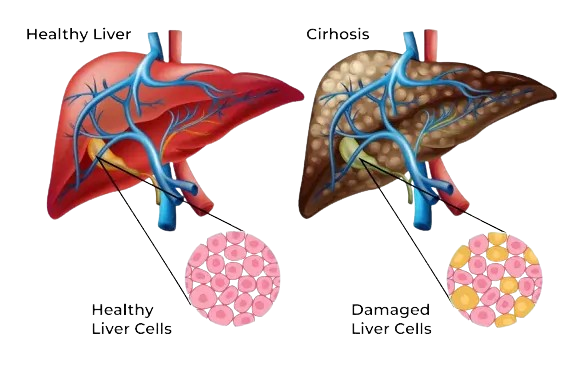
Cirrhosis can happen because of many liver diseases such as ongoing hepatitis (hepatitis B, C, and D), Autoimmune hepatitis Cystic fibrosis, or drinking too much alcohol, etc.
Hepatic Encephalopathy Staging-West Haven Criteria:
The stages of encephalopathy are the parameter that helps to assess the Child-Pugh score.
The five stages of hepatic encephalopathy are:
| Grades | Clinical Findings |
| Unimpaired | At this stage of encephalopathy there are no symptoms |
| Normal psychometric or neuropsychological tests | |
| Grade 1 | The symptoms are mild a shortened attention span and changes to sleep habits like hypersomnia or insomnia may include |
| Abnormal psychometric or neuropsychological tests | |
| Grade 2 | At this stage of encephalopathy the symptoms are moderate, here you may feel disoriented to time |
| Grade 3 | The symptoms are severe. Indicates you will be unable to perform even the basic tasks. Also, you will feel confused and experience personality changes |
| Grade 4 | This is the stage of encephalopathy that is characterized by coma |
Today the meld score is mostly used while performing the transplantation of the liver but the Child-Pugh score is still a valuable system.
How To Interpret Child-Pugh Score?
According to the child score, a specific class is assigned to the patient. The Child-Pugh score interpretation is described below:
| Class A – Least severe liver disease | Class B – Moderately severe liver disease | Class C – Most severe derangement | |
| Points | 5-6 | 7-9 | 10-15 |
| 1-year survival | 100% | 81% | 45% |
| 2-year survival | 85% | 57% | 35% |
- The class A patients are in a safe condition for the elective surgery
- The patients that are in class B are at higher risk, but they can still undergo the surgery
- Child-Pugh Class C patients are not in a safe condition for elective surgery
To perform a quick quick assessment of cirrhosis severity, use the Child-Pugh score calculator. It will let you calculate Child Pugh score and the probability of survival along with the severity of the disease.
FAQ's:
What Are The Signs Your Liver Is Shutting Down?
Below we have provided some signs of cirrhosis:
- Weakness
- Easily bleeding or bruising
- Swelling in the legs, feet or ankles
- Itching on different areas of the body
What Is The Longest You Can Live With Cirrhosis?
The survival for patients with compensated cirrhosis may be more than 12 years. But the Patients with decompensated cirrhosis may live nearly 2 years.
Disclaimer:
The results obtained from this Child Pugh calculator should not be used for the treatment or diagnosis of any health conditions, problems, or diseases. Always consult with qualified Healthcare Professionals for any severe condition or treatment.
Related Tools