


Coefficient of Variation Calculator
Enter your data, choose sample/population, and click on “Calculate” to find the coefficient of variation step-by-step.
Coefficient of Variation Calculator
Use this coefficient of variation calculator to determine the standard deviation value relative to the mean for a sample or population. By calculating the mean, CV, and standard deviation, our calculator provides valuable insights into the distribution of data, which is useful in comparing the variability of different data sets.
What Is The Coefficient of Variation (CV)?
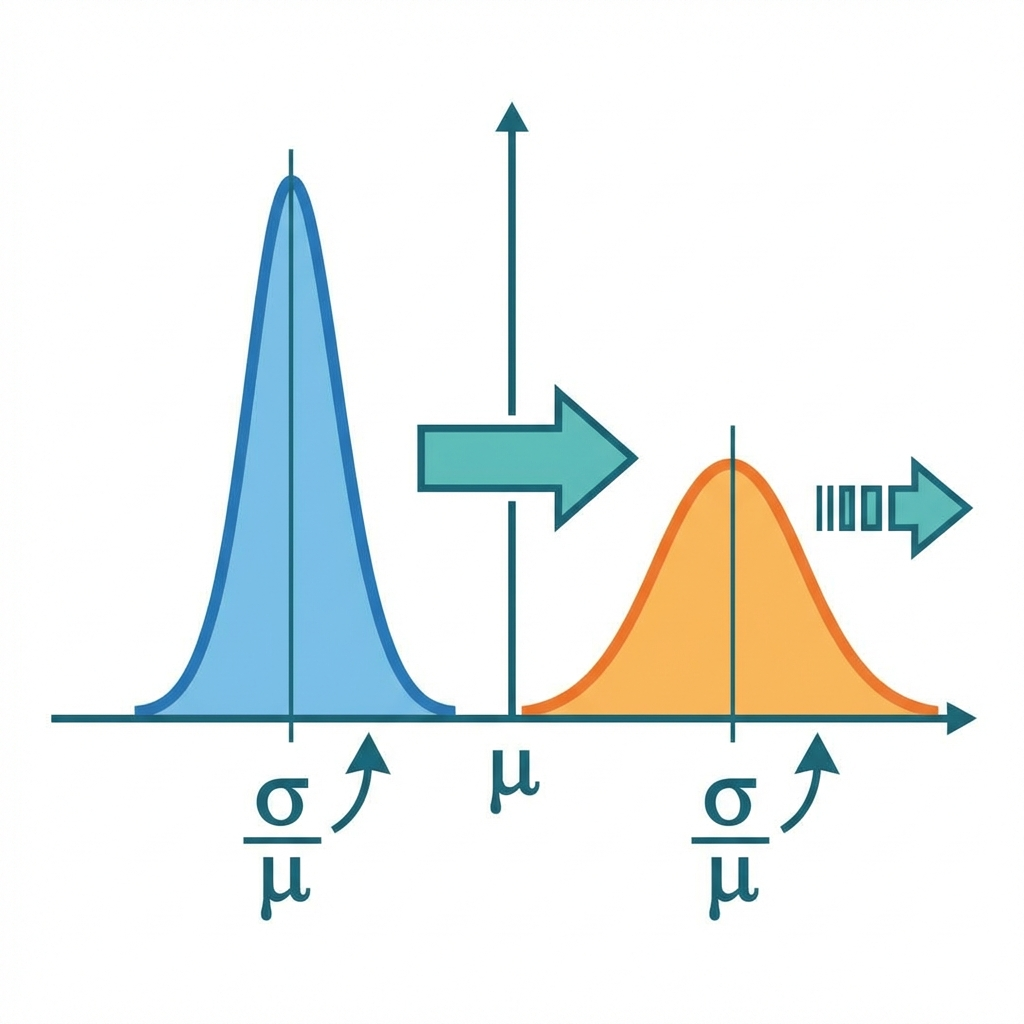
The coefficient of variation is the statistical measure that is used to quantify the relative dispersion of a data set. It is the ratio of standard deviation to the mean and is also known as root mean square deviation (RMSD).
In simple words, CV is the measure of relative variability and is used to determine the dispersion of data points around the mean. It is beneficial in comparing the relative variability of different data sets. A higher CV indicates greater variability, which means the investment is riskier.
Coefficient of Variation Formula:
For Sample:
\[ CV = \frac{s}{\bar{x}} \]
Where:
- s is the sample standard deviation
- \(\bar{x}\) is the sample mean
For Population:
\[ CV = \frac{\sigma}{\mu} \]
Where:
- CV represents the coefficient of variation
- \(\sigma\) is the population standard deviation
- \(\mu\) is the population mean
How To Calculate The Coefficient of Variation?
Example to Find Coefficient of Variation:
Find the coefficient of variation for the samples \(62.25, 60.36, 64.28, 61.24,\) and \(66.24\) of a population.
Solution:
Step #1: Calculate Mean
\[ \text{Mean} = \frac{62.25 + 60.36 + 64.28 + 61.24 + 66.24}{5} \]
\[ \text{Mean} = 62.874 \]
Step #2: Calculate Standard Deviation
\[ SD = \sqrt{\frac{1}{5 - 1} \left[ (62.25 - 62.874)^2 + (60.36 - 62.874)^2 + (64.28 - 62.874)^2 + (61.24 - 62.874)^2 + (66.24 - 62.874)^2 \right]} \]
\[ SD = \sqrt{5.67158} \]
\[ SD = 2.38150 \]
Step #3: Calculate Coefficient of Variation (CV)
Put the values into the coefficient of variation formula:
\[ CV = \frac{SD}{\text{Mean}} = \frac{2.38150}{62.874} \]
\[ CV = 0.037877 \]
For a quick comparison of variability across different datasets, use our CV calculator.
References:
From Wikipedia: According to The Theory And Statistics, CV.
Sørensen, J. B. 2002. The Use And Misuse of The Coefficient of Variation In Organizational Demography Research.
Related Tools