


Combined Gas Law Calculator
Select the parameter from the list and enter the necessary ones in their designated fields. The calculator will determine the results by using the combined gas law equation.
The combined gas law:
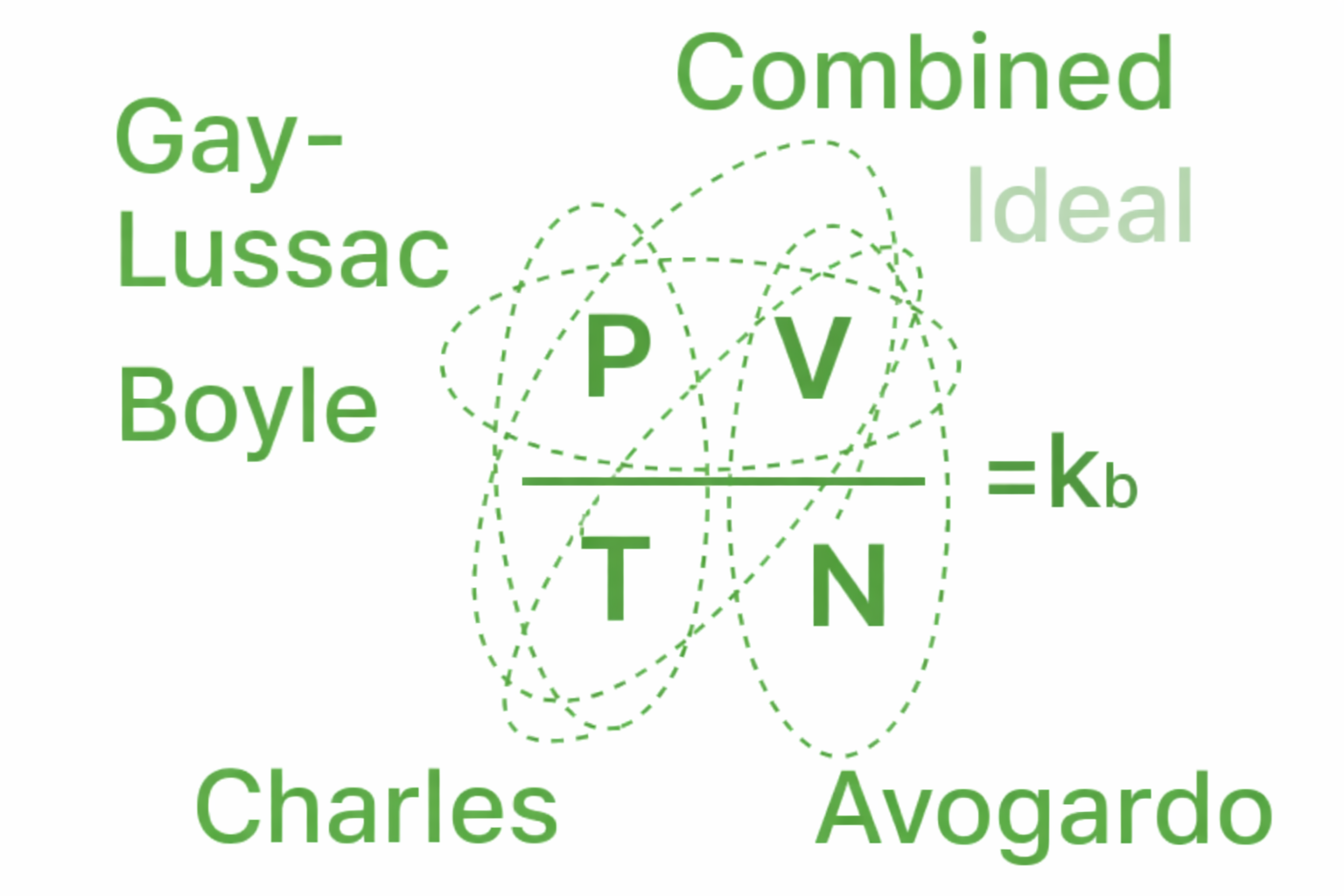
"The combined gas law combines the three gas laws: Boyle's Law, Charles' Law, and Gay-Lussac's Law. It states that the ratio of the product of pressure and volume and the absolute temperature of a gas is equal to a constant"
The combined gas law formula:
The simple combined gas law equation:
\[ \frac{P V}{T} = k \]
Where:
- \(k\) = Constant of proportionality
- \(P\) = Pressure of the gas
- \(V\) = Volume of the gas
- \(T\) = Temperature of the gas
To compute changes in temperature, volume, or pressure, we can write the combined gas law as:
\[ \frac{P_1 V_1}{T_1} = \frac{P_2 V_2}{T_2} \]
The units of Volume, Pressure, and Temperature:
There are various units of the volume, pressure, and temperature, we can use to input in the combined gas law calculator. This calculator supports the various measurements in standard units of the volume temperature and the pressure.
The units of the volume:
By default unit of the volume in the gas volume calculator is m^3. We can find the vloume of the gas by rhte volume of gas calculator in a matter of seconds.We can find the the other conversion of units to m3(meter cube) by the gas volume calculator.
| From | To: m3 |
| l | 0.001 |
| ml | 0.000001 |
| ft^3 | 0.02831685 |
| in^3 | 0.00001638706 |
The units of the pressure:
By default is the unit of the pressure of Pascal and it can be coveint to find the otehr units of the pressure by the pressure calculator chemistry. We are giving the conversion of remaining units of the pressure into the Pascal in the below table:
| From: | To: Pa |
| KPa | 1000 |
| Bar | 100000 |
| atm | 101325.01 |
| mmHg | 133.32238157895 |
| mbar | 100 |
The units of the temperature:
The combined gas law uses Kelvin as the standard unit of temperature. You can also convert from Celsius or Fahrenheit to Kelvin using the following formulas:
From Celsius to Kelvin:
\[ K = t^\circ\text{C} + 273.15 \]
From Fahrenheit to Kelvin:
\[ K = \frac{t^\circ\text{F} + 459.67}{9} \times 5 \]
The derivation of the Combined Gas Law:
The combined gas law is a combination or of three of the known gas laws
- Boyle's Law: \[ P V = K \]
- Charles' Law: \[ \frac{V}{T} = K \]
- Gay-Lussac’s Law: \[ \frac{P}{T} = K \]
It states the ratio of pressure, volumes and the absolute temperature is always equal law, thenonstant. When we combine Avogadro's Law with the combined gas law then we are able to define the ideal gas law. This is the main reason there are no official discoveries of the Combined gas law as it is just a combination of all the gas-known laws. The combined gas law formula calculator using all the known laws of the gases and to implement the combined gas law.
Example of Combined Gas Law:
Consider a gas with an initial volume of 6 L and a final volume of 3 L. Find the final pressure if the initial temperature was 273 K, the final temperature is 200 K, and the initial pressure was 25 kPa.
Given:
- \(P_1 = 25 \, \text{kPa}\)
- \(V_1 = 6 \, \text{L}\)
- \(V_2 = 3 \, \text{L}\)
- \(T_1 = 273 \, \text{K}\)
- \(T_2 = 200 \, \text{K}\)
Solution:
Using the combined gas law:
\[ \frac{P_1 V_1}{T_1} = \frac{P_2 V_2}{T_2} \]
Substitute the values:
\[ \frac{25 \times 6}{273} = \frac{P_2 \times 3}{200} \]
Solving for \(P_2\):
\[ P_2 = \frac{25 \times 6 \times 200}{273 \times 3} \approx 36.63 \, \text{kPa} \]
Hence, the final pressure is \(P_2 \approx 36.63 \, \text{kPa}\).
This can also be verified using a combined gas law calculator.
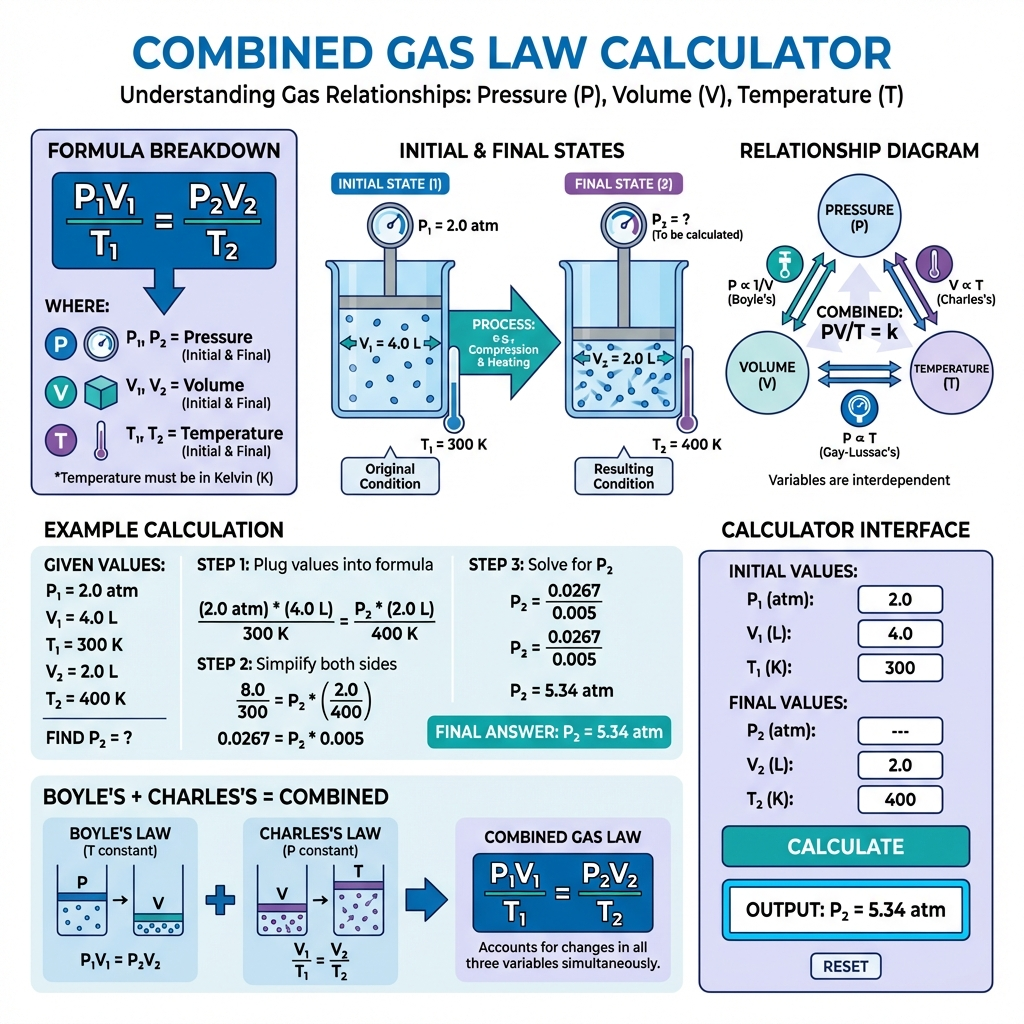
Working of the combined gas law calculator:
The volume temperature and pressure calculator measure accurately either the pressure, temperature, or the volume of any gas by combining the Charles, Boyle, and Gay-Lussac laws:
Input:
- Select the desired value of the temperature, pressure, and volume
- Use the required units for the calculations
- Hit the calculate button to find the temperature, pressure or volume
Output:
The combined gas law calculator displays following output
- The required values are displayed in all the common units.
FAQs:
What is meant by Pascal?
A Pascal is the unit of the pressure and is defined as the “One pascal is a pressure of one newton per square meter”. The kPa standard "atm" pressurealso used along with the pascal.
What is meant by standard atm pressure?
The standard atmospheric pressure is abbreviated as standard atm. 1 atm=101,325 pascal
How many mm is equal to 1 torr?
The 1 torr= 1mmHG of mercury at “0” Centigrade. The name of torr was given by the Torricelli, a person who discovered this unit of pressure.
How do you find the mmHg?
The conversion of mmHg can be found by the following relations
- 1 mmHg = 133.322 pascals (Pa)
- 1 inHg = 3386.39 pascals (Pa)
- mmHg value x 133.322 Pa = inHg value x 3386.39 Pa.
- mmHg value = inHg value x 25.4
The combined gas law calculator with steps using most of the common units of the pressure.
What is Kelvin?
A kelvin is a unit of temperature and is less commonly known as the degree Kelvin. It is a standard SI unit of temperature and one Kelvin is defined as the 1/273.16 (3.6609 x 10 -3 ) of the thermodynamic temperature of pure water (H_2O)
Conclusion:
The combined gas law is widely used in thermodynamics and fluid mechanics. While individual gas laws are useful, their applications are limited because certain variables must remain constant. In contrast, the combined gas law allows us to calculate changes in temperature, pressure, and volume simultaneously, making it more versatile. Using a combined gas law calculator, we can easily determine the final values of these variables based on the combined gas law formula.
References:
From the source of Khan Academy:The ideal gas law,calculate number of moles
From the source of Wikipedia:Combined gas law,Derivation from the gas laws
Related Tools