


Density Altitude Calculator
To calculate the altitude density, enter air temperature, dewpoint, altimeter setting, and station elevation in the tool and click ‘Calculate’
Density Altitude Calculator
“The term density altitude refers to the pressure altitude that is set for non-standard temperature. It measures how high an aircraft or location feels above sea level in terms of air density”
As the density altitude gets higher then it corresponds to the decreasing of air density and thus reduces the aircraft's performance, affecting factors including lift and thrust that are considered important for pilots when they operate at elevated locations. Density altitude is based on the International Civil Aviation Organization (ICAO). According to this model, the air temperature at zero altitudes to 15 °C ( 59 °F ), air pressure to 1013.25 mbar ( 29.921 inHg ), relative humidity to 0%, and air density to 1.225 kg/m³ ( 0.076474 lb/ft³ ).
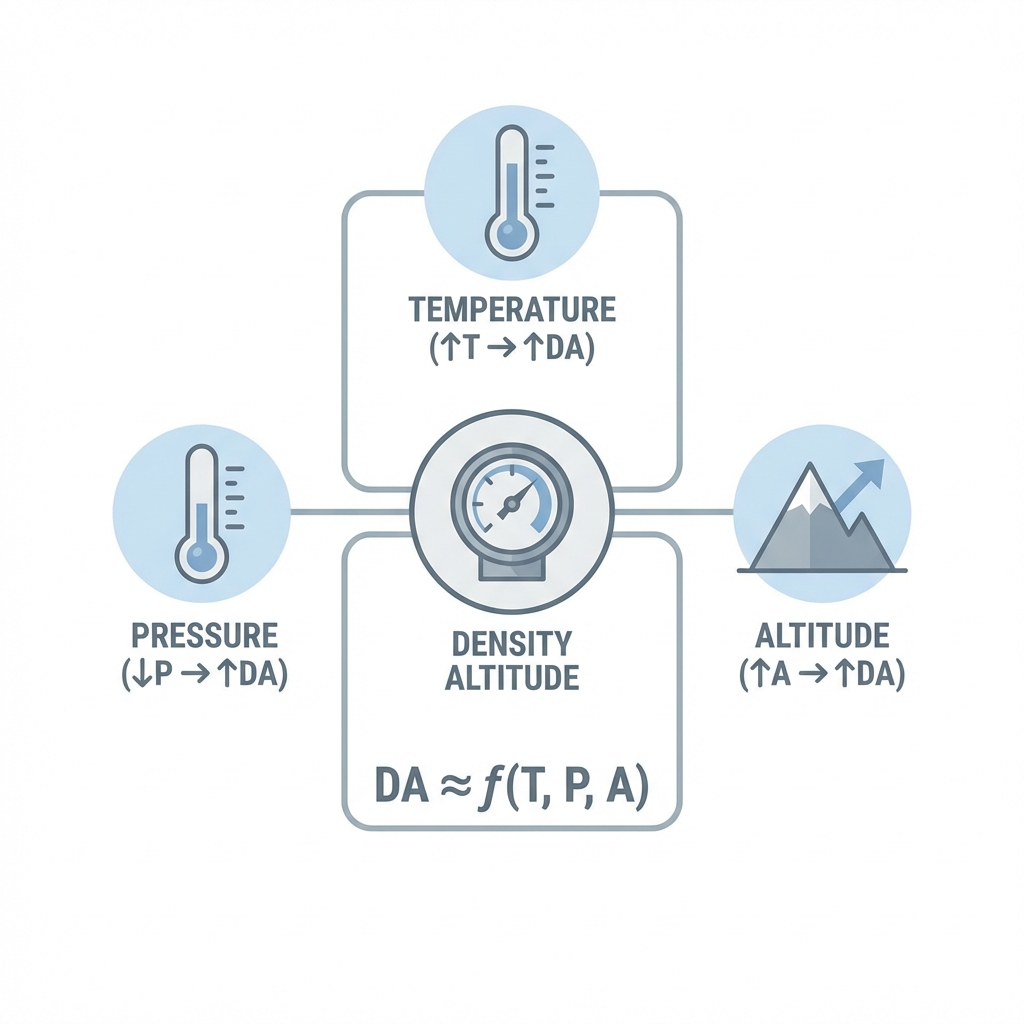
How To Calculate Density Altitude Calculator?
Density Altitude (ft) = Pressure Altitude (ft) + \(120 \times (\text{OAT}^\circ\text{C} - \text{ISA Temperature}^\circ\text{C})\)
Below are general steps to calculate density altitude:
1. Determine Standard Temperature:
Standard Temperature (\(^\circ\text{C}\)) = 15 - \(\frac{\text{Altitude (ft)}}{1000} \times 2\)
2. Calculate Temperature Difference:
Temperature Difference = Actual Temperature - Standard Temperature
3. Determine Pressure Altitude:
Pressure Altitude (ft) = Altitude (ft) + \(\frac{29.92 - \text{Actual Pressure (inHg)}}{\text{Pressure Lapse Rate (inHg/ft)}}\)
Note: For every 1,000 ft, standard pressure decreases by 1 inHg.
4. Apply Correction for Temperature:
Correction Factor = Temperature Difference \(\times 120\)
5. Calculate Density Altitude:
Density Altitude (ft) = Pressure Altitude (ft) + Correction Factor
Or equivalently:
Density Altitude (ft) = Pressure Altitude (ft) + \(120 \times (\text{OAT}^\circ\text{C} - \text{ISA Temperature}^\circ\text{C})\)
Practical Example:
Imagine you're a pilot planning a flight in a small aircraft. The airport has the following weather conditions:
- Temperature = 30°C (86°F)
- Altitude = 1,000 ft above sea level
- Barometric Pressure = 29.92 inHg
Solution:
Step 1: Determine Standard Temperature
Standard Temperature decreases approximately 2°C per 1,000 ft of altitude: \[ T_\text{standard} = 15 - \frac{\text{Altitude (ft)}}{1000} \times 2 \] At 1,000 ft: \[ T_\text{standard} = 15 - \frac{1000}{1000} \times 2 = 13^\circ\text{C} \] (If you are using ISA starting from 15°C at sea level.)
Step 2: Calculate Temperature Difference
\[ \Delta T = T_\text{actual} - T_\text{standard} = 30^\circ\text{C} - 13^\circ\text{C} = 17^\circ\text{C} \]
Step 3: Determine Pressure Altitude
Pressure Altitude is the altitude at which the atmospheric pressure equals 29.92 inHg. \[ \text{Pressure Altitude} = \text{Altitude} + \frac{29.92 - P_\text{actual}}{\text{Pressure Lapse Rate}} \] Since actual pressure = 29.92 inHg: \[ \text{Pressure Altitude} = 1,000\ \text{ft} + \frac{29.92 - 29.92}{1\ \text{inHg / 1000 ft}} = 1,000\ \text{ft} \]
Step 4: Apply Correction for Temperature
Correction Factor = Temperature Difference × 120 ft/°C \[ \text{Correction} = \Delta T \times 120 = 17 \times 120 = 2,040\ \text{ft} \]
Step 5: Calculate Density Altitude
\[ \text{Density Altitude} = \text{Pressure Altitude} + \text{Correction} = 1,000 + 2,040 = 3,040\ \text{ft} \]
Factors Driving The Air Density:
Several factors influence the air density. The primary factors which drive the air density are as follows:
- Temperature: With the increase in temperature, there decrease in air density because air molecules get energy and move faster.
- Altitude: With the higher altitude, the density of air decreases. At higher altitudes, atmospheric pressure decreases, which leads to lower air density.
- Humidity (Water Vapor Content): Humid air has a lower density than dry air due to the lighter weight of water vapor.
- Pressure: As pressure decreases the air density also decreases and vice versa.
- Composition of Air: Ait is composed of different gases so alteration in the proportion of these gases can influence the air density.
- Barometric Pressure: Increased barometric pressure is linked to more compact air, while decreased pressure is associated with less compact air.
FAQs:
Why Do Pilots Calculate Density Altitude?
Pilots need to calculate the density altitude because high density has implications for takeoff performance and landing distance. Pilots determined the reported density altitude and checked suitable aircraft performance charts during pre-flight preparations.
What Is Barometric Pressure?
Barometric pressure is the measure of the weight exerted by the air molecules above a specific point.
What Is Actual Air Pressure?
Actual air pressure is equal to the average air pressure at sea level at the temperature of 15 degrees Celsius (59 degrees Fahrenheit). It is the sum of dry air pressure and water vapor pressure.
P = Pd + Pv
What Is The Altimeter Setting?
The altimeter setting is a parameter used to adjust the altimeter for variations in the atmospheric pressure. Typically, it is given in Hg (inches of mercury) or hPa (hectopascal).
Related Tools