


Domain and Range Calculator
Write the function in the designated field and the tool will display the domain and range of the function.
Domain And Range Calculator:
This domain and range calculator finds all the possible sets of input(domain) and output(range) values for the given function. It shows the result in interval notation form and also provides the graph, helping you understand where the function is defined and what values it can produce.
What Are Domain and Range?
The domain and range show the possible inputs and outputs of a function. They help to understand how a function behaves, what inputs it can take, and what output it can produce
Definition of Domain:
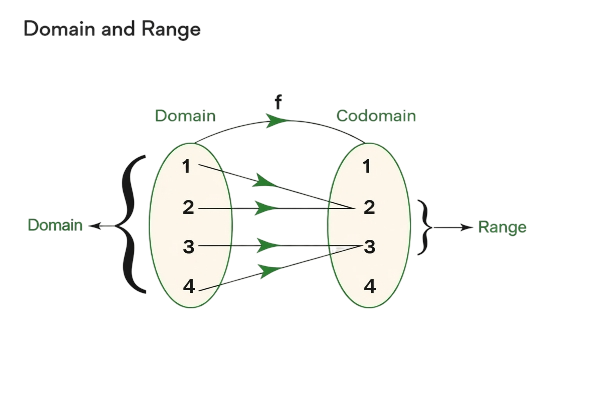
The set of all possible input values of a function. It's a particular set of values that helps to define a function.
Definition of Range:
The set of all possible output values of a function. These are the values that the function yields when the domain values are put in it.
Consider the figure below:
Notation (Interval, Set-builder, Inequality):
The domain and range are represented in the form of:
- Interval notation: (−∞,+∞)[0,+∞)
- Set-builder notation: {x ∣ x>0}
- Inequality notation: x>0, y ≤ 5
How To Use the Calculator?
Step 1: Enter the Function
Enter your function f(x) into the input box of the calculator.
Step 2: Click the “Calculate” Button
After providing the input, click the Calculate button.
Step 3: Review the Results
You will see:
- The domain and range values are written in interval form
- A graphical view to see where the function exists. It helps to visualize how x and y values are related
➤ Input Format Rules:
Enter the standard mathematical expression by following these rules:
✅ Use lowercase letters
✅ Always use x as the variable
➤ Allowed Functions:
Our calculator supports the following functions:
- Polynomial functions: x^2 + 3x + 2
- Rational functions: 1 / (x − 4)
- Root functions: sqrt(x), cbrt(x)
- Exponential and logarithmic: e^x, log(x)
➤ Limitations:
- The complex numbers are not supported
- Use parentheses accurately to avoid ambiguity
➤ Syntax Tips:
To get the accurate results, please follow these syntax guidelines:
- Exponents: Use ^ (e.g., x^3 for x³)
- Parentheses: Never forget to close the parentheses properly
- Multiplication: Use * for clarity (2*x instead of 2x)
- Constants: You can use pi, e, and standard numbers (e.g., 3.14, 2.718)
➤ Common Input Errors to Avoid:
- Missing or extra parentheses
- Using capital letters for functions
? Note: If you enter an invalid expression, the calculator will display an error message indicating that the input is not correct.
Why Use a Domain and Range Calculator?
Using a domain and range calculator makes the process quick, easy, and error-free. Here's how it helps:
- ⚡ Instant Calculation: The use of an online calculator lets you have instant results for the entered functions, saving time and reducing manual errors
- ? Visual Graph and Number Line: Our calculator provides you with a visual graph so that you can easily see where the function exists and how the domain and range behave. The line on the graph makes it easy to interpret the intervals
- ? Handles Various Function Types: With a calculator, you can easily handle a wide variety of function types, including polynomial, rational, root, exponential, and logarithmic
- ? Help Reduce Conceptual Confusion: The calculator finds out the restrictions ( division by zero, negative roots, or undefined roots) and handles them correctly, minimizing the math mistakes
How to Find the Domain and Range of a Function?
Go through the example below to better understand how to find the domain and range of a function:
Statement:
Find the domain and range of the graph function given as follows:
y = (x+3)/(10-x)
Solution:
➤ Domain:
First, look for the value of x that will make the denominator zero. In our case, it is 10, such that;
10 - x = 10 - 10 = 0
Since division by zero is undefined, x = 10 is excluded from the domain.
✅ Domain: x∈(−∞, 10)∪(10, ∞)
➤ Range:
Solving for x:
y = (x + 3) / (10 - x)
y(10 - x) = x + 3
10y - xy = x + 3
-xy - x = 3 - 10y
-x(y+1)
-x = (3 - 10y) / (y + 1)
x = (10y - 3) / (- y - 1)
Now, the denominator 1 + y must not be zero:
1 + y = 0 ⇒ y = -1
So, y = -1y = -1y = -1 is not included in the range.
✅ Range: y ∈ (-∞, -1)∪(-1, ∞)
Interpretation & Explanation of Results:
Here’s how you can interpret the domain and range of a function:
Reading the Domain Result:
In a result, the domain tells about all the possible values of x for which the function is defined.
For Example:
x∈(−∞,10)∪(10,∞)
Now this result shows that all the values are valid except the 10
? Note: Remember, when the domain and range calculator shows undefined or excluded values, it means it is indicating division by zero or negative roots, or other kinds of restrictions.
Reading the Range Result:
It indicates all the possible output values that a function can generate
For Example:
y ∈ (−∞, −1)∪(−1, ∞)
It shows the function can not reach
Y = -1
This situation occurs when a rational expression or asymptotic behavior is present in the equation. It means the function approaches a specific value but never touches it.
Understanding Continuity, Restrictions & Asymptotes:
Keep in mind that the functions are not always continuous, some functions have holes, breaks, and asymptotes. These factors affect the domain and range of the functions. Knowing and understanding these points deeply helps to interpret the result correctly.
- Continuity: A function is said to be continuous when there are no gaps, holes, or breaks in its graph, and you can move the pencil along the curve without lifting it. On the other hand, a function is discontinuous when there are gaps, holes, or sudden jumps in the graph
- Restrictions: Some restrictions occur when certain values make the function undefined, division by zero or the square root of a negative number, etc
- Vertical Asymptotes: It occurs when the function becomes infinitely large or small as x approaches a restricted value (e.g., x = 10, x(x + 3) / (10 - x))
- Horizontal Asymptotes: The lines that the function approaches but never reaches as the x moves towards the positive or negative infinity (e.g., y=1y = 1y=1)
- Holes: These are the points where the numerator and denominator become zero, forming a gap in the generated graph where the function is undefined
? Note: The calculator identifies these automatically, so you can instantly see where the function is continuous or restricted.
Common Mistakes & Pitfalls:
Finding the domain and range of a function requires taking care of small mistakes that can lead to wrong conclusions. Here are a few of them:
1. Forgetting When the Denominator Equals Zero:
Remember that most of the functions become undefined when the denominator is equal to zero. So, determine the values that can make the denominator zero. These values should not be in the domain of the function.
Example: f(x) = 1 / (x−4) → Denominator = 0 at x = 4 so exclude x = 4 from the domain of the function.
2. Negative Inside a Square Root:
Taking the square root of negative numbers is not possible for real functions, so always check the expression before performing any operation on it.
Example: f(x) = √(x - 5) → Domain starts from x = 5 and extends to infinity.
3. Misinterpreting Interval Endpoints:
Avoid confusion about open and closed intervals when finding the domain and range of a function.
- If the endpoint is not included (e.g., division by zero), then use the parentheses ( )
- If the endpoint is included (e.g., square root boundary), then use the brackets [ ]
Example: [5, ∞) means x = 5 is included, while (5, ∞) means it is not included.
To learn how to convert inequity and value sets into an interval notation form, try our interval notation calculator.
4. Ignoring Complex or Imaginary Domains:
Remember, the imaginary results are not part of the domain.
Example: f(x) = √-x → Only defined for x ≤ 0.
? Note: Our domain and range calculator automatically checks for these issues and excludes invalid values, so you always get the correct domain and range for the provided function.
FAQ’s:
Can Domain & Range Be the Same?
As we know that the domain represents the input and the range represents the output. They can be the same only if the function maps from a set onto itself. It means each input value should also appear in the output:
f(x) = x
- Domain: all real numbers ℝ
- Range: all real numbers ℝ
In this case, both domain and range are the same, because whatever you input, you will get the same as the output.
What if the Function is Constant?
A constant function always has the same value for all the input values.
f(x) = c
References:
- From the source of allen.in: Domain and Range of A Relation.
- From the source of Wikipedia: Domain of a function, Natural domain, Set theoretical notions.
- From the source of Khan Academy: Domain and range from graph, Intervals.
Related Tools