


Improper Integral Calculator
Provide the function with the required limits and the calculator will let you know whether it is convergent or divergent over the range, with the steps shown.
This improper integral calculator computes the values of improper integrals. Serving as a converge or diverge improper integral calculator it also determines whether the given function is convergent or divergent, eliminating potential human errors. It provides a clear, detailed solution to help you solve complex integral problems with confidence.
What is Improper Integral?
In calculus, an improper integral is an extension of the definite integral. It is especially used when the limits are infinite or when the function being integrated has a discontinuity within the interval. improper integrals address situations where the calculated area extends to infinity or involves a function that is undefined at certain points. An improper integral represents the reverse process of differentiation.
Types of Improper Integrals:
Type 1 (Integration Over an Infinite Domain):
In type One improper integrals, one or both limits of integration are infinite. Consider a function f(x) defined on the interval [a, ∞). To evaluate the integral of f(x) over this infinite interval, we use a limit:
∫a∞ f(x) dx = limn→∞ ∫an f(x) dx
It means that we integrate the function f(x) from “a” to an infinite value “n” and after that find the limit when the value of “n” approaches infinity.
Let us suppose that we have a function f(x) which is defined for the interval [a, ∞). Now, if we consider to integrate over a finite domain, the limits become:
∫∞a f(x) dx = limn→∞ ∫na f(x) dx
If the function is defined for the interval (-∞, b], then the integral becomes:
∫-∞b f(x) dx = limn→-∞ ∫nb f(x) dx
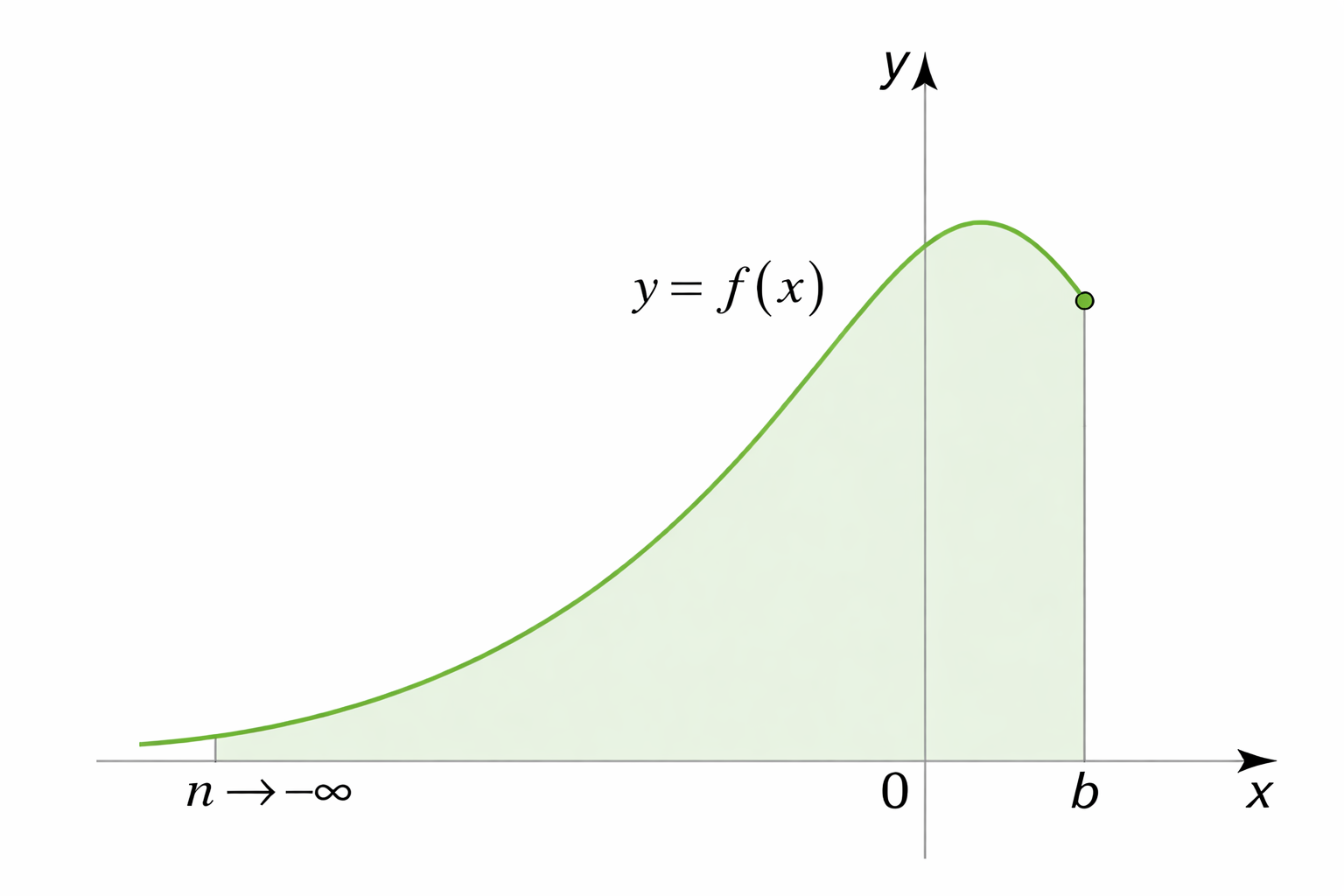
It should be remembered that if the limits are finite and result in a number, the improper integral is convergent. But if limits are not a number, then the given integral is divergent.
Now, let us discuss the case in which our improper integral has two infinite limits. In this situation, we choose an arbitrary point and break the integral at that particular point. After doing so, we get two integrals having one of the two limits as infinite.
∫-∞∞ f(x) dx = ∫-∞c f(x) dx + ∫c∞ f(x) dx.
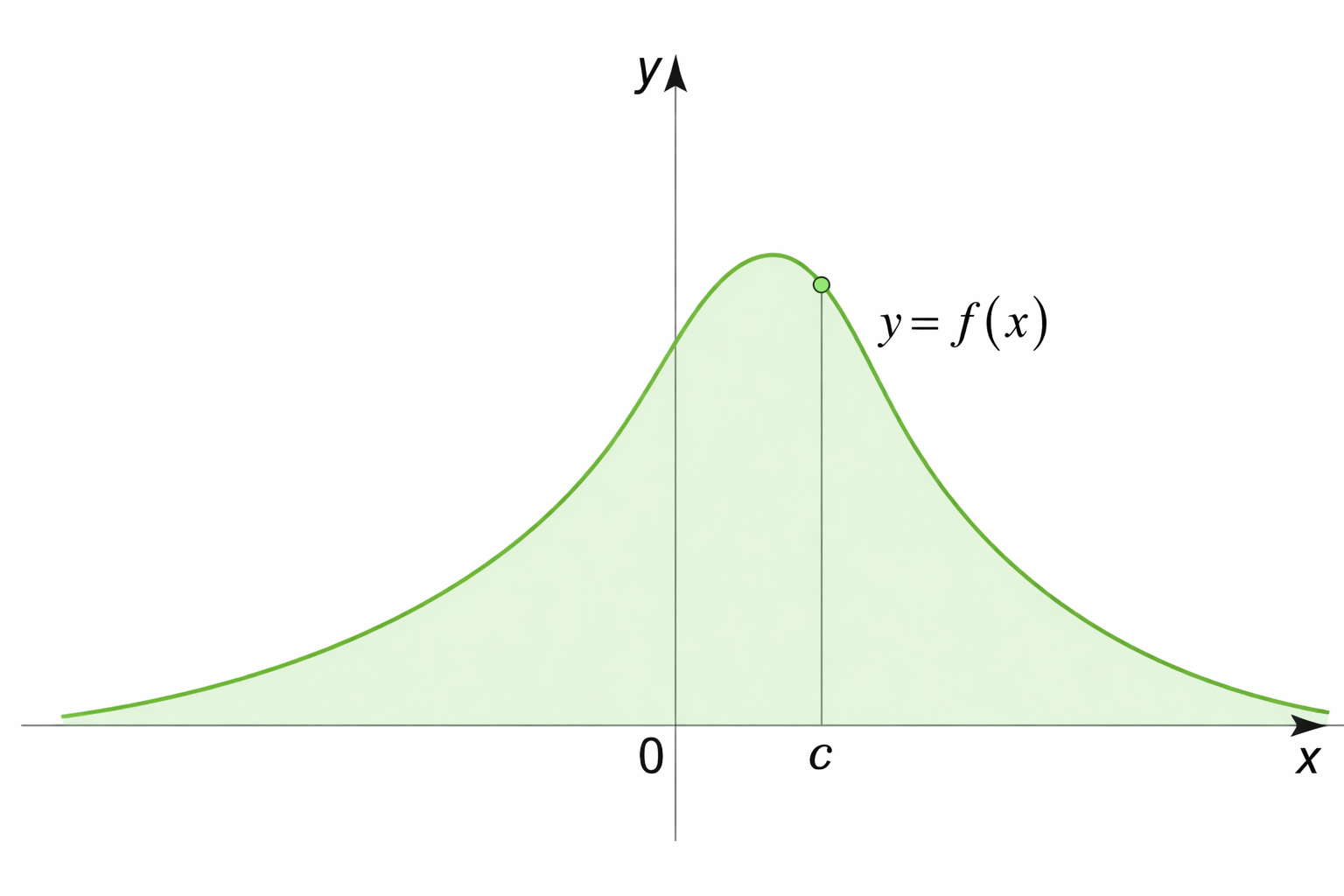
You can easily evaluate these integrals, now with single infinite limits, by using our type 1 improper integral calculator.
Type 2(Improper Integrals With Infinite Discontinuity):
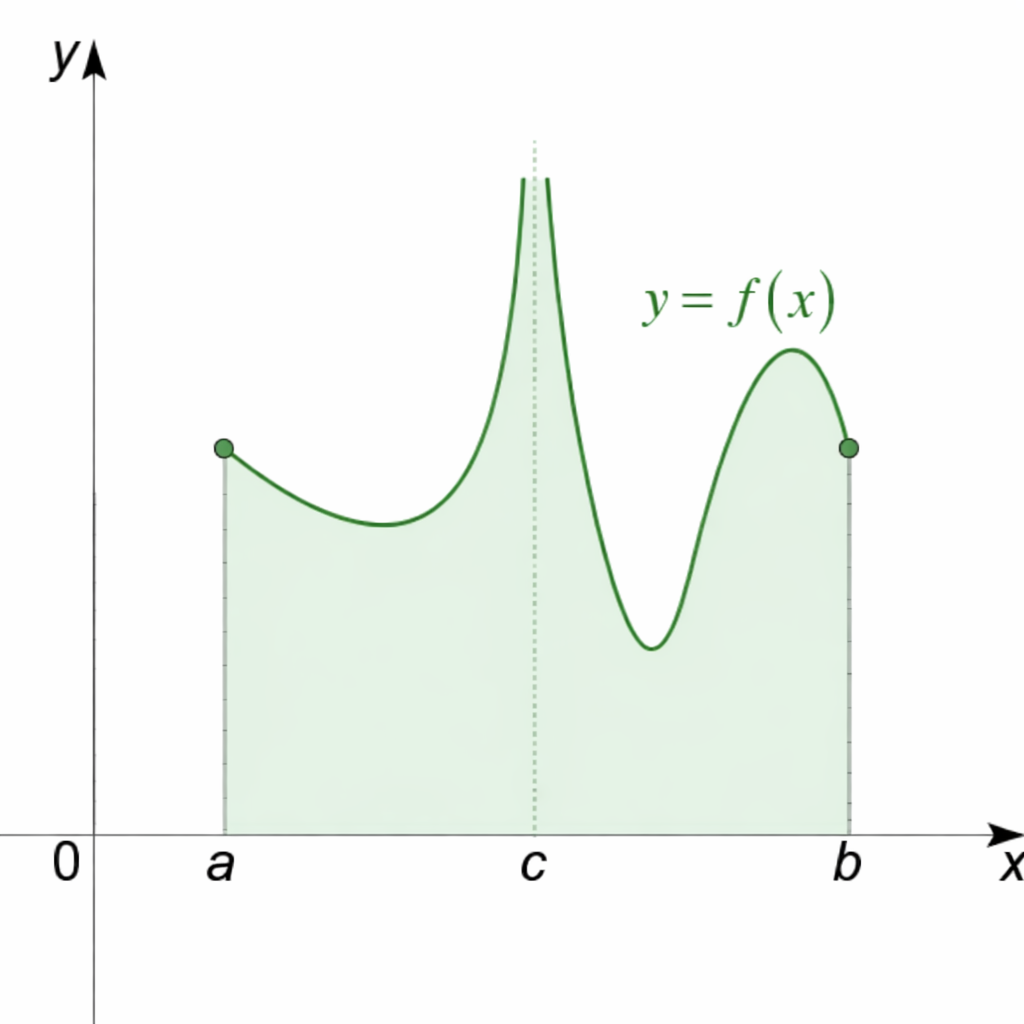
These integrals have undefined integrands at one or more points of integration. Let f(x) be a function that is discontinuous at x = b and is continuous in the interval [a, b).
∫ab f(x) dx = limτ→0⁺ ∫ab-τ f(x) dx
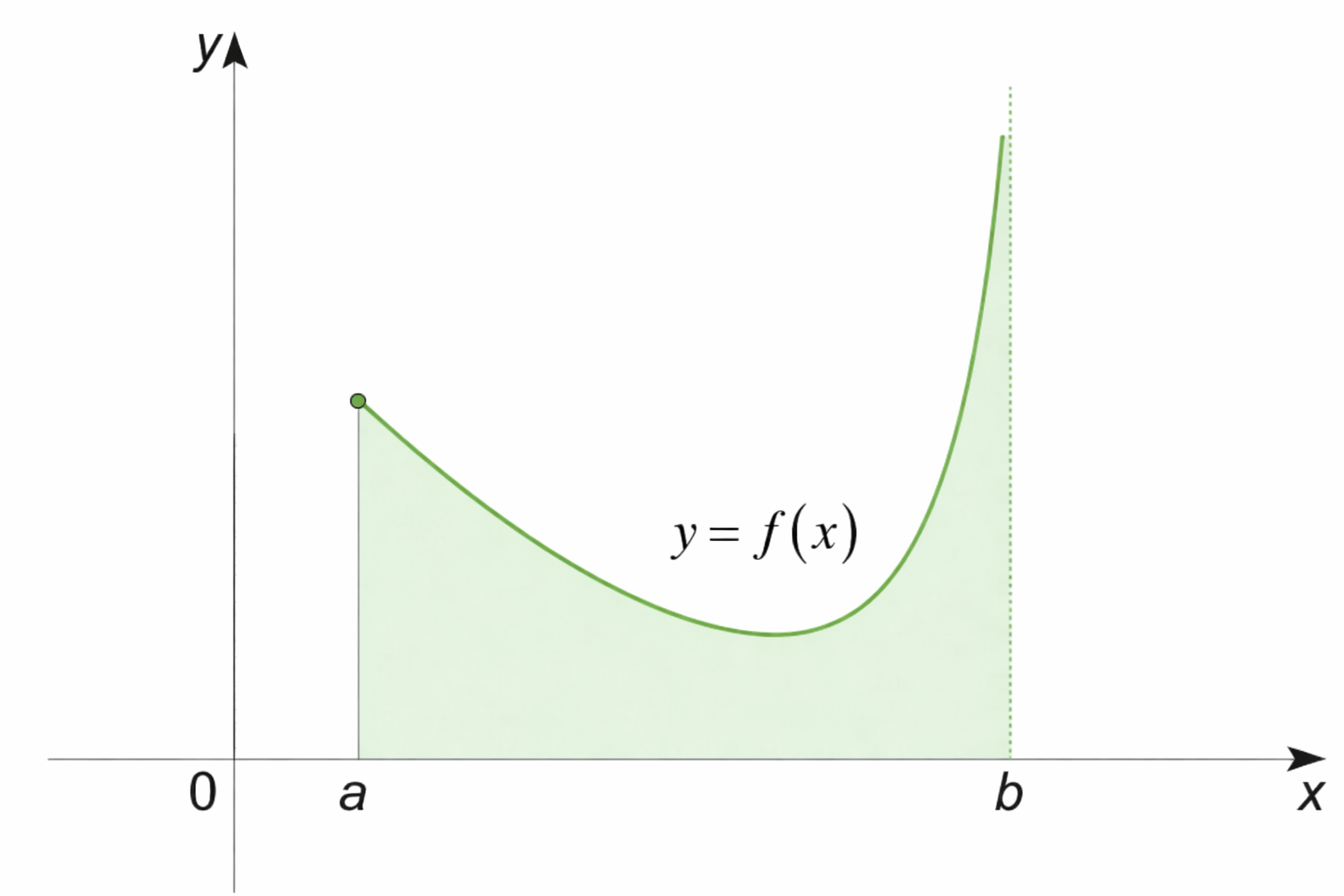
Like above, we consider that our function is continuous at the interval (a, b] and discontinuous at x = a.
∫ab f(x) dx = limτ→0⁺ ∫a+τb f(x) dx
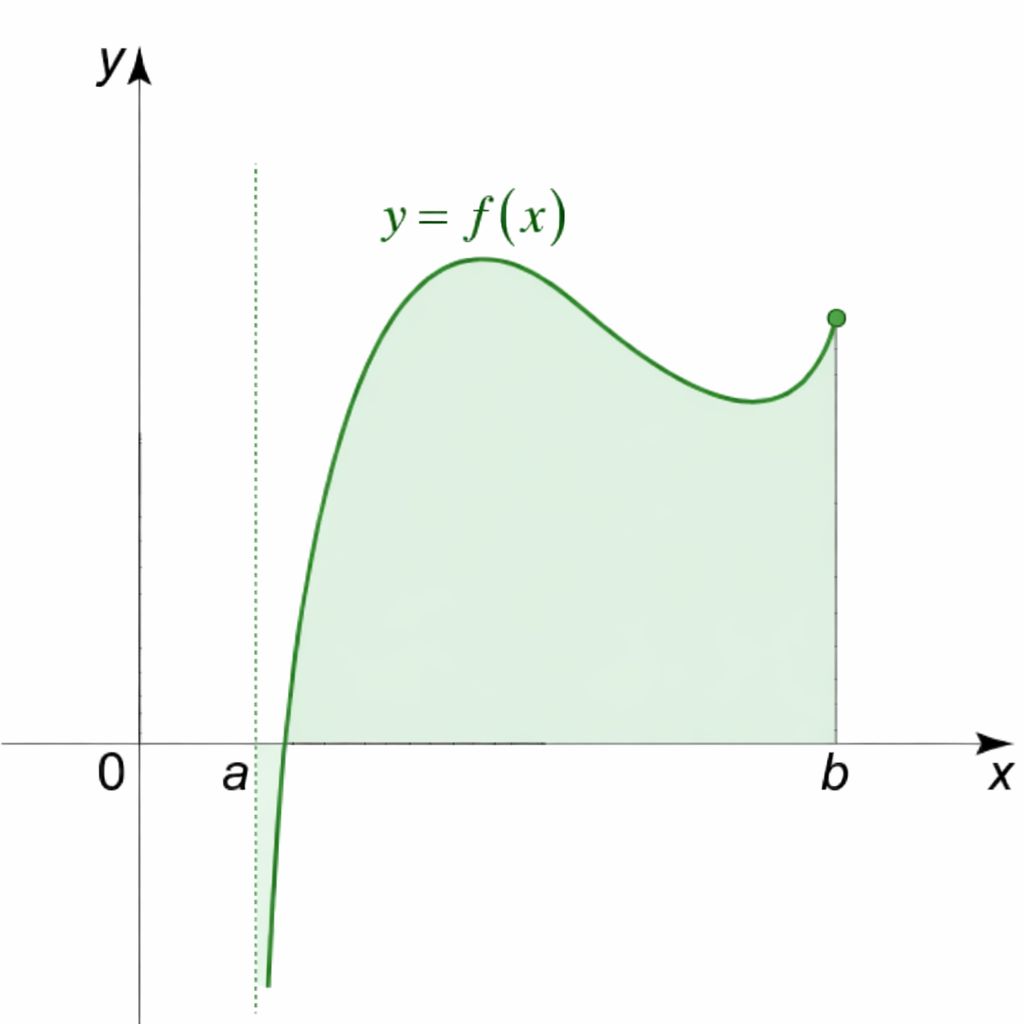
Now if the function is continuous at the interval (a, c] ⋃ (c, b] with a discontinuity at x = c.
∫ab f(x) dx = ∫ac f(x) dx + ∫cb f(x) dx.
For quick solutions to these types of integrals, especially those with discontinuities, consider using a type 2 improper integral calculator.
How To Evaluate An Improper Integral?
Follow these steps to evaluate an improper integral:
Step #1: Identify the Type of Improper Integral
Determine if it's Type 1 (infinite limits) or Type 2 (discontinuity).
Step #2: Rewrite Using Limits
Replace infinite limits or discontinuities with variables, and express them as a limit.
If the limit of the integral is infinite:
- Use the variables (e.g., 'n' or 't') at the place of the infinite limit
- When the variables go to infinity, consider the integral as the limit of the definite integral
If the integral has a discontinuity:
- Place the variable (e.g., 'τ') at the point of discontinuity
- When the variables go to discontinuity, write the integral as the limit of the definite integral
Step #3: Integrate
Calculate the definite integral.
Step #4: Limit
Evaluate the limit.
Step #5: Conclude
If the limit is finite, it converges; otherwise, it diverges.
Step #6: Split (If Needed)
For discontinuities within the interval or double infinite limits, split the integral and repeat steps 2-5 for each part. Keep in mind splitting is necessary because limits cannot be evaluated across points of discontinuity or across both infinite limits at the same time.
If you want to check your work or quickly evaluate improper integrals, consider using our online improper integral calculator.
Now, let's walk through a couple of manual examples to help you see how it's done.
Example # 01:
Evaluate the improper integral given:
∫0∞ (1/x) dx
Solution:
Your input is:
∫0∞ (1/x) dx
First, we need to calculate the definite integral:
∫ (1/x) dx = log(x)
(for steps, see Integral Calculator).
Evaluating the limits:
log(x) |x=0 = -∞
limx → ∞ log(x) = ∞
Now, evaluating the improper integral:
∫0∞ (1/x) dx = (log(x) |x=0) - (limx → ∞ log(x)) = ∞
Thus, the improper integral diverges:
∫0∞ (1/x) dx = ∞
Since the value of the integral is not a finite number, so the integral is divergent. Moreover, the integral convergence calculator is the best option to obtain more precise results.
Example # 02:
Evaluate the improper integral:
∫-1∞ (1/x2) dx
Solution:
As the given input is:
∫-1∞ (1/x2) dx
So, we have to solve for the indefinite integral first:
∫ (1/x2) dx = - (1/x)
(for steps, see Integral Calculator).
Evaluating the limits:
(- 1/x) |x=-1 = 1.0
limx → ∞ (- 1/x) = 0
Now, evaluating the improper integral:
∫-1∞ (1/x2) dx = ((- 1/x) |x=-1) - (limx → ∞ (- 1/x)) = -1.0
Thus, the improper integral evaluates to:
∫-1∞ (1/x2) dx = -1.0
As we have a finite number, the given integral is said to be convergent. Also, you can clear your doubts by feeding the same function in converge or diverge calculator.
How To Use The Improper Integral Calculator?
Follow these steps to use the improper integral calculator correctly:
- Enter Your Function: Write down your function in the menu bar
- Select Integration Variable: Choose the variable (e,g. dx, dy, dz….) w.r.t which you wish to determine the integral
- Enter Integration Limits: Provide the lower and upper limits of integration
- Calculate: Click on “Calculate and the calculator will then apply the necessary limit techniques to evaluate the improper integral
- View Results: The calculator will display the result of the integral, indicating whether it converges or diverges
FAQ’s:
How Do You Know If An Integral Is Improper?
An integral is improper if it meets one or both of the following conditions:
- Infinite Limits: If the upper, lower, or both limits of integration are infinite
- Discontinuities: If the function being integrated has a discontinuity (becomes undefined) within the interval of integration
How Do You Determine Whether The Improper Integral Converges or Diverges?
To know that evaluate the limit of the definite integral. If the lower or upper limit goes to infinity or any point of discontinuity.
- Convergence: If the limit exists and is a finite number, the improper integral converges
- Divergence: If the limit is infinite or if the limit does not exist, the improper integral diverges
Can You Split An Improper Integral?
Yes, you can split an improper integral. Splitting is necessary when:
- The integrand has a discontinuity within the interval of integration
- The integral has 2 infinite limits (e.g., from negative infinity to positive infinity)
Why Do We Use Improper Integrals?
The improper integral helps to handle integrals with:
- Infinite limits (e.g., integrating to infinity)
- Discontinuities within the integration interval
They help to find values for integrals that can not be normally defined.
Is 0 convergent or divergent?
0 itself does not converge or diverge. The convergence/divergence applies to sequences, series, or integrals.
- A sequence/series converges if its terms or sums approach a finite limit
- An integral converges if its value approaches a finite limit
Reference:
From the source of Wikipedia: Improper integral, Convergence of the integral, Types of integrals, Improper Riemann integrals, and Lebesgue integrals.
From the source of Khan Academy: Improper integrals, Divergent improper integral.
Related Tools