


ML to Moles Calculator
Enter the total number of mL and the molarity into the calculator and the tool will determine the number of moles of a solution.
Need to find out how many moles are in your solution? The ML to Moles Calculator does it for you in seconds. Just punch in your volume and molarity, and you’re set. This makes life a lot easier when you’re prepping solutions or running reactions in the lab.
What’s a Mole?
Let’s get basic for a second. In chemistry, a mole is just the standard way to measure how much of something you’ve got.
It tells you the number of particles, atoms, molecules, ions, in your solution. That’s why chemists talk about moles so much.
How to Convert ML to Moles
To go from milliliters (ml) to moles, you need two things: your solution’s molarity (that’s the concentration, in mol/L)
and the volume.
Here’s the formula
n = C × V
Where
n = number of moles
C = concentration or molarity (mol/L)
V = volume (L)
Quick tip: Make sure to turn milliliters into liters first. Just divide by 1,000.
So, Volume (L) = Volume (ml) ÷ 1,000
Let’s See It in Action
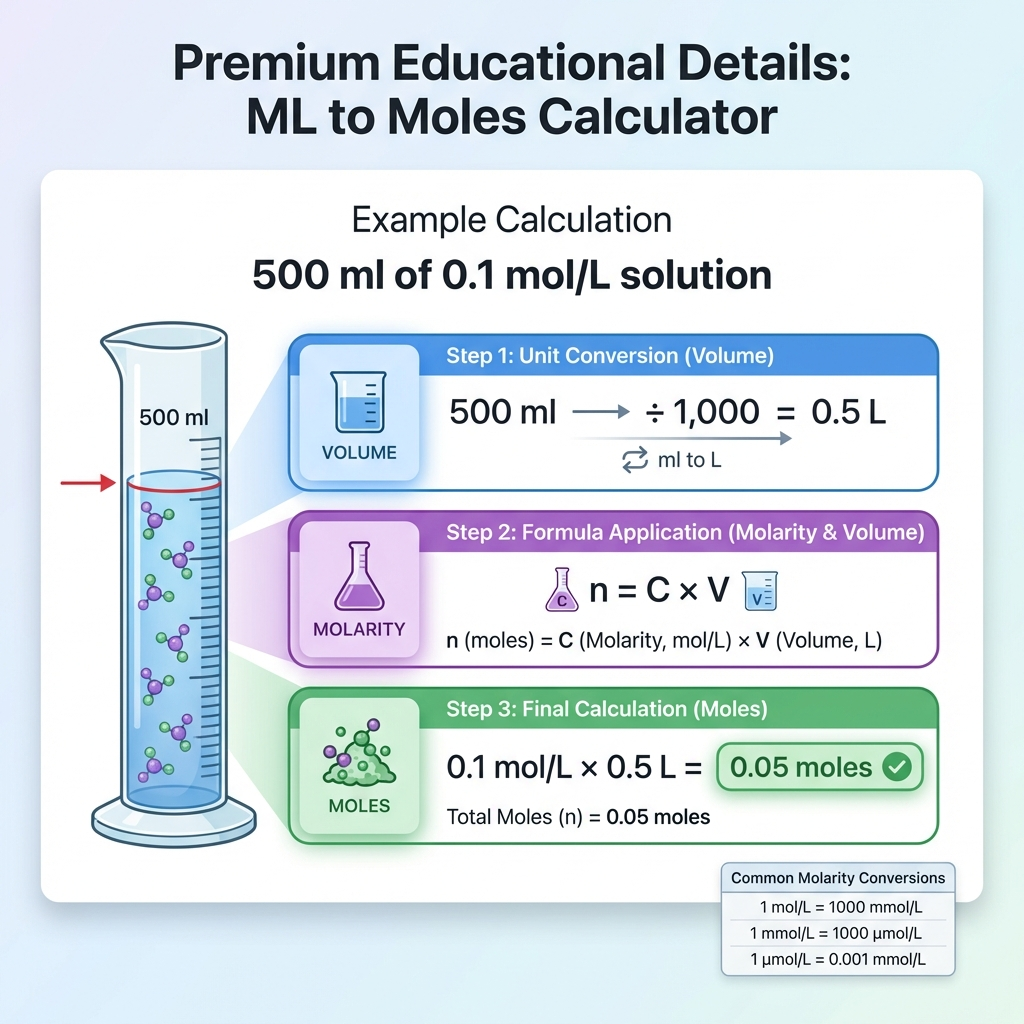
Say you have 500 ml of a 0.1 mol/L solution. How many moles is that?
First, convert the volume
500 ml ÷ 1,000 = 0.5 L
Now, use the formula
n = 0.1 × 0.5 = 0.05 moles
Done. That solution holds 0.05 moles of the substance.
Common Molarity Unit Conversions
Sometimes, you’ll run into different units when you’re converting ml to moles. Here’s a quick cheat sheet:
The ml to moles calculator converts the molar concentration/Molarity and volume into the number of moles of the substance.
How to Convert ml to Mol?
It is necessary to find the number of moles of a substance in the solution before conducting the chemical reaction. To convert ml to moles, it is essential to know the concentration of the substance in the volumes of the solution. The concentration of a substance is expressed in units per liter(mol/L) or simply molarity.
For converting ml to moles, you need to multiply the volume(L) by the molarity.
The ml to Mole Formula:
Our ml to moles calculator can also find the molarity of the substance you need to add to your solution to obtain a desired molar concentration.
n = CV
Where:-
n = Moles
C= Concentration / Molarity (mol/L)
V= Volume of Solution (L)
You can also describe the convert ml to moles formula as:
moles = concentration x volume (in liters)
Practical Example:
Consider there is a solution of a molar concentration of 0.1 mol/L and a volume of 500 ml. Then convert ml to mol of the substance.
Given:
Molarity of the substance = 0.1 mol/L
The volume of the substance = 500 ml
Solution:
Convert the ml to liter:
Volume of solution = 500 ml ÷ 1000 ml/L = 0.5 L
Then convert ml to moles by the given formula:
moles = Molarity (mol/L) x volume (in liters)
moles = 0.1 mol/L x 0.5 L
moles = 0.05 moles
The solution of the substance contains 0.05 moles of the substance. The specifically designed convert to moles calculator can identify the number of moles of the substance in its solution. You only need to enter the molarity and volume in the tool for the ml to mol conversion.
Common Conversion Units of Molarity:
You may find it difficult how to go from ml to moles from one unit of like 1 mol/l to mol/ml or to the mol/m³. The ml to moles calculator makes it simple to calculate the number of moles in solution from one unit to another. The common conversion of the majority is given below in the table below:
| From \ To | mol/L | mol/ml | mol/m³ | mmol/L | mmol/ml | µmol/L | nmol/L | pmol/L |
|---|---|---|---|---|---|---|---|---|
| 1 mol/L | 1 | 0.001 | 1000 | 1000 | 1 | 1e6 | 1e9 | 1e12 |
| 1 mol/ml | 1000 | 1 | 1e6 | 1e6 | 1000 | 1e9 | 1e12 | 1e15 |
| 1 mol/m³ | 0.001 | 1e-6 | 1 | 1 | 0.001 | 1000 | 1e6 | 1e9 |
| 1 mmol/L | 0.001 | 1e-6 | 1 | 1 | 0.001 | 1000 | 1e6 | 1e9 |
| 1 mmol/ml | 1 | 0.001 | 1000 | 1000 | 1 | 1e6 | 1e9 | 1e12 |
| 1 µmol/L |
| # | mol/l | mol/ml | mol/m³ | mmol/l | mmol/ml | µmol/l | nmol/l | pmol/l |
|---|---|---|---|---|---|---|---|---|
| 1 mol/l = | 1 | 0.001 | 1000 | 1000 | 1 | 1.0e+6 | 1.0e+9 | 1.0e+12 |
| 1 mol/ml = | 1000 | 1 | 1.0e+6 | 1.0e+6 | 1000 | 1.0e+9 | 1.0e+12 | 1.0e+15 |
| 1 mol/m³ = | 0.001 | 1.0e-6 | 1 | 1 | 0.001 | 1000 | 1.0e+6 | 1.0e+9 |
| 1 mmol/l = | 0.001 | 1.0e-6 | 1 | 1 | 0.001 | 1000 | 1.0e+6 | 1.0e+9 |
| 1 mmol/ml = | 1 | 0.001 | 1000 | 1000 | 1 | 1.0e+6 | 1.0e+9 | 1.0e+12 |
| 1 µmol/l = | 1.0e-6 | 1.0e-9 | 0.001 | 0.001 | 1.0e-6 | 1 | 1000 | 1.0e+6 |
| 1 nmol/l = | 1.0e-9 | 1.0e-12 | 1.0e-6 | 1.0e-6 | 1.0e-9 | 0.001 | 1 | 1000 |
| 1 pmol/l = | 1.0e-12 | 1.0e-15 | 1.0e-9 | 1.0e-9 | 1.0e-12 | 1.0e-6 | 0.001 | 1 |
You can use the various units of the molarity like the mol/lit, mmol/lit, and µmol/lit when converting ml to moles by the ml to mol calculator.
Working of the ml to Moles Calculator:
The ml to mole conversion can be done by the ml to moles converter through the following steps:
Input:
- Enter the volume and molarity
- Tab the calculate
Output:
- The number of moles
References:
From the source Wikipedia: Molar concentration, ml to mole
From the source of Socratic.org: Moles from the volume, Example
Related Tools