


Mmol to Mg/dl Calculator
Select the desired unit and enter the number of moles in the tool and the calculator will convert mmol/l to mg/dl conversion.
Mmol to Mg/dL Calculator
If you’ve ever had to compare lab results or medical reports, you know how confusing it gets when numbers show up in different units. The Mmol to Mg/dL Calculator takes out the guesswork. It converts millimoles per liter (mmol/L) to milligrams per deciliter (mg/dL) in seconds, something that comes up all the time in medicine, research, and labs, especially for things like blood sugar or cholesterol.
What’s the difference between mmol/L and mg/dL?
Millimoles per liter (mmol/L) tells you how many millimoles of something are dissolved in a liter of fluid. You’ll see this all over lab reports and medical charts.
Milligrams per deciliter (mg/dL) measures mass instead, how many milligrams are in 100 milliliters of fluid. In the US, this is the standard for blood glucose, cholesterol, and similar tests.
Different countries and even different labs might report the same thing in either unit. Converting between them is essential if you want to make sense of the numbers.
Why bother converting mmol/L to mg/dL?
Doctors want to compare your results to reference ranges in mg/dL, but maybe your lab gives you mmol/L. Or, maybe you’re reading a research paper that uses one, but your guidelines use the other. It’s all about making sure you’re speaking the same language with your data.
Here’s the formula you need
The actual math depends on the molecular weight of the substance you’re measuring.
Formula
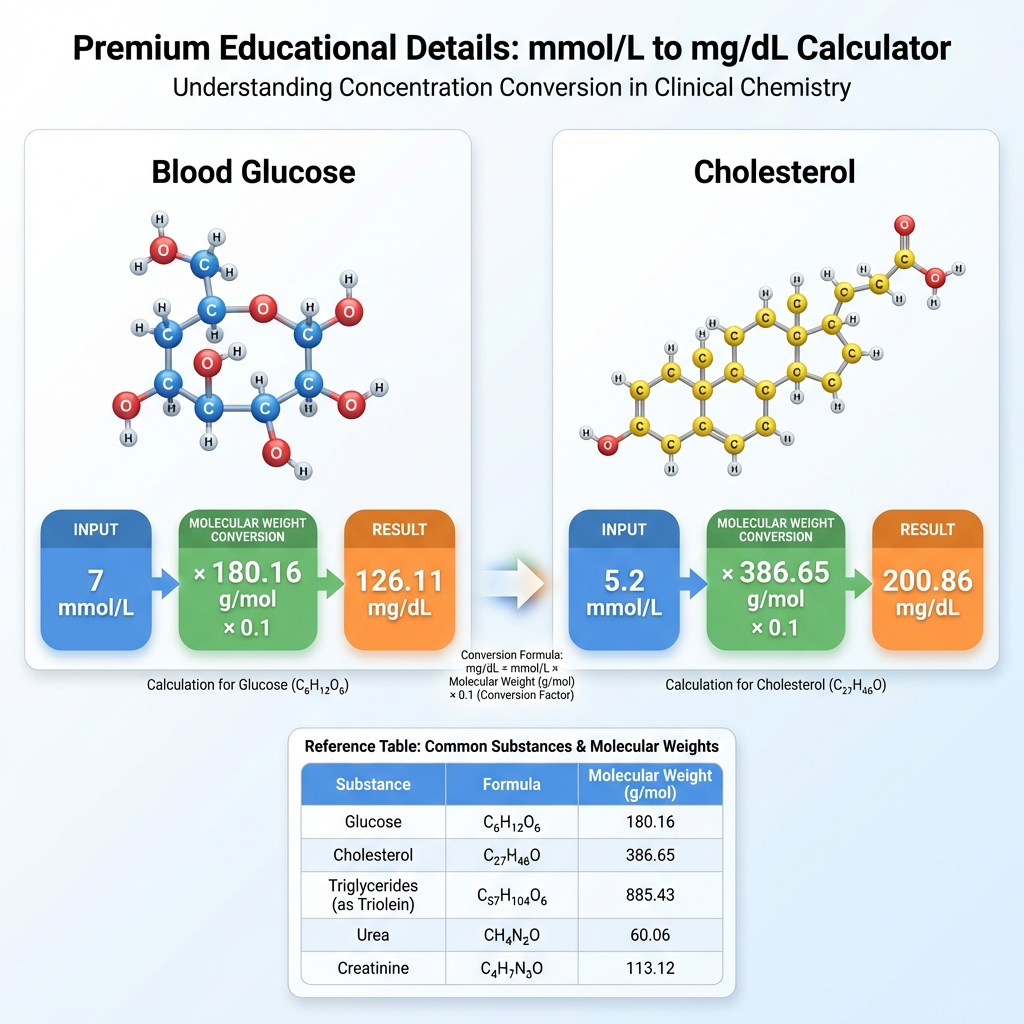
mg/dL = mmol/L × Molecular Weight (g/mol) × 0.1
Where
mg/dL = the value you want (milligrams per deciliter)
mmol/L = your original value (millimoles per liter)
Molecular Weight = in grams per mole (g/mol)
0.1 = to convert liters to deciliters
For glucose, the molecular weight is 180.16 g/mol. So, if you have 5 mmol/L
mg/dL = 5 × 180.16 × 0.1 = 90.08 mg/dL
How do you use this calculator?
1. Choose your substance or type in its molecular weight.
2. Enter the mmol/L value.
3. Hit Calculate.
That’s it. The answer pops up, and some calculators will even walk you through the conversion step by step so you can double-check.
A couple of real-world examples
Example 1: Blood Glucose
Concentration: 7 mmol/L
Glucose’s molecular weight: 180.16 g/mol
mg/dL = 7 × 180.16 × 0.1 = 126.11 mg/dL
Example 2: Cholesterol
Concentration: 5.2 mmol/L
Cholesterol’s molecular weight: 386.65 g/mol
mg/dL = 5.2 × 386.65 × 0.1 = 200.86 mg/dL
A few tips for accuracy
Double-check the molecular weight, every compound is different.
Make sure you enter the mmol/L value correctly. Even tiny mistakes can throw off your results.
Let the calculator do the heavy lifting, it’s faster and more reliable than doing it by hand.
FAQ
Can I convert the other way, from mg/dL to mmol/L?
Yes, you can. Here’s how
To go from mmol/L to mg/dL
mg/dL = mmol/L × Molecular Weight (g/mol) × 0.1
To go from mg/dL to mmol/L
mmol/L = mg/dL ÷ (Molecular Weight (g/mol) × 0.1)
Is this calculator just for glucose?
Nope. You can use it for any substance, as long as you know the molecular weight.
What’s with the 0.1 in the formula?
It’s just because 1 liter equals 10 deciliters. Multiplying by 0.1 switches your answer from per liter to per deciliter.
In short
The Mmol to Mg/dL Calculator saves time, removes confusion, and helps make sense of lab results, whether you’re a doctor, student, or researcher. No more fumbling with conversions or second-guessing your math.
References
Related Tools