


Relative Risk Calculator
Enter the exposed group and controlled group along with the confidence level in the tool and the calculator will calculate the relative risk.
What is Relative Risk Calculation?
The relative risk (RR) is the measure of the probability of an outcome in an exposed group to the probability of an outcome in an unexposed group. The association between the exposed and control variables can be calculated by the Relative Risk Calculator.
Why Calculate Relative Risk?
Now calculating relative risk RR allows you to predict the comparative risk of occurrence of a significant event (or outcome) of exposed and control groups. The RR matrix is critical in the following situation:
- Relative risk is essential to measure when management is making critical decisions.
- To know the certain medicine or formula on the exposed population and controlled sample of the population.
- RR is the risk difference between the odd ratio correlation or association between the exposure and the outcome.
The result predicted by the RR interval calculator has a relative 95% confidence level to the actual event happening.
How to Calculate Relative Risk?
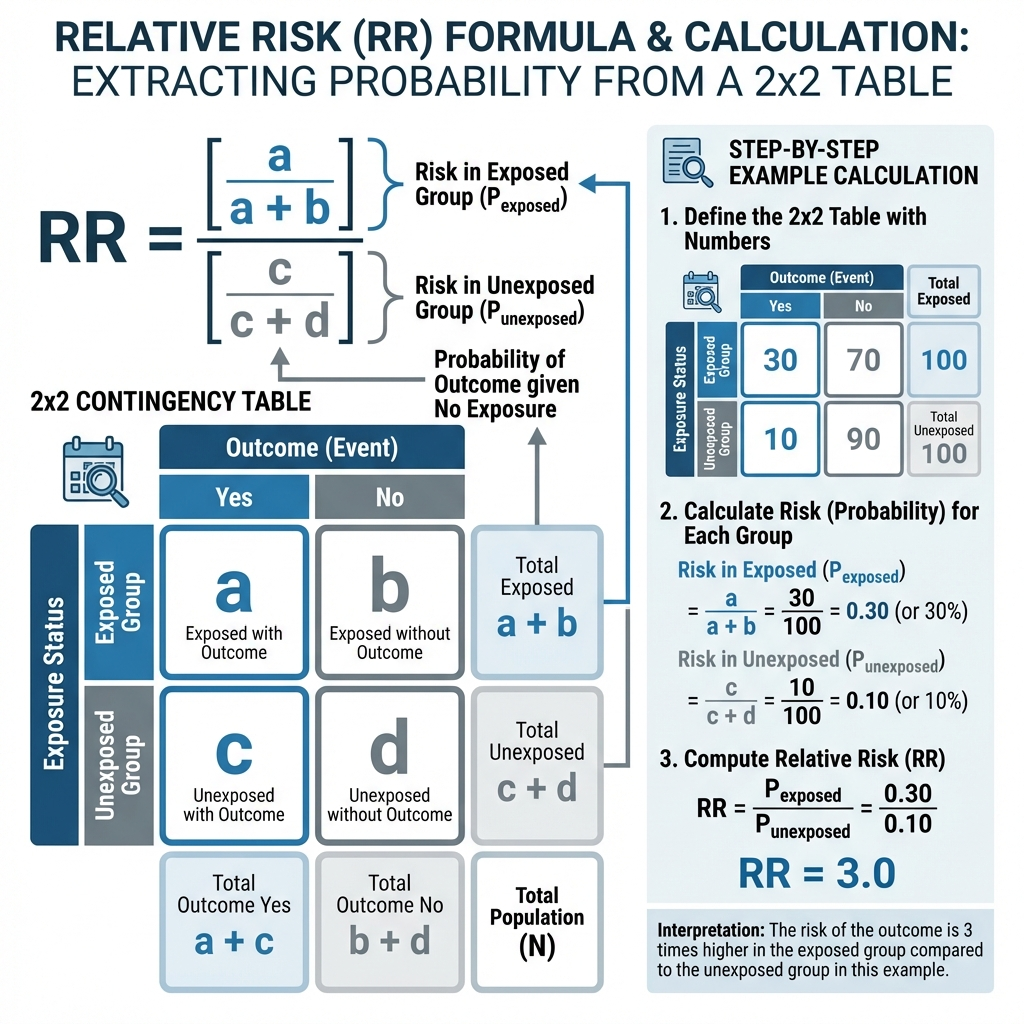
Let's suppose a certain disease test is conducted on the exposed and controlled group. The dataset for the controlled group is 10 affected by the disease and 5 have no effect. For the controlled group result 7 affected 3 have no effect. Then calculate relative risk confidence interval of 95%.
Given Data:
Confidence Level: 95% → \( Z = 1.96 \)
Exposed Group: Disease: \(a = 10\), No Disease: \(b = 5\)
Control Group: Disease: \(c = 7\), No Disease: \(d = 3\)
Step 1: Relative Risk (RR)
The formula for Relative Risk:
\[ RR = \frac{\text{Risk in Exposed Group}}{\text{Risk in Control Group}} = \frac{\frac{a}{a+b}}{\frac{c}{c+d}} \]
Substitute the values:
\[ \text{Risk in Exposed Group} = \frac{10}{10+5} = 0.6667 \] \[ \text{Risk in Control Group} = \frac{7}{7+3} = 0.7 \] \[ RR = \frac{0.6667}{0.7} \approx 0.9524 \]
Step 2: 95% Confidence Interval for RR
The formula for log confidence interval:
\[ \text{CI} = \exp \Bigg[ \ln(RR) \pm Z \sqrt{\frac{1}{a} - \frac{1}{a+b} + \frac{1}{c} - \frac{1}{c+d}} \Bigg] \]
Step by step:
\[ \frac{1}{10} - \frac{1}{15} + \frac{1}{7} - \frac{1}{10} = 0.0333 + 0.042857 \approx 0.076157 \] \[ \sqrt{0.076157} \approx 0.276 \] \[ \ln(RR) = \ln(0.9524) \approx -0.0488 \] \[ \ln(\text{CI}) = -0.0488 \pm 1.96 \cdot 0.276 = -0.0488 \pm 0.54096 \] \[ \text{Lower limit: } -0.0488 - 0.54096 = -0.58976 \] \[ \text{Upper limit: } -0.0488 + 0.54096 = 0.49216 \] \[ \text{Convert back to RR scale: } \text{Lower CI} = e^{-0.58976} \approx 0.554, \quad \text{Upper CI} = e^{0.49216} \approx 1.636 \]
Final Answer:
\[ RR \approx 0.95, \quad 95\% \text{ CI: } (0.55, 1.64) \]
Calculation Steps:
- Calculate the natural logarithm
ln(RR)= = 0.95238095238095
- Calculate the square root term:
\(text{Sqrt Term} = \sqrt{\frac{1}{a} + \frac{1}{c} - \frac{1}{a+b} - \frac{1}{c+d}}\)
- Calculate the lower bound:
\(text{Lower Bound} = exp(-0.048790164169432 - (1.9600\times 0.27602622373694)\)
Lower Bound = 0.554
- Calculate the upper bound:
\(text{Upper Bound} = exp(-0.048790164169432 + (1.9600\times 0.27602622373694)\)
Upper Bound= 1.64
Working of the Relative Risk Calculator:
The procedure of calculating the relative risk with our RR interval calculator requires the following values:
Input:
- Enter the exposed and controlled groups' values
- Enter the confidence level
- Tap calculate
Output:
- Relative Risk
- Lower bound
- Upper bound
- Step-by-step calculations
FAQs:
What Does a Relative Risk of 0.5 Mean?
The RR of 0.5 means that the chance of a bad outcome is twice as likely to occur without the intervention. When the RR calculator indicates the risk is 1, then the relative risk calculation is unchanged.
How to Calculate Risk Ratio?
The relative risk is also the ratio of the risk of an event in one group(controlled group) versus the risk of the event in the other group(exposed group). The RRR calculator is specially designed to find the Relative Risk Ratio of certain factors.
References:
From the source of Wikipedia: Relative Risk From the source of Bestpractice.bmj.com: Ratio of RR
Related Tools