


Sum of Squares Calculator
Enter the dataset numbers, and click “Calculate” to find the sum of squares.
Sum of Squares Calculator:
Use this sum of squares calculator to find the algebraic & statistical sum of squares for the given datasets. It also shows how to solve the sum of squares step by step.
What Is Sum of Squares?
Statistics:
- The sum of squares (SS) measures the variability of a dataset. It's calculated by finding the squared deviations of each data point from the mean value and summing them all up. A higher SS indicates more spread in the within the given dataset.
Algebra:
- It refers to the addition of several terms that have been squared and not necessarily involve deviations from the mean.
What Is The Sum of Squares Formula?
For Statistical Calculation:
The sum of squares equation for statistical data is as follows:
(Xi -X̄)2
Where:
- Xi = Statistical Data
- X̄ = Statistical mean
You can use our sum of squares calculator to calculate the sum of squared deviations from the mean.
For Algebraic Calculation:
The formula for the calculation of sum of squares for algebraic calculation is as follows:
\(\ (n_1)^{2} +(n_2)^{2}+(n_3)^{2}.....(n_n)^{2}\)
Where:
- n = total numbers in expression
The Relationship Between Sum of Squares and Sample Variance:
The Sum of Squares (SS):
- It represents the total squared deviation of the dataset values from the mean
- The sum of squares represents the variability of the data points
Sample Variance (s²):
- It calculates the average squared deviation from the mean in a sample
- Sample variance helps to measure the population variation
Sample variance helps you to estimate the population variance (variation of the entire population from which the sample is drawn). The sum of squares (SS) is the numerator in the sample variance (s²) formula. As you can see below:
\(\ S^{2} =\frac{S.S}{n-1}\)
Where:
- s² is the sample variance
- S.S is the sum of squares
- n is the sample size
What are The Limitations of Using The Sum of Squares?
Limitations of the Sum of Squares (SS):
- Sensitivity to Outliers: The extreme data points can make the data seem more spread out than it is. It can lead to overestimation of data variability
- Assumption of Normality: The sum of squares works best with the normally distributed data(a bell-shaped curve). If the data is not normally distributed then the sum of squares may not let you have the variance and standard deviation
- Limited Information: The sum of squares only tells you about the total variation of the dataset (how spread out the data points are from the mean). It doesn't provide information about the direction or shape of the distribution (e.g., skewed or symmetrical)
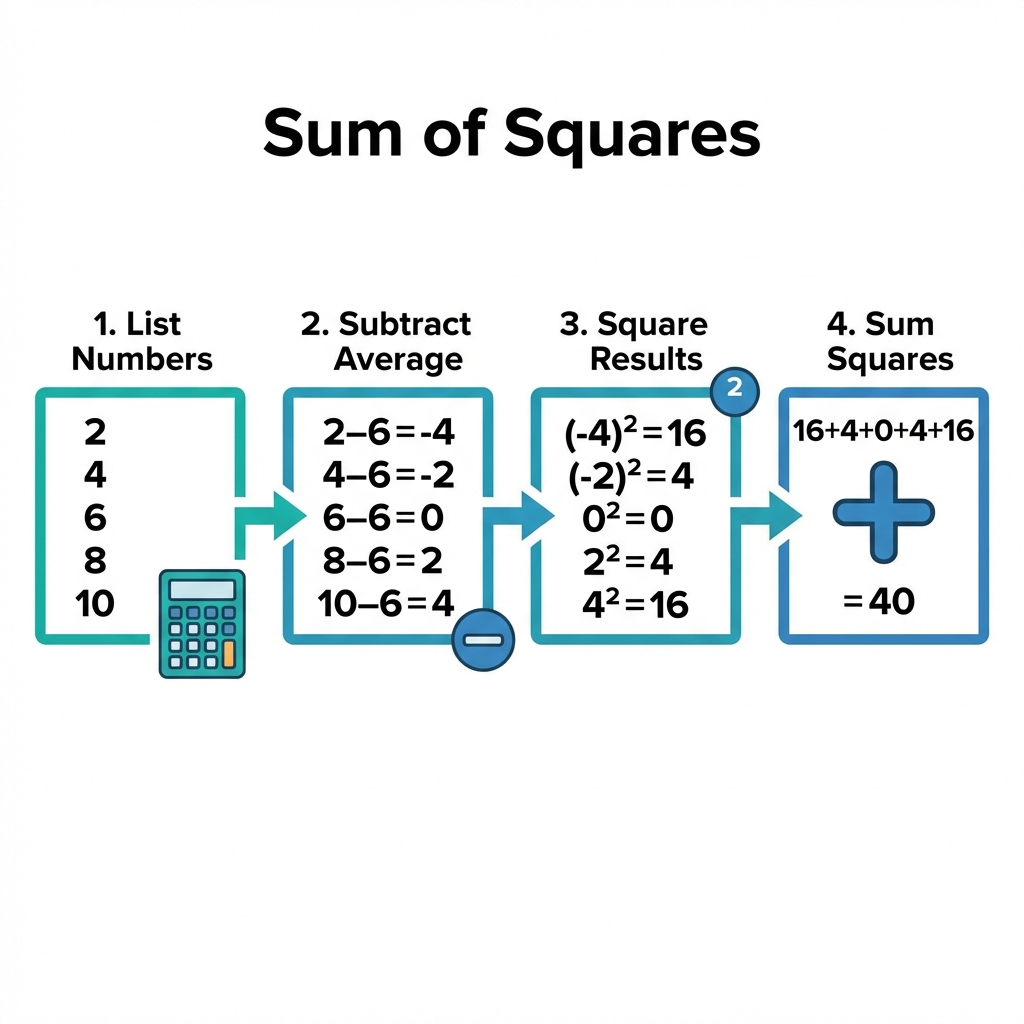
How To Calculate Sum of Squares?
Follow these steps:
- Find the Mean (Average)
- Subtract the mean value from each data point
- Square each difference and sum them together
Example:
Suppose you have a dataset: 6, 9, 3, 17, 19, 23. Find the sum of squares.
Solution (Statistical Method):
Dataset: \(6, 9, 3, 17, 19, 23\)
Number of data points: \(n = 6\)
Sum of data: \(6 + 9 + 3 + 17 + 19 + 23 = 77\)
Mean: \[ \bar{X} = \frac{77}{6} \approx 12.833 \]
Sum of squares formula (statistical):
\[ SS = \sum (X_i - \bar{X})^2 \]
Substitute the values:
\[ \begin{aligned} SS &= (6 - 12.833)^2 + (9 - 12.833)^2 + (3 - 12.833)^2 \\ &\quad + (17 - 12.833)^2 + (19 - 12.833)^2 + (23 - 12.833)^2 \end{aligned} \]
Compute each term:
\[ SS \approx 46.6944 + 14.6944 + 96.6944 + 17.3611 + 38.0277 + 103.3611 \]
So, the total sum of squares (statistical) is:
\[ SS \approx 316.8333 \]
Solution (Algebraic Method):
Total sum of squares (algebraic):
\[ SS = 6^2 + 9^2 + 3^2 + 17^2 + 19^2 + 23^2 \]
Compute each term:
\[ SS = 36 + 81 + 9 + 289 + 361 + 529 \]
Total sum of squares (algebraic):
\[ SS = 1305 \]
Apart from manual calculations, you can use a sum of squares calculator to simplify computations for any dataset, either statistically or algebraically.
References:
From the source of Wikipedia: Sum of squares, Statistics, Algebra and algebraic geometry, and much more!
From the source of sciencing.com: How to Calculate a Sum of Squared Deviations from the Mean (Sum of Squares)
Related Tools