


Tension Calculator
Please enter the values to find the tension (force) in a rope, string, or similar object.
Tension Calculator (Physics):
This calculator helps you to calculate the tension (force) in a rope, cable, or string that is used to lift (stretch) or pull an object. With this tool, you can make tension calculations in physics for:
- 1 or 2 strings used to lift the object against gravity
- String used to pull 1, 2, or 3 objects on a surface
What is Tension in Physics?
Tension is a stretching or pulling force that is transmitted axially along an object such as a rope, cable, chain, etc. to pull an object. It is a special kind of force that acts in a direction opposite to the compression and acts on opposite ends of the rope.
How to find Tension (Force) In Ropes Suspending an Object?
Tension in a cable (due to object hanging) can be classified in two cases:
1.1 Single Rope:
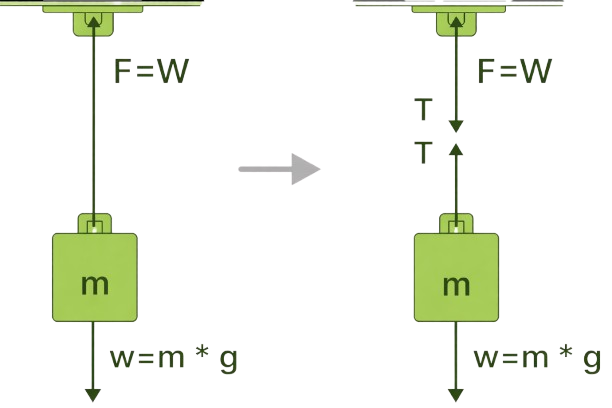
Suppose an object is lifted with a string. In this situation, the tension in the string is equal to the weight of the object due to gravity (\(g \approx 9.8 \, \text{m/s}^2\)). If we consider the upward force as positive and the downward force as negative, the forces cancel each other, and the net force is zero.
In equation form:
\[ \sum F_\uparrow = 0 \] \[ \sum F_\uparrow = T + (-W) \] \[ T = W \]
Where:
- \(W\) = Weight of the object acting downward
- \(T\) = Upward tension force in the string
1.2. Tension In Multiple Ropes at Angles:
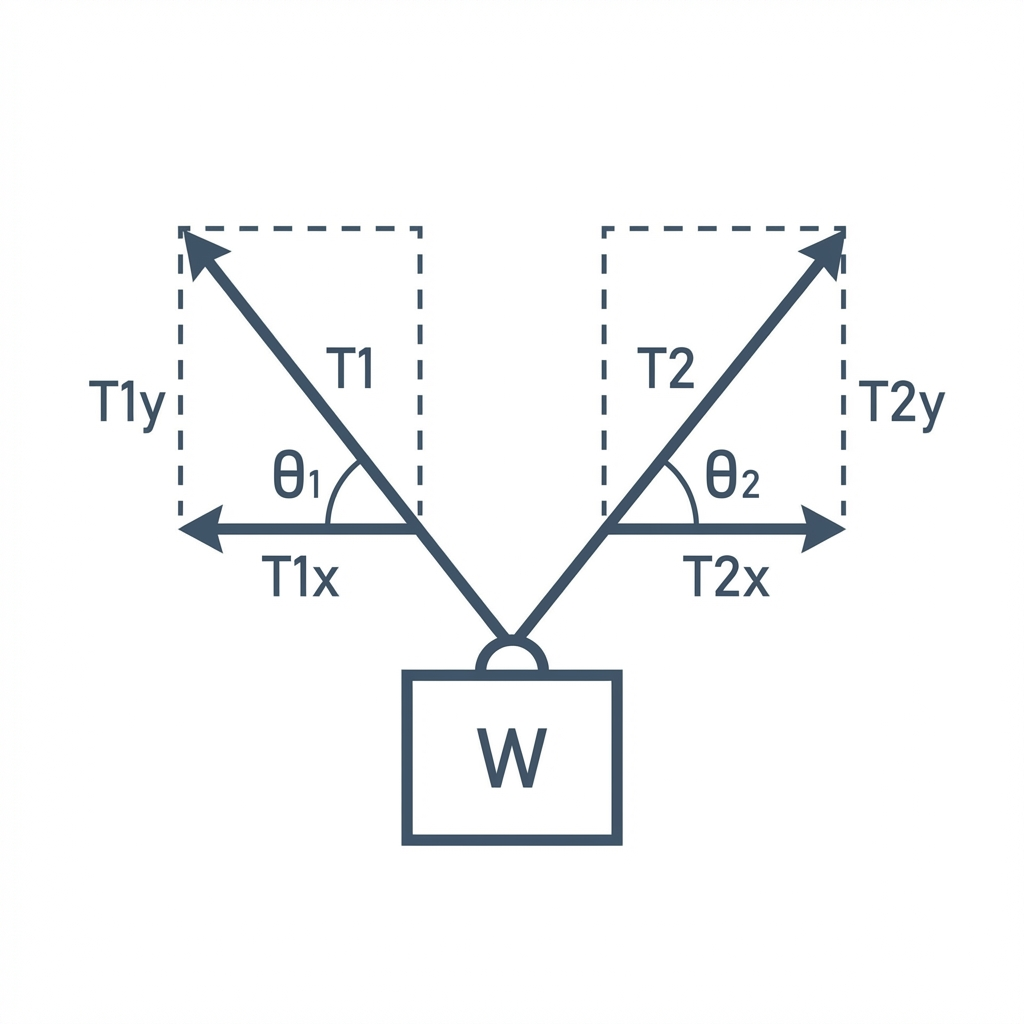
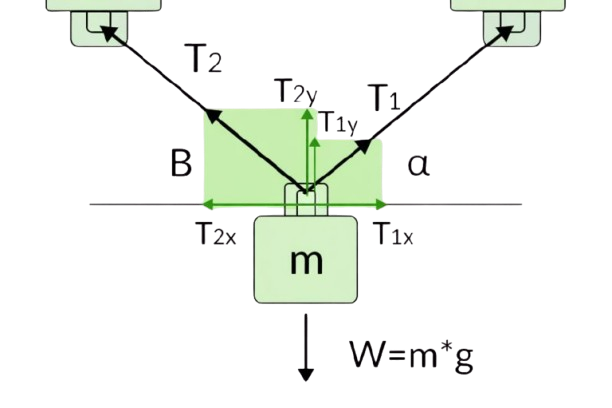
This is a bit more complex case, where the tension is distributed along two ropes used to suspend an object of hanging mass ‘m’. This force has influence along the horizontal and vertical components of the force.
- \(T_{1x}\) and \(T_{2x}\) are the horizontal components
- \(T_{1y}\) and \(T_{2y}\) are the vertical components
As the gravitational force acts vertically downwards, we will only consider the vertical components of the pulley tension force, such that:
\(\sum{F}↑=0\) \(T_{1y} + T_{2y} + \left(-W\right) = 0\)
Moving ‘-W’ to the other side of the equation
\(W = T_{1y} + T_{2y}\)
The components of the angle along
\(T_{1y}\) and \(T_{2y}\) can be expressed in terms of \(T_{1}\) and \(T_{2}\),
such that:
\(T_{1y} = T_{1} × sin\left(α\right)\)
\(T_{2y} = T_{2} × sin\left(β\right)\)
\(W = T_{1} × sin\left(α\right) + T_{2} × sin\left(β\right)\) — (1)
Now coming to the horizontal components, there is no movement in this direction because the whole system is in a static equilibrium state. It shows that both of the x components are equal to each other.
\(T_{1}x = T_{2}x\) or \(T_{1} × cos\left(α\right) = T_{2} × cos\left(β\right)\) Moving \(cos\left(α\right)\)
to the other side; \(T_{1} = \dfrac{T_{2} × cos\left(β\right)}{cos\left(α\right)}\)
Putting the value of \(T_{1}\) in equation (1);
\(W = T_{1} × sin\left(α\right) + T_{2} × sin\left(β\right)\)
\(W = T_{2} * [\dfrac{cos\left(β\right)}{cos\left(α\right)}] × sin\left(α\right) + T_{2} × sin\left(β\right)\)
\(W = T_{2} × [\dfrac{cos\left(β\right) × sin\left(α\right)}{cos\left(α\right) + sin\left(β\right)}]\)
\(T_{2} = \dfrac{W}{[\dfrac{cos\left(β\right) × sin\left(α\right)}{cos\left(α\right) + sin\left(β\right)}]}\)
Now we have;
\(T_{1} = \dfrac{W}{[\dfrac{cos\left(β\right) × sin\left(α\right)}{cos\left(α\right) + sin\left(β\right)}]} × [\dfrac{cos\left(β\right)}{cos\left(α\right)}]\)
The given formula is considered to calculate tension (force) considering tension formula with angle of its orientation.
\(T_{1} = \dfrac{W}{[\dfrac{cos\left(α\right) × sin\left(β\right)}{cos\left(β\right) + sin\left(α\right)}]}\)
Tension Cases for Dynamic Equilibrium:
In dynamic equilibrium, the value of acceleration (a) is not zero. In this condition, tension in a string has variable cases, including:
| Motion of the Object | Rope Tension (T) |
|---|---|
| Moving Upward with Acceleration (a) | T = W + ma |
| Moving Downward with Acceleration (a) | T = W - ma |
| Suspended (Not Moving) | T = W |
| Moving Upward or Downward at Uniform Speed | T = W |
Our tension calculator also considers these cases to help you find tension in a string (cable) under dynamic equilibrium state.
How to find Tension In Ropes While Pulling an Object?
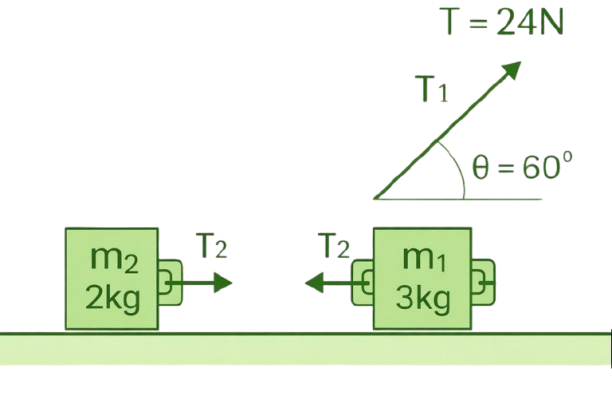
Steps to find the tension force applied through a string while pulling an object:
- Find the acceleration of the entire system using Newton’s 2nd law of motion (F = ma)
- Calculate the sum of horizontal net forces acting to pull the object through a rope.
Considering the terms of physics, the tension force calculator is capable of determining the pulling force acting either with rope, wire, cable, etc.
How to Find Tension?
Let’s solve a couple of examples to better understand the concept of tension!
Example 1
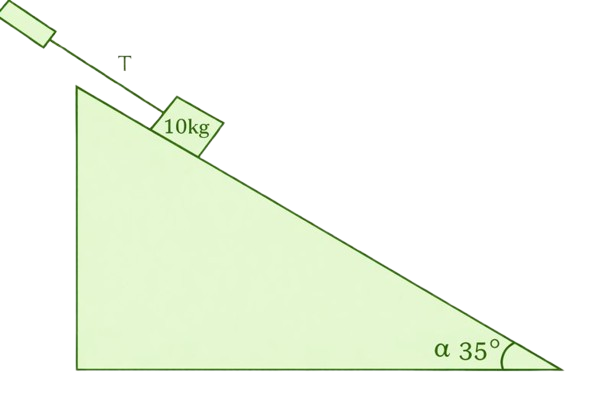
A mass of \(m = 10 \, \text{kg}\) is attached to a string and pulled against a frictionless surface at an angle of \(\theta = 35^\circ\). Find the tension in the string.
Solution:
Step 1: Since there is no friction, tension equals the component of gravitational force along the direction of motion:
\[ T = f_g \]
Step 2: Express tension in terms of mass, gravity, and angle:
\[ T = m g \sin(\theta) \]
Step 3: Substitute the given values:
\[ T = 10 \times 9.8 \times \sin(35^\circ) \] \[ T \approx 56.15 \, \text{N} \]
Example 2
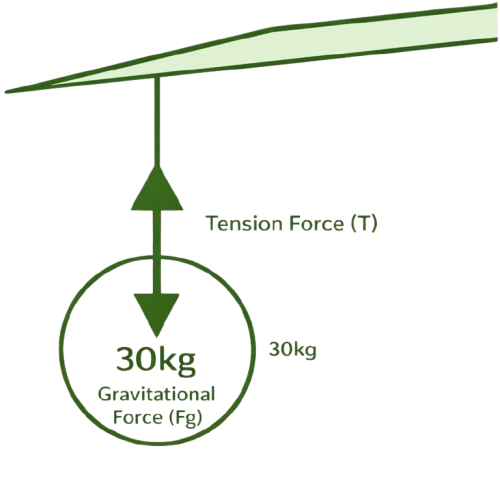
Find the tension in a string used to lift a tire of \(m = 30 \, \text{kg}\) at a height of 15 m.
Solution:
Step 1: Sum of forces in equilibrium:
\[ F_g = m g, \quad F = T + F_g \] \[ F = T - (30 \times 9.8) \] \[ F = T - 294 \, \text{N} \]
Step 2: Since the tire is stationary, acceleration is zero:
\[ F = m a = 0 = T - 294 \]
Step 3: Solve for tension:
\[ T = 294 \, \text{N} \]
Alternatively, you can use a tension calculator to get results instantly without manual calculations.
FAQs:
Is tension a contact force?
Yes, it is. When you tie an object of a certain hanging mass with a string, an internal pulling force is generated in the string that helps connect the object and the reference point. This is why, tension is regarded as contact force.
Can tension be negative?
The tension force is negative along the opposite side of the direction of motion.
Why is the work done by tension always zero?
As we know, the work done by a force is given by:
\[ W = F \cdot S \]
If the tension in a string does not cause any displacement, then:
\[ S = 0 \]
So the work done by the tension is:
\[ W = F \cdot 0 = 0 \]
Hence proved, the work done by tension is always zero.
How does gravity affect the force of tension?
The tension and gravitational forces act in the opposite directions of each other. Now if the hanging object is not balanced by tension, it will accelerate towards the ground due to the fore of gravity.
References:
From the source of Wikipedia: Tension (physics), System in equilibrium, System under net force
From the source of Khan Academy: The force of tension, Super hot tension, Tension in an accelerating system and pie in the face, Mild and medium tension
From the source of Lumen Learning: Normal Force, Tension, and Other Examples of Forces, Normal Force, Tension, Real Forces and Inertial Frames, Problem-Solving Strategies
Related Tools