


Terminal Velocity Calculator
Enter the mass, cross-section area, and drag coefficient for the selected shape and the calculator will calculate its terminal velocity in the air.
Terminal Velocity:
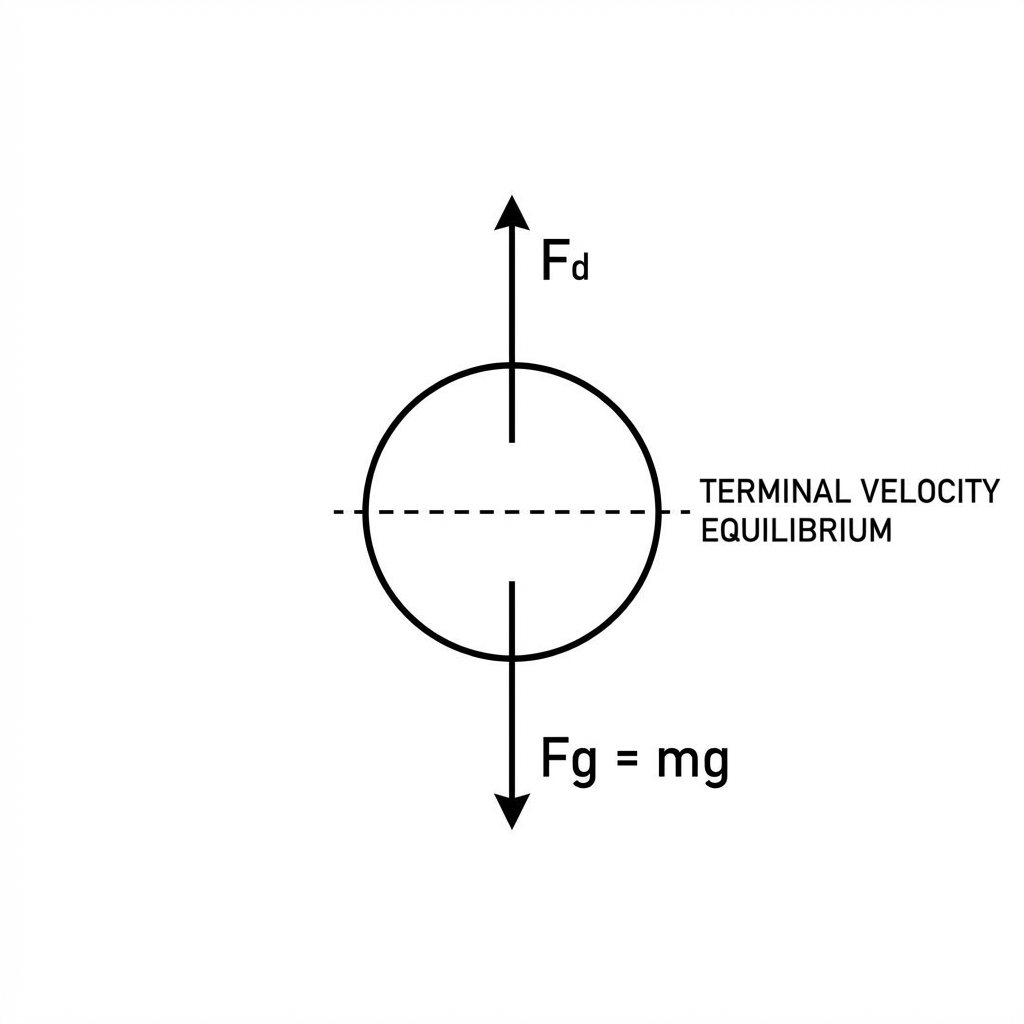
“The Terminal velocity is the highest velocity an object is going to attain when it is going to fall through the air.” The terminal velocity is the resultant force when the dragged force (Fd) and the downwards force of gravity (FG) acting on the body. When we are finding the terminal velocity, then at this point, the acceleration is equal to “Zero”. The terminal velocity calculator is efficiently able to find the terminal velocity of a falling object.
Terminal Velocity Equation:
The simple terminal velocity equation is given by:
\[ V_t = \sqrt{\frac{2 \, m \, g}{\rho \, A \, C_d}} \]
Where:
- V_t = Terminal velocity (maximum falling speed)
- m = Mass of the falling object
- g = Gravitational acceleration
- \(\rho\) = Density of the fluid
- A = Projected area of the object
- C_d = Drag coefficient
Dimension of Terminal Velocity:
The unit of terminal velocity is meter/seconds(m/s). We can find the dimension of any quantity by the dimension analysis calculator.
Examples:
Practical implementations of the terminal velocity formula:
Example 1:
A man is falling from a height of \(h = 2000 \, \text{m}\). Find his terminal velocity.
Solution:
Using the simplified terminal velocity formula for free fall:
\[ V_t = \sqrt{2 g h} \] \[ V_t = \sqrt{2 \cdot 9.8 \cdot 2000} \] \[ V_t = \sqrt{39200} \approx 197.98 \, \text{m/s} \]
Example 2:
Find the height of a body if its terminal velocity is \(V_t = 100 \, \text{m/s}\).
Solution:
Rearranging the formula \(V_t = \sqrt{2 g h}\) to solve for height \(h\):
\[ h = \frac{V_t^2}{2 g} \] \[ h = \frac{100^2}{2 \cdot 9.8} \] \[ h = \frac{10000}{19.6} \approx 510.20 \, \text{m} \]
You can also verify these results using a terminal velocity calculator for accuracy.
Forces Affecting the Falling Object:
When an object is falling in the atmosphere, it is experiencing two types of external forces. These forces determine how fast is terminal velocity. The external forces are as follows:
- The Gravitational Force
- The Drag Force
The Gravitational Force:
Consider an object with mass \(m\) moving under a force \(F\) with acceleration \(a\). According to Newton's second law of motion:
\[ F = m \, a \]
Solving for acceleration:
\[ a = \frac{F}{m} \tag{1} \]
On Earth, the acceleration due to gravity is \(g\), so:
\[ g = \frac{F}{m} \]
At the surface of the Earth, \(g \approx 9.8 \, \text{m/s}^2\). The value of \(g\) changes with altitude.
The Drag Force:
The drag force depends on the shape and surface of the object, which is why various drag coefficients (\(C_d\)) exist. The drag force is expressed as:
\[ F = W - D \tag{2} \]
Where:
- F = Net force or drag force
- W = Weight of the object
- D = Drag force on the object
By combining equations (1) and (2), the acceleration of a falling object under gravity and drag is:
\[ a = \frac{W - D}{m} \]
The drag force depends on the drag coefficient (\(C_d\)), the atmospheric density (\(\rho\)), the reference area of the object (\(A\)), and the square of the velocity (\(V_t\)):
\[ D = \frac{1}{2} C_d \, \rho \, A \, V_t^2 \]
From this, the terminal velocity \(V_t\) can be determined. Terminal velocity calculators allow you to input different drag coefficients and other parameters for quick calculations.
Drag coefficient for Various Surfaces:
The Drag coefficient for various surfaces are as follows:
| Various Surfaces | Drag Coefficient |
| Sphere | 0.47 |
| Golfball | 0.389 |
| Baseball | 0.3275 |
| Hemisphere | 0.42 |
| Cube | 1.05 |
| Angled Cube | 0.8 |
| Streamlined Body | 0.04 |
Working of Terminal Velocity Calculator:
The terminal velocity equation is simple to find if you have the information about the drag coefficient particular to a specific surface. Let’s have a look at working!
Input:
- Choose the desired shape from the list.
- Enter the mass of the object and cross sectional area.
- Hit the calculate button.
Output: The terminal velocity calculator is specifically designed to find the terminal velocity of various shapes:
- The separate result is represented for specific shape
- The terminal velocity and the drag force is displayed
FAQs:
What is the Terminal Velocity of a Human?
The terminal velocity of a human depends on body position and surface area. Typically:
- In a horizontal (spread-eagle) position: \(V_t \approx 120 \, \text{mph} \, (\approx 193 \, \text{km/h})\)
- In a vertical (head-down) position: \(V_t \approx 150-180 \, \text{mph} \, (\approx 240-290 \, \text{km/h})\)
The variation occurs because the head-down position reduces air resistance due to a smaller cross-sectional area, resulting in a higher terminal velocity.
Do heavy objects fall faster than lighter objects?
Yes, the heavier objects do fall quickly, it may be confusing for most of us but it is a fact. Consider the equation F=mg, when heavier objects fall they are experiencing more force due to their large or heavier mass as compared to the lighter mass.
Example:
The elephant continues to accelerate much faster due to its heavier mass as compared to the mouse .This is the main reason the elephant is going to hit much earlier than the mouse.
What factors affect the rate of fall of an object and its speed?
The terminal velocity of an object depends on the following factors:
- Mass.
- Surface area.
- Acceleration due to gravity,”g”
What is the effect of gravity on mass?
The gravity has a direct effect on mass, the greater the mass the more gravitational pull the object would experience.
Can mass be zero of an object?
It is the mass of the matter in an object and it can never be Zero but weight can be Zero when there is no existence of gravity.
Conclusion:
The terminal speed is essential to know when an object is falling in space or in air. We need the terminal velocity of various objects to know the aerodynamics of various shapes.We can find the terminal velocity of most of the Geometrical spades by the terminal velocity calculator.
Reference:
From the source of Wikipedia: Terminal velocity , Physics, Derivation for terminal velocity From the source of concepts-of-physics.com : Stokes' Law and Terminal Velocity, Problem from IIT JEE 2016
Related Tools