


Theoretical Yield Calculator
Enter the values of the limiting reagent and desired product of the given reaction to calculate its theoretical yield.
Theoretical Yield Calculator
Use this theoretical yield calculator to find the maximum amount of product that can be formed from a given chemical reaction. It also calculates the limiting reagent and the stoichiometry of the product between the moles of reactants and the product formed.
What Is Theoretical Yield?
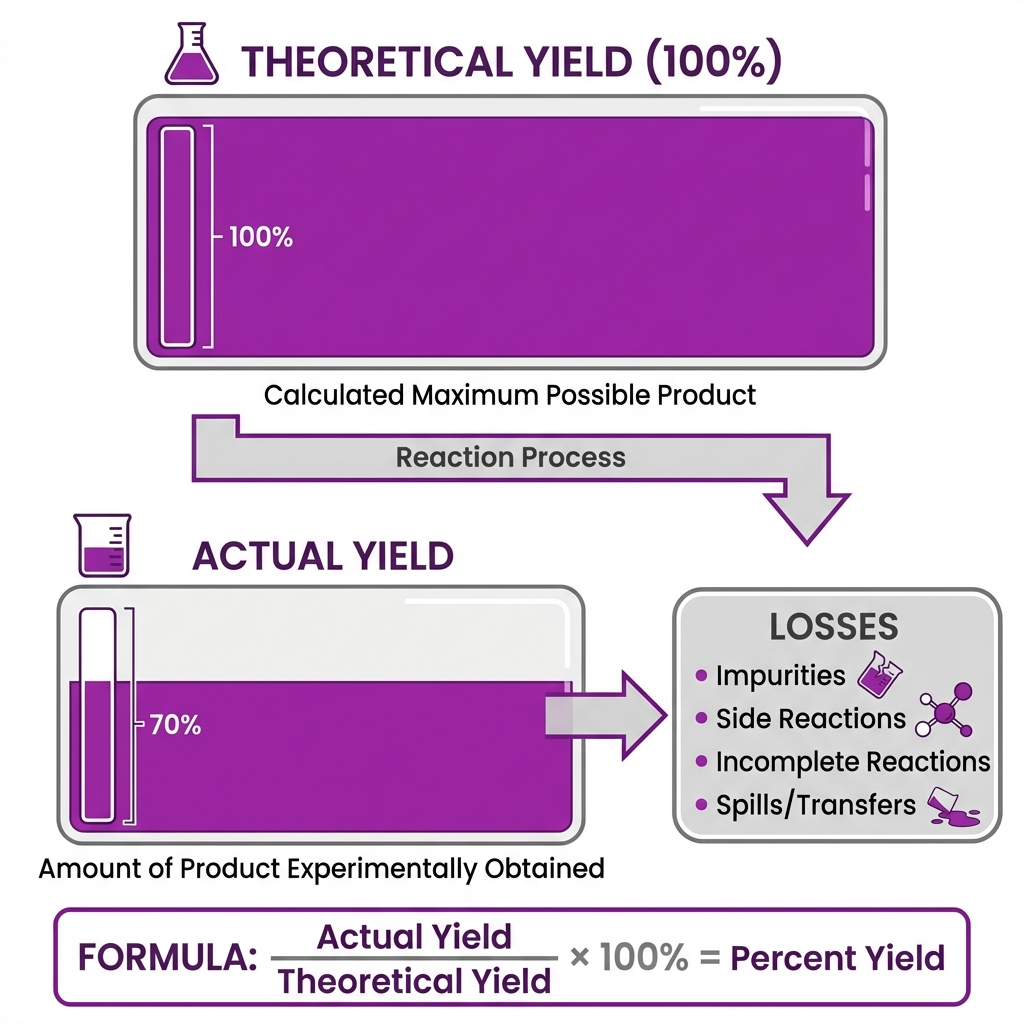
Theoretical yield is the maximum quantity of the product that can be produced from a given amount of reactants in a chemical reaction. The maximum possible product formed under 100% efficiency.
Theoretical Yield Formula:
By using the given formula, we can find the theoretical yield from the moles of the limiting reagent:
mproduct = nlim × Mmol,product × Clim
Where:
- mproduct = Mass of the product that we need to find
- nlim = Number of moles of the limiting reagent
- Mmol,product = Molar mass of the desired product (in grams per mole)
- Clim = Stoichiometric coefficient of the product
To find the number of moles of the limiting reagent, simply divide its given mass by the product of its molar mass and stoichiometric coefficient.
nlim = mlim mmol,lim . Clim
Note: Keep in mind that all stoichiometric calculations, including finding the limiting reagent and using the theoretical yield formula, require you to have a balanced chemical equation.
How To Calculate Theoretical Yield?
For theoretical yield calculation, follow these steps:
- Balance the Chemical Equation
- Recognize The Limiting Reactant
- Determine The Moles of Limiting Reagent
- Use The Theoretical Yield Equation
Theoretical Yield Example:
In a combustion reaction, 44 grams of propane (C₃H₈) reacts with 128 grams of oxygen (O₂). Calculate the theoretical yield of carbon dioxide (CO₂).
Solution:
Step 1: Write the Balanced Chemical Equation
C₃H₈ + 5O₂ → 3CO₂ + 4H₂O
Step 2: Identify the Given Data
- Mass of propane (C₃H₈) = 44 g
- Mass of oxygen (O₂) = 128 g
- Molar masses:
- C₃H₈ = 44.1 g/mol
- O₂ = 32 g/mol
- CO₂ = 44 g/mol
Step 3: Find the Moles of Each Reactant
Moles of C₃H₈:
44 g ÷ 44.1 g/mol = 1.00 mol
Moles of O₂:
128 g ÷ 32 g/mol = 4.00 mol
Step 4: Determine the Limiting Reactant
From the balanced equation:
- 1 mol of C₃H₈ reacts with 5 mol of O₂.
- We have 4 mol of O₂, but we need 5 mol to fully react with 1 mol of C₃H₈.
- O₂ is the limiting reactant because we don't have enough of it.
Step 5: Calculate the Moles of CO₂ Produced
From the balanced equation:
5O₂ → 3CO₂
Since we have 4 mol of O₂ instead of 5:
Moles of CO₂ = (3/5) × 4 = 2.4 mol CO₂
Step 6: Convert Moles of CO₂ to Mass
Mass of CO₂ = 2.4 × 44 = 105.6 g
Final Answer:
The theoretical yield of CO₂ is 105.6 g.
Summary:
- Limiting Reagent Moles = 4 moles (O₂)
- Theoretical Yield of CO₂ = 105.6 grams (CO₂)
You can easily simplify these calculations by using our chemistry theoretical yield calculator and make an informed decision to optimize the chemical process.
How To Use The Theoretical Yield Calculator?
Step 1: Input Limiting Reagent
- Mass of The Limiting Reagent: Input the mass of the limiting reagent
- Molecular Weight: Enter the molecular weight of the limiting reagent
- Stoichiometry: If available then you should provide the stoichiometry ratio
Step 2: Input Desired Product
- Moles of Product: Enter the moles of the expected product in the designated field
- Molecular Weight of the Product: Provide the molecular weight of the product
Step 3: Calculate
- Click on the “Calculate” button and the calculator will provide the theoretical yield in grams, along with some additional information
Why Is It Important To Calculate Theoretical Yield?
Calculating theoretical yield is important for various reasons, including:
- Reaction Optimization: Helps to recognize the area for improvement by comparing the actual and theoretical yield
- Resource Management: Minimize the waste by providing the maximum product yield
- Estimating the Cost: By calculating the theoretical yield, industries can easily predict the final product cost
- Maintaining Product Quality: Determines the amount of reactant required to form the quality product
- Understanding The Mechanisms of Reactions: Finding theoretical yield provides insight into chemical processes and side reaction
How Theoretical Yield Depends on Reaction Conditions?
However, it can be obtained under perfect conditions, where no product is lost in the process.
Ideal Conditions for Theoretical Yield:
- No impurities mixed in the reactants
- No production of unexpected products that can reduce the yield
- There is no loss of product because of any measurement, processing, and handling of reactants or products
Limiting Reagent:
In a chemical reaction, the limiting reagent is a reactant that is completely used up first. It helps to determine how much product can be formed. Meanwhile, it limits" the amount of product that is formed in a chemical reaction.
Stoichiometry:
Stoichiometry is the study of relationships between reactants and products in chemical reactions. It finds the mole ratios of reactants and products, helping you understand how much quantity of a substance is needed to react with another substance.
The numbers in front of each ingredient in a chemical reaction are the reactant's stoichiometry. If no number is found, then the stoichiometry is said to be 1. Keep in mind that stoichiometry is needed to reflect the ratios of molecules that come together to form a product.
People Also Ask:
What is The Effect of Concentration on Yield?
Increasing the concentration of reactants enhances the rate of the reaction. A higher rate of reactions means more reactant molecules are present, leading to more frequent collisions. Therefore more reactions occur, leading to a high yield.
What's The Difference Between Theoretical Yield And Actual Yield?
- Theoretical Yield: The predicted amount of product that can be formed in a chemical reaction based on stoichiometric calculations
- Actual Yield: The actual quantity of the product produced in a chemical reaction
The actual yield is always lower than the theoretical yield because of the occurrence of side reactions and impurities.
Research Sources:
From a chem.Libretexts – All about chemistry - Excess reagent, limiting reagent – Theoretical Yield.
The source of one class offers ultimate solutions of Chemistry - how to calculate theoretical yield of aspirin.
Related Tools