


Unit Vector Calculator
Select method, dimension of vector of value 1, and write down the coordinates values. The calculator will immediately calculate the coordinates of the unit vector, with detailed steps shown.
What is Unit Vector?
The vectors that have a magnitude equal to 1 are called unit vectors and it is donated by A^. Sometimes, it is also named as the multiplicative identity of a vector and direction vector. Usually, it is used for the direction of a vector. The length of the unit vector is one.
Unit Vector Formula:
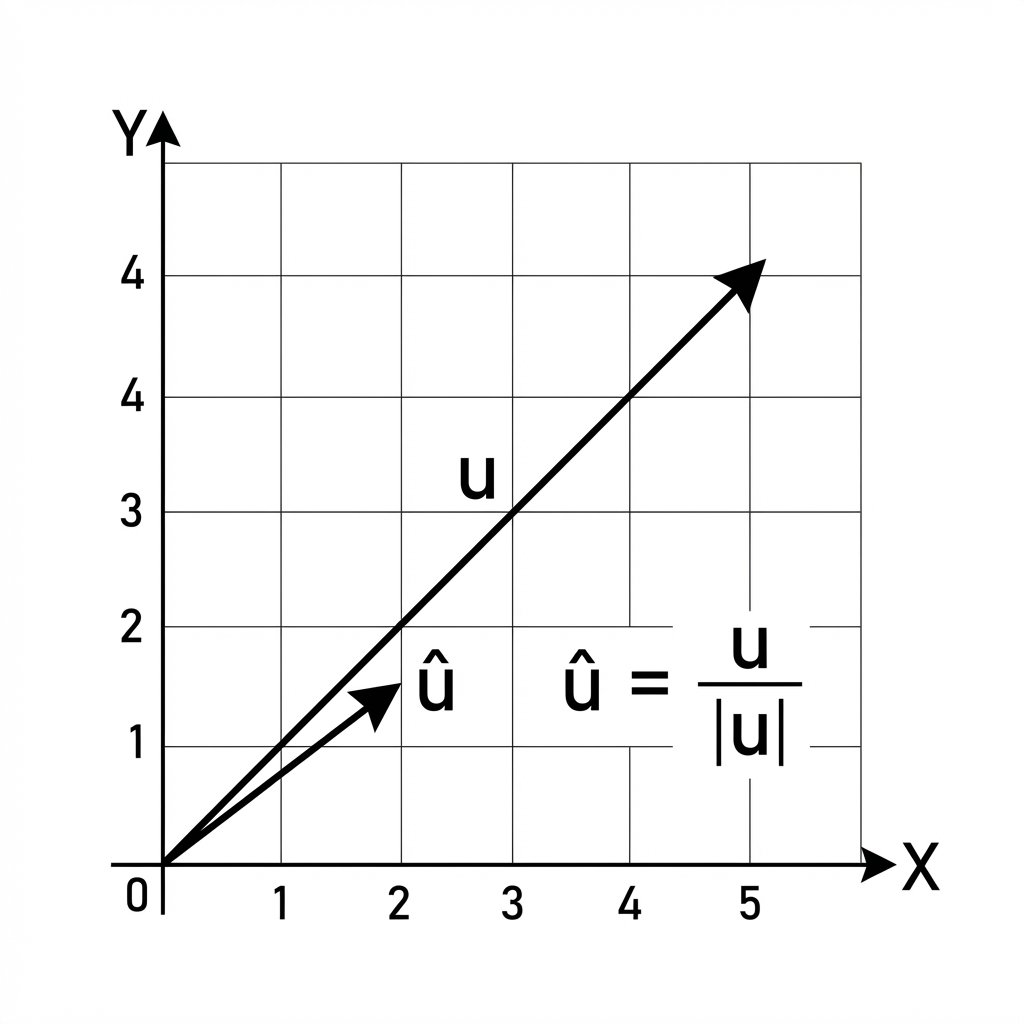
A unit vector has a magnitude of 1 and is denoted with a “^”, such as \( \hat{b} \). Any vector can be converted into a unit vector by dividing it by its magnitude. Unit vectors are often expressed in XY or XYZ coordinates using two common methods:
- Bracket notation: \( \vec{u} = (x, y, z) \)
- Component notation using unit vectors along axes: \( \vec{u} = x \hat{i} + y \hat{j} + z \hat{k} \)
The magnitude of a vector is calculated as:
\( \mid \vec{u} \mid = \sqrt{x^2 + y^2 + z^2} \)
Hence, the unit vector is obtained by dividing each component by the magnitude:
\( \hat{u} = \frac{\vec{u}}{\mid \vec{u} \mid} \)
Bracket notation for unit vector:
\( \hat{u} = \frac{\vec{u}}{\mid \vec{u} \mid} = \frac{(x, y, z)}{\sqrt{x^2 + y^2 + z^2}} = \left( \frac{x}{\sqrt{x^2 + y^2 + z^2}}, \frac{y}{\sqrt{x^2 + y^2 + z^2}}, \frac{z}{\sqrt{x^2 + y^2 + z^2}} \right) \)
Component (XYZ) notation for unit vector:
\( \hat{u} = \frac{\vec{u}}{\mid \vec{u} \mid} = \frac{x \hat{i} + y \hat{j} + z \hat{k}}{\sqrt{x^2 + y^2 + z^2}} = \frac{x}{\sqrt{x^2 + y^2 + z^2}}\hat{i} + \frac{y}{\sqrt{x^2 + y^2 + z^2}}\hat{j} + \frac{z}{\sqrt{x^2 + y^2 + z^2}}\hat{k} \)
For practical calculations, an online Unit Tangent Vector Calculator can quickly compute the tangent vector of a given vector function at specified points.
Derivation of the Unit Vector Formula:
Let us define the quantities involved:
- \( \hat{v} \) = unit vector (has magnitude 1 and a specific direction)
- \( \vec{v} \) = a vector with any magnitude and direction
- \( \mid \vec{v} \mid \) = magnitude of vector \( \vec{v} \)
- x, y, z = components of the vector along the x, y, and z axes respectively
- \( \hat{i} \) = unit vector along the x-axis
- \( \hat{j} \) = unit vector along the y-axis
- \( \hat{k} \) = unit vector along the z-axis
Using these definitions, any vector \( \vec{v} \) in 3D space can be written as:
\( \vec{v} = x \hat{i} + y \hat{j} + z \hat{k} \)
The magnitude of the vector is:
\( \mid \vec{v} \mid = \sqrt{x^2 + y^2 + z^2} \)
Finally, the **unit vector** in the direction of \( \vec{v} \) is given by:
\( \hat{v} = \frac{\vec{v}}{\mid \vec{v} \mid} = \frac{x \hat{i} + y \hat{j} + z \hat{k}}{\sqrt{x^2 + y^2 + z^2}} = \frac{x}{\sqrt{x^2 + y^2 + z^2}} \hat{i} + \frac{y}{\sqrt{x^2 + y^2 + z^2}} \hat{j} + \frac{z}{\sqrt{x^2 + y^2 + z^2}} \hat{k} \)
How to Find the Unit Vector?
For instant calculations, you just have to add values of components into the magnitude and direction calculator and let it do it all in seconds. And even you can perform manual calculations with these simple steps:
Example 1:
Find the unit vector of a vector \( \vec{u} = (8, -3, 5) \) in the same direction.
Solution:
Step 1: Write all components:
\( a_1 = 8, \quad b_1 = -3, \quad c_1 = 5 \)
Step 2: Calculate the magnitude of \( \vec{u} \):
\( |\vec{u}| = \sqrt{a_1^2 + b_1^2 + c_1^2} = \sqrt{8^2 + (-3)^2 + 5^2} = \sqrt{98} \approx 9.899 \)
Step 3: Divide each component by the magnitude to find the unit vector:
\( a_2 = \frac{8}{9.899} \approx 0.808 \)
\( b_2 = \frac{-3}{9.899} \approx -0.303 \)
\( c_2 = \frac{5}{9.899} \approx 0.505 \)
Step 4: Write the unit vector in vector form:
\( \hat{u} = (0.808, -0.303, 0.505) \)
Example 2 (2D Vector):
Calculate the unit vector of \( \vec{v} = (3, 4) \) in two-dimensional space.
Solution:
Step 1: Compute the magnitude:
\( |\vec{v}| = \sqrt{3^2 + 4^2} = 5 \)
Step 2: Divide each component by the magnitude to get the unit vector:
\( \hat{v} = \left( \frac{3}{5}, \frac{4}{5} \right) = (0.6, 0.8) \)
Example 3 (Find Missing Component):
Find the missing unit vector component \( z \) in 3D, given \( x = 0.9 \) and \( y = 0.4 \).
Solution:
Step 1: Use the unit vector magnitude equation:
\( x^2 + y^2 + z^2 = 1 \)
Step 2: Solve for \( z \):
\( z = \sqrt{1 - x^2 - y^2} = \sqrt{1 - 0.9^2 - 0.4^2} = \sqrt{1 - 0.81 - 0.16} = \sqrt{0.03} \approx 0.173 \)
Step 3: The unit vector is:
\( \hat{v} = (0.9, 0.4, 0.173) \)
Spherical Coordinate Unit Vector:
In spherical coordinates, a unit vector can be expressed in terms of rectangular coordinates as:
\( \hat{r} = x \hat{i} + y \hat{j} + z \hat{k} = \sin\theta \cos\phi \, \hat{i} + \sin\theta \sin\phi \, \hat{j} + \cos\theta \, \hat{k} \)
The unit vector in the azimuthal direction is:
\( \hat{\phi} = -\sin\phi \, \hat{i} + \cos\phi \, \hat{j} \)
The unit vector in the polar direction is:
\( \hat{\theta} = \cos\theta \cos\phi \, \hat{i} + \cos\theta \sin\phi \, \hat{j} - \sin\theta \, \hat{k} \)
How does Unit Vector Calculator Works?
An online unit normal vector calculator determines the unit vector in the direction of entered vectors by following these steps:
Input:
- First, select a method and dimensions of a vector from the drop-down list.
- When you choose 2D or 3D dimensions from the list, the calculator shows different diagrams for both options.
- Then, substitute all corresponding values in the fields.
- Click on the “Calculate Unit Vector” button.
Output:
- The normal vector calculator computes the magnitude of a vector, angle direction, and unit vector.
FAQ:
Does the unit vector have any units?
No, a unit vector has not any unit or dimensions, it has only directions.
What is a Polar Vector?
The vector that has either an application point or a starting point is defined as a polar vector. Velocity is the best example of a polar vector.
What is the magnitude of the zero vector?
A zero vector is the null vector with zero magnitudes. The velocity of stationary objects is an example of a zero vector.
When are two vectors equal?
Two vectors are equal if they represent the same magnitude and direction.
Are unit vectors always perpendicular?
No, the unit vectors are not perpendicular all the time. These vectors are always tangent and parallel to the original vector.
Conclusion:
An online unit vector calculator computes the unit vector, magnitude, and angle of the vector from another vector. This online calculator is more beneficial for engineering and science students, which are used to solve physics and mathematical problems in their daily life routine.
Reference:
From the source of Wikipedia: Cartesian coordinates, cylindrical coordinates, Spherical coordinates, General unit vectors, Curvilinear coordinates, Right versor. From the source of Topper: Unit Vector Formula, Derivation of the unit vector formula, Euclidean space, cross product of two random vectors. From the source of Vedantu: What is unit vector in physics, formula, Spherical Coordinate, Unit Tangent Vector, Unit Normal Vector, Orthogonal Unit Vector, Vector Perpendicular to Two Vectors.
Related Tools