


Activation Energy Calculator
Enter the required parameters and the tool will calculate the activation energy of a reaction.
The Activation Energy Calculator helps you determine the energy required to start a chemical reaction. Simply enter the necessary values, and the tool will display the results along with step-by-step calculations.
What Is Activation Energy?
Activation energy is the minimum energy needed for a chemical reaction to occur.
This energy allows the atoms in the reactants to break bonds, enabling the reaction to proceed.
Activation Energy Equation:
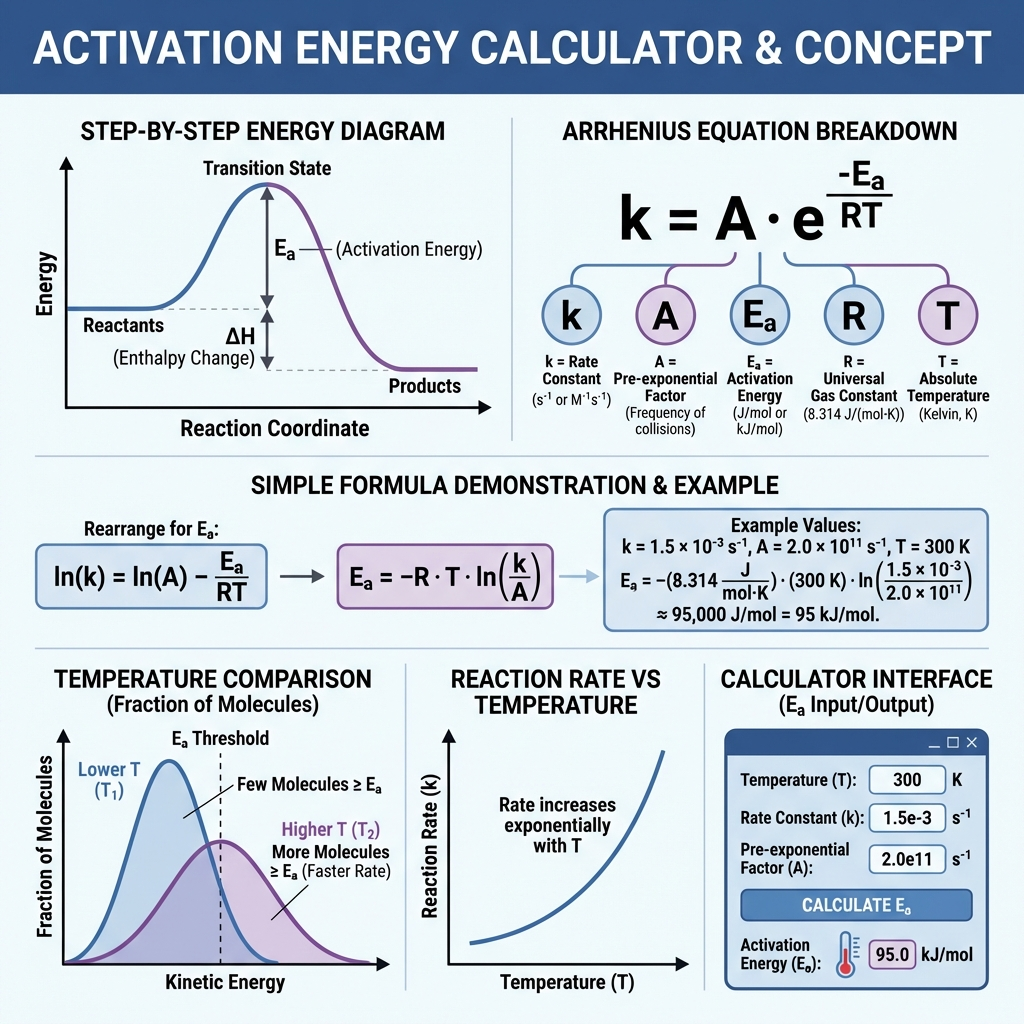
If you are willing to calculate the energy by hand, you need to understand the Arrhenius equation as follows:
E_a = -R * T * ln(k / A)
Where;
- R is the universal gas constant. Its value is 8.314 J/(K ⋅ mol)
- T represents the temperature in the surrounding environment
- k is the reaction rate coefficient
- A denotes the frequency factor
You can visit here to explore the activation energy graph if your goal comes up with calculations through it.
Example:
How to find activation energy with temperature and rate constant as follows:
Temperature = 253 K
Frequency factor = A = 210
Rate Constant = 100
Solution:
E_a = -R * T * ln(k / A)
E_a = -0.008314 * 373.15 * ln(100 / 1000)
E_a = (-3.1023691) * (ln(0.1))
E_a = (-3.1023691) * (-2.302585092994)
E_a = 7.143 KJ
Our calculator also computes the same answer but reduces the times from minutes to milliseconds. The tool maintains accuracy in calculations and shows complete steps that are involved in calculating activation energy.
How To Calculate Activation Energy From Graph?
To do this, follow the key points:
- Considering the reaction energy and progress, make a plot among the two
- After that, look for any change in the energy among the transition state and reactants
Working of Activation Energy Calculator:
To use the calculator, you need to stick to the following guide:
Input:
- Enter the values of temperature, rate coefficient, and constant in their respective fields
- Tap Calculate
Output:
- Activation energy of the chemical reaction
- Step-by-step calculations
Sometimes, a limiting reagent also affects the reaction kinematics and hence the activation energy also shows deviation.
FAQs:
Does Activation Energy Change With Rate?
Yes, it does! As there is an inverse relation between both quantities, increasing activation energy will decrease the rate of the reaction. However, our activation energy calculator helps you to estimate the minimum energy that you may require to start a reaction according to the situations given.
Do Enzymes Lower Activation Energy?
Yes! Enzymes increase the reaction rate by lowering the activation energy. They achieve this by using their active sites to bind substrate molecules, which reduces the energy required for the reaction to occur.
Can Activation Energy Be Negative?
Yes, in certain cases activation energy can appear negative. While activation energy is generally independent of temperature, very slow reactions at higher temperatures can result in calculated negative values. This can also be determined easily using an activation energy calculator.
References:
From the source Wikipedia: Activation energy, Temperature dependence and the relation to the Arrhenius equation, Catalysts, Relationship with Gibbs energy of activation, Negative activation energy, Activation energy in a 2D potential energy surface
From the source Lumen Learning: Activation Energy and the Arrhenius Equation, Determining the Activation Energy, Reaction Mechanisms
Related Tools