


Chemical Equation Balancer
Enter any chemical equation to balance it with the help of this chemical equation balancer.
Chemical Equation Balancer
This balancing chemical equations calculator helps to balance any chemical equation by determining the appropriate coefficients. Our chemical equation calculator provides with a complete periodic table and makes it simple to identify and enter various elements.
What is a Chemical Equation?
A chemical equation is a symbolic representation of a chemical reaction. It ensures an equal number of atoms for each element on both sides of the equation. This uses the formulas and symbols to show the reactants and the products as well as quantities of each substance in moles.
Example:
When magnesium reacts with oxygen, it forms magnesium oxide. The reaction is initially unbalanced because the number of atoms for each element is not equal on both sides.
Unbalanced Equation: \[ \text{Mg} + \text{O}_2 \rightarrow \text{MgO} \]
By balancing the atoms on both sides, the chemical equation obeys the Law of Conservation of Mass. A chemical equation balancer can automate this process by determining the correct coefficients for each substance involved.
Balanced Equation: \[ 2\text{Mg} + \text{O}_2 \rightarrow 2\text{MgO} \]
With this tool, you can balance even complex chemical reactions in seconds without manually calculating the coefficients.
Why is it Important to Balance a Chemical Equation?
A chemical equation is balanced to ensure that the number of atoms in the reactants equals the number of atoms in the product. During the chemical reaction, atoms reshape themselves and cannot be created or destroyed. Therefore, the balancing of the chemical equation is controlled by the law of conservation of mass. This law states that "the mass can not be created or destroyed". So, to reflect this law it must balance the chemical equation. You can also take help from the law of conservation of mass calculator to verify that the total mass of reactants in a chemical reaction is equal to the total mass of the products.
How to Balance Chemical Equations?
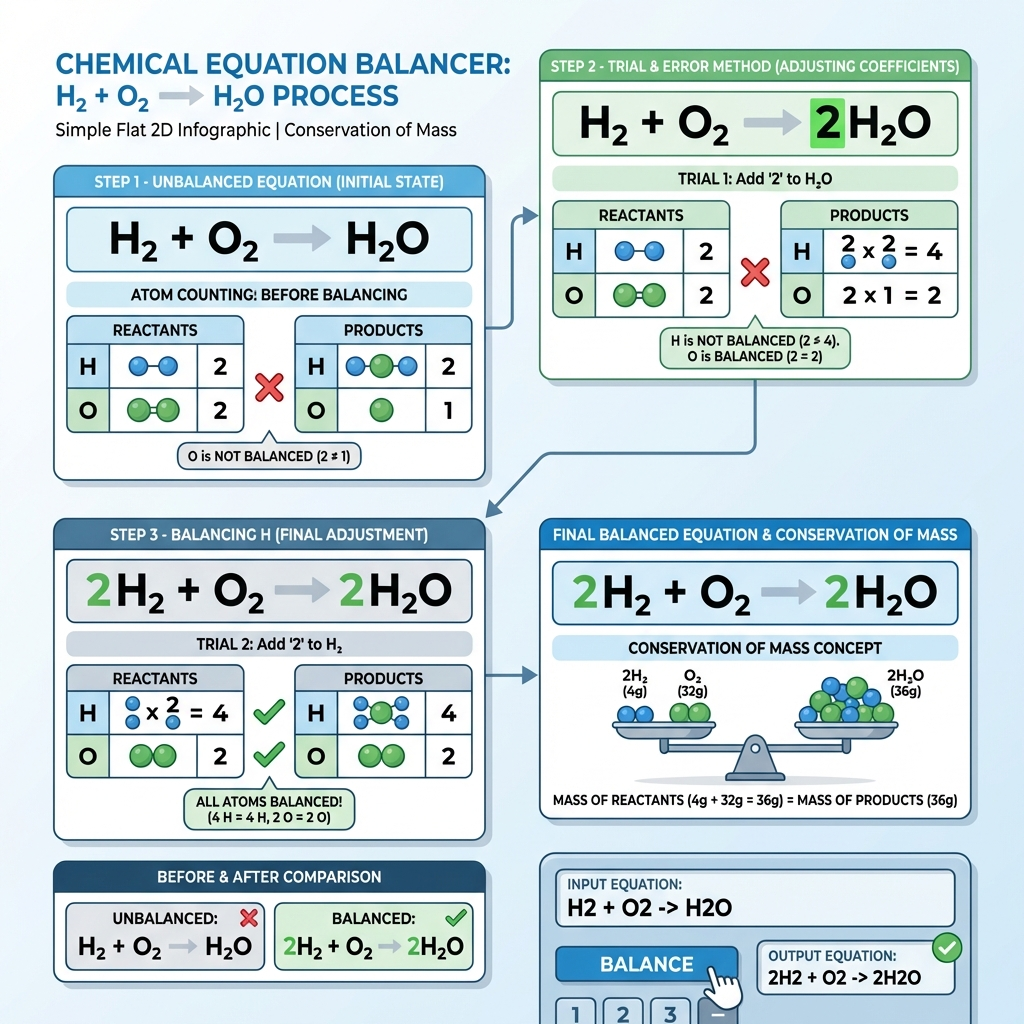
There are several methods to balance a chemical equation. Each method is considered suitable for different levels of complexity so follow these.
Traditional Balancing Method:
The traditional balancing method is the trial and error approach that involves the addition of coefficients to the reactant and products until the equation balances.
Steps:
- Count the number of atoms of each element on both sides of the equation
- Adjust the coefficients to equalize the number of atoms of each element on both sides
- Continue adjusting coefficients until all elements are balanced
Example:
Balance the given chemical equation:
\[ \text{H}_2 + \text{O}_2 \rightarrow \text{H}_2\text{O} \]
We can see that there are 2 hydrogen atoms on both sides, but 2 oxygen atoms on the left and only 1 on the right.
To balance oxygen, we put a coefficient of 2 in front of H₂O:
\[ \text{H}_2 + \text{O}_2 \rightarrow 2\text{H}_2\text{O} \]
Now, hydrogen is unbalanced. To balance hydrogen, we put a coefficient of 2 in front of H₂:
\[ 2\text{H}_2 + \text{O}_2 \rightarrow 2\text{H}_2\text{O} \]
Algebraic Balancing Method:
The algebraic method uses variables as stoichiometric coefficients for each species in the unbalanced chemical equation.
Steps:
- Assign variables (a, b, c, etc.) as coefficients for each compound.
- Write equations based on the number of atoms of each element on both sides.
- Solve the system of equations to find the values of the variables.
- Substitute the values back into the equation to get the balanced chemical equation.
Example:
Balance the following chemical equation using algebraic coefficients:
\[ a \, \text{Fe} + b \, \text{O}_2 \rightarrow c \, \text{Fe}_2\text{O}_3 \]
For iron (Fe):
\[ a = 2c \]
For oxygen (O):
\[ 2b = 3c \]
Solving these equations, we get:
\[ a = 4, \quad b = 3, \quad c = 2 \]
The balanced chemical equation is:
\[ 4\text{Fe} + 3\text{O}_2 \rightarrow 2\text{Fe}_2\text{O}_3 \]
Balancing with Oxidation Number Method:
This method is utilized in the redox reaction, where the variation in the oxidation number identifies the transfer of electrons to balance the chemical equation.
Steps:
- Identify the oxidation state of each atom in the equation
- Determines the elements that change oxidation number
- Find the total decrease and increase in the oxidation number
- By adjusting the coefficients to equalize the total increase and decrease
- Balance the rest of the atoms (except oxygen and hydrogen) by inspection
- Balance oxygen by adding H₂O molecules
- Balance hydrogen by adding H⁺ ions
If the reaction occurs in a basic solution, H⁺ can be converted to OH⁻ by adding equal amounts of OH⁻ to both sides.
Example:
Balance the redox reaction in acidic solution:
\[ \text{Fe}^{2+} + \text{MnO}_4^- \rightarrow \text{Fe}^{3+} + \text{Mn}^{2+} \]
Step 1: Identify oxidation numbers:
- \( \text{Fe}^{2+} = +2 \)
- \( \text{MnO}_4^-: \text{Mn} = +7, \text{O} = -2 \)
- \( \text{Fe}^{3+} = +3 \)
- \( \text{Mn}^{2+} = +2 \)
Step 2: Determine redox changes:
- Fe is oxidized: \( +1 \) change
- Mn is reduced: \( -5 \) change
Step 3: Balance Fe and Mn:
\[ 5\text{Fe}^{2+} + \text{MnO}_4^- \rightarrow 5\text{Fe}^{3+} + \text{Mn}^{2+} \]
Step 4: Balance O by adding H₂O:
\[ 5\text{Fe}^{2+} + \text{MnO}_4^- \rightarrow 5\text{Fe}^{3+} + \text{Mn}^{2+} + 4\text{H}_2\text{O} \]
Step 5: Balance H by adding H⁺:
\[ 5\text{Fe}^{2+} + \text{MnO}_4^- + 8\text{H}^+ \rightarrow 5\text{Fe}^{3+} + \text{Mn}^{2+} + 4\text{H}_2\text{O} \]
Step 6: Balance charges by adding electrons:
\[ 5\text{Fe}^{2+} + \text{MnO}_4^- + 8\text{H}^+ + 5e^- \rightarrow 5\text{Fe}^{3+} + \text{Mn}^{2+} + 4\text{H}_2\text{O} \]
Balancing with Ion-Electron Half-Reaction Method:
This balancing equation method involves two half-reactions, one is oxidation and other involves the reduction. Both half-reactions are balanced with respect to mass and charge, and then two equations are reassembled with the coefficients to allow for electron cancellation.
Steps:
- Divide the equation into two half-reactions
- Balance each of them separately for atoms other than oxygen and hydrogen
- Balance oxygen by adding H₂O molecules
- Balance hydrogen by adding H⁺ ions
- Balance charge by adding electrons (e⁻)
- Multiply the half-reactions by the factors to ensure an equal number of electrons involved
- Add the half-reactions together and cancel out common species
Example:
Balance the redox reaction:
\[ \text{Cu} + \text{HNO}_3 \rightarrow \text{Cu}^{2+} + \text{NO} \]
Step 1: Write half-reactions
- Oxidation: \(\text{Cu} \rightarrow \text{Cu}^{2+} + 2e^-\)
- Reduction: \(\text{HNO}_3 \rightarrow \text{NO}\)
Step 2: Balance oxygen in reduction:
\[ \text{HNO}_3 \rightarrow \text{NO} + 2\text{H}_2\text{O} \]
Step 3: Balance hydrogen in reduction:
\[ \text{HNO}_3 + 3\text{H}^+ \rightarrow \text{NO} + 2\text{H}_2\text{O} \]
Step 4: Balance charge in reduction by adding electrons:
\[ \text{HNO}_3 + 3\text{H}^+ + 3e^- \rightarrow \text{NO} + 2\text{H}_2\text{O} \]
Step 5: Equalize electrons by multiplying half-reactions:
- Oxidation ×3: \(3\text{Cu} \rightarrow 3\text{Cu}^{2+} + 6e^-\)
- Reduction ×2: \(2\text{HNO}_3 + 6\text{H}^+ + 6e^- \rightarrow 2\text{NO} + 4\text{H}_2\text{O}\)
Step 6: Add half-reactions and cancel electrons:
\[ 3\text{Cu} + 2\text{HNO}_3 + 6\text{H}^+ \rightarrow 3\text{Cu}^{2+} + 2\text{NO} + 4\text{H}_2\text{O} \]
Why is it crucial that a chemical equation is always balanced?
Chemical equations are used to create different chemicals and compounds. Using these chemical equations with balanced atoms leads to chemical reactions that produce the desired product. That is why this balancing chemical equations calculator takes a couple of clicks in displaying the exact amount of each reactant and product to balance the final representing equation.
Final Summary
Balancing chemical equations is essential in chemistry to ensure accurate representation of reactions. The Chemical Equation Balancer saves time, reduces errors, and helps students understand stoichiometry more effectively by providing instant balanced results.
Related Tools