


Box Fill Calculator
Enter the required parameters to precisely calculate “Box Fill" requirements for an electrical wiring box.
What Is Box Fill Calculation?
This Box Fill Calculator helps electricians quickly determine safe electrical box capacity and prevent overfilling issues.
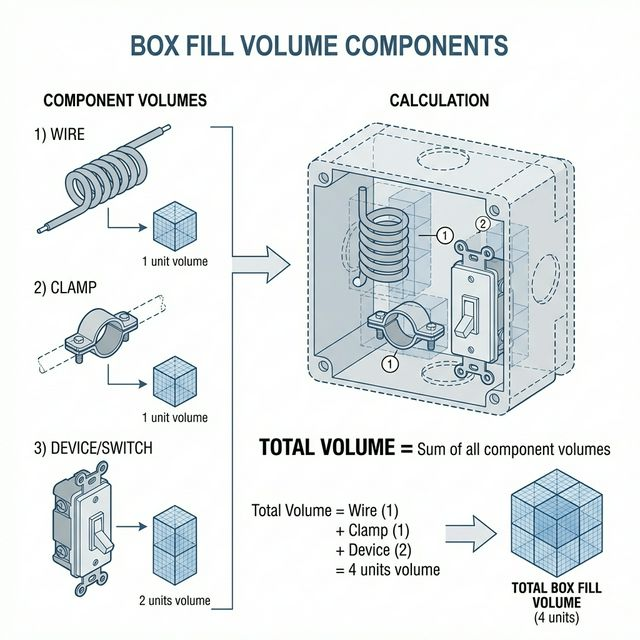
It is the calculation of the combined volume occupied by conducting wires, grounding wires, and other components in an electrical utility box.
The main objective of this box fill calculation is to prevent overcrowding in electrical boxes because an overloaded box can result in faults, arcing, or even pose a risk of fire.
How To Calculate Box Fill?
Follow the below-mentioned steps to calculate box fill:
Identify Components:
- Determine the number of conductors (wires) and their volume
- Recognize the device (switches, receptacles, etc.) that you have to install in the box
- Count any internal cable clamps, luminaire studs, or other fittings
Assign Values:
- Every conductor is considered one
- All the devices have a specific value, mostly two
Apply Multipliers:
- Multiply the total number of device mountings by the values specified in NEC Table 314.16(B)
Calculate Box Fill:
- Put these values in the formulas to calculate the fill volume of each component and sum all the fill volumes to find the right box size
Now, let's calculate the volume allowances for each component within an electrical box
Conductor Fill:
Formulas:
\( A_w = n_w \)
And
\( V_w = A_w \times V_{\text{largest conductor}} \)
Where:
- \( A_w \) is the conductor fill volume allowance
- \( n_w \) represents the number of conducting wires
- \( V_w \) is the conductor fill volume
- \( V_{\text{largest conductor}} \) is the free space provided for the largest conductor
In the following table we have provided the conductor wire size and their allowance volumes. For ease, use our wire size calculator and optimize your wire size assessments.
| Size of Conductor (AWG) | Volume Allowance Required Per Conductor (in.³) |
| 18 | 1.5 |
| 16 | 1.75 |
| 14 | 2 |
| 12 | 2.25 |
| 10 | 2.5 |
| 8 | 3 |
| 6 | 5 |
Source Better Homes & Gardens
Clamp Fill:
Clamp Fill:
If you are using an electrical box with internal clamps:
\( A_c = 1 \)
Otherwise (no clamps):
\( A_c = 0 \)
\( V_c = A_c \times V_{\text{largest conductor}} \)
Where:
- \( A_c \) is the clamp fill volume allowance
- \( V_c \) is the clamp fill volume
Support Fittings Fill:
If there are one or more luminaire studs or hickey inside the box:
\( A_s = 1 \)
If there are no luminaire studs or hickey inside the box:
\( A_s = 0 \)
\( V_s = A_s \times V_{\text{largest conductor}} \)
Where:
- \( A_s \) is the support fittings fill volume allowance
- \( V_s \) is the support fittings volume
Device or Equipment Fill:
\( A_d = 2 \times n_d \)
Where:
- \( A_d \) is the device fill volume allowance
- \( n_d \) is the number of devices
\( V_d = A_d \times V_{\text{largest conductor}} \)
Where:
- \( V_d \) is the device fill volume
Equipment Grounding Conductor Fill:
If 1–4 grounding conductors that are entering in the electrical box,
\(\ A_g=\ 1\)
If 5 or more:
\(\ A_g=\ 1+\dfrac{n_g−4}{4}\)
Or
\(\ A_g=\dfrac{n_g}{4}\)
Where
- \(\ A_g\) is the representative of the grounding conductor fill volume allowance
- \(\ N_g\) is the total number of grounding conductors
In equation form, it can be expressed as:
\(\ V_g =\ A_g\times \ V_{largest\ ground\ Wire}\)
Where
- \(\ V_g\) shows the equipment grounding conductor fill volume
- \(\ A_g\) represents the grounding conductor fill volume allowance
- \(\ V_{largest\ ground\ Wire}\) is the free space
The Total Box Fill Volume:
\(\ V_{total} =\ V_w+V_c+V_s+V_d+V_g\)
If the largest conductor is equal to the largest grounding wire size then find the total volume allowance and multiply it by the free space required for the largest conductor.
\(\ A_{total} =\ A_w+A_c+A_s+A_d+A_g\)
\(\ V_{total} =\ A_{total}\times \ V_{largest\ conductor}\)
Where
- \(\ V_{total}\) is the total box fill
- \(\ A_{total}\) represents the total volume allowance
- \(\ V_{largest\ ground\ Wire}\) is the free space as defined in Table 314.16(B)
Example:
Suppose you have a box with 10 wires, the largest conducting wire size is 12 AWG, 5 devices, and 10 grounding conductors with the largest grounding wire size being 12 AWG. Determine:
- Grounding wire volume
- Equipment grounding fill volume
- Total volume allowance needed
- Total box fill volume
Given:
- Largest conducting wire size = 12 AWG = 2.25 cu in
- Number of conducting wires = 10
- Devices = 5
- Grounding conductors = 10
- Largest grounding conductor wire size = 12 AWG = 2.25 cu in
Conductor Fill Volume:
\( A_w = n_w \)
\( A_w = 10 \)
\( V_w = A_w \times V_{\text{largest conductor}} \)
\( V_w = 10 \times 2.25 = 22.5 \text{ cu in} \)
Device Fill Volume Allowance:
\( A_d = 2 \times n_d \)
\( A_d = 2 \times 5 = 10 \)
Device Fill Volume:
\( V_d = A_d \times V_{\text{largest conductor}} \)
\( V_d = 10 \times 2.25 = 22.5 \text{ cu in} \)
Equipment Grounding Fill Volume Allowance:
\( A_g = \frac{n_g}{4} \)
\( A_g = \frac{10}{4} = 2.5 \)
Grounding Wire Volume:
Largest Grounding Wire Size = 12 AWG = 2.25 cu in
Equipment Grounding Fill Volume:
\( V_g = A_g \times V_{\text{largest ground wire}} \)
\( V_g = 2.5 \times 2.25 = 5.625 \text{ cu in} \)
Total Volume Allowance Needed:
\( A_{\text{total}} = A_w + A_c + A_s + A_d + A_g \)
\( A_{\text{total}} = 10 + 0 + 0 + 10 + 2.5 = 22.5 \)
Total Box Fill Volume:
\( V_{\text{total}} = V_w + V_c + V_s + V_d + V_g \)
\( V_{\text{total}} = 22.5 + 0 + 0 + 22.5 + 5.625 = 50.625 \text{ cu in} \)
Ensure precision by cross-checking your manual calculations with our electrical box fill calculator and optimize your results for a safe electrical system.
The Importance of Electrical Box Fill Calculation:
The box fill calculations are very important in electrical installations for many reasons, including:
- Preventing Overcrowding: It prevents overheating, increased fire hazards, and potential damage to electrical components
- Compliance with Regulations: Helps to comply with the National Electrical Code (NEC) regulations, ensuring that the installations meet the necessary codes
- Enhancing System Reliability: Using the box fill calculations, you can form reliable electrical systems
- Safety: It's the electricians' main concern and can be achieved easily with the help of this calculation that they can perform manually or by using a box fill calculator.
FAQ’s:
How Many Wires Can I Put In An Electrical Box?
A standard single-gang box has 18 cubic inches of space, which can contain:
- \( 9 \) wires of #14 gauge
- \( 8 \) wires of #12 gauge
- \( 7 \) wires of #10 gauge
These figures apply to boxes that house only wires. If you install devices in the box, deduct 2 wires from the specified counts.
Do Grounds Count In Box Fill?
Yes, grounding wires are included in calculating box fill volumes. According to the NFPA 70: National Electrical Code® 2020:
- A single volume allowance is specified for 1 to 4 equipment grounding conductors or equipment jumper conductors.
- Every additional grounding conductor requires an extra \( \frac{1}{4} \) volume allowance.
What Is The NEC Code For Box Fill?
The box fill code, outlined in NEC 314.16, states that boxes and conduit bodies must have the appropriate approved size to provide free space to all enclosed conductors. The volume of the box, calculated as per 314.16(A), should never be less than the fill calculation determined in 314.16(B).
Related Tools