


DC Wire Size Calculator
Input the required values into the calculator and get the perfect wire size estimation, gauge number, and wire cross-sectional area.
The DC wire size calculator estimates the required wire size for your circuit upon the given current and voltage rating. Solve all of your wire size calculation-related problems with this tool. Use it to get a precise estimation for budgeting your electrical project.
DC Wire Size:
The type of wire that is specifically designed to be used with the direct current or in DC circuits is known as the DC Wire. The direct current flows in one direction. A DC wire is mainly used in various electronic devices, automotive systems, and in the installation of solar panels. These wires are available in various types and sizes. It is necessary to choose the right type and size to have optimal performance. Below we have mentioned a few key factors that you must consider while purchasing the DC wire:
- Wire Gauge (AWG): It's the short form of American Wire Gauge that defines the size of the wire. Meanwhile, a smaller AWG means a large diameter wire.
- Voltage Rating: Choose the right voltage rating to ensure the safety
- Temperature Rating: The maximum temperature limit that the wire can bear
- Resistance: Consider the resistance of the wire
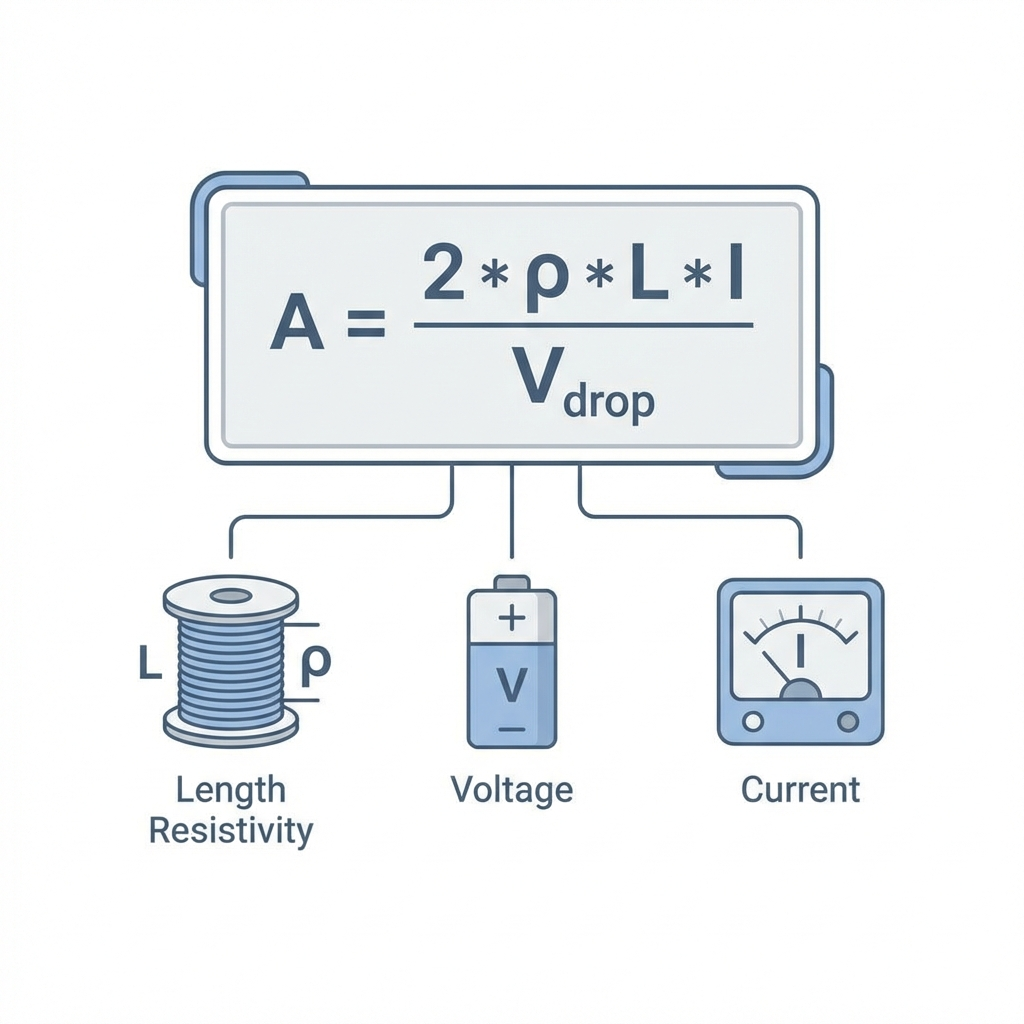
DC Wire Size Formula:
\(A(m^2)= \dfrac{2 \times ρ(Ω·m) \times L(m) \times I(A)}{V_V}\)
Where,
- A is the representative of the area
- Ρ is the resistance of the conductor in ohms meters(Ω·m)
- L shows the length in meters
- I is the current in amperes
- V is the allowable voltage drop for the wire
How To Calculate DC Wire Size?
Follow the below-outlined steps to calculate the wire size:
- First of all, determine the value of the current
- Measure the length of the wire by considering the path that the wire will cover from the source to the appliance
- Determine the material of the conductor for the wire
- Write down the value of the allowable voltage drop
- Determine the temperature of the wire
- Put these values in the DC wire size formula as we have done below
Example:
Let's suppose you have the following values:
- Conductor (ρ) = copper (1.883616) Ω⋅m
- Wire length(L) = 100 m
- Current (I) = 300 amp
- Source voltage (V) = 12 V
- Voltage drop (v) = 3 %
Find the 300 amp wire size for a DC/AC single-phase.
Solution:
\(A(m^2) = \dfrac{I(A) \times ρ(Ω·m) \times L(m) }{V_V}\)
\(A(m^2) = \dfrac{300 \times 1.88 \times 10^{-8} \times (2 \times 100) }{0.03 \times 12}\)
\(A(m^2) = \dfrac{0.00011301696 }{0.36}\)
\(A(m^2) =\ 0.00313936 mm\times1000000\)
\(A(m^2) =\ 3139.36mm^{2}\)
Wire Size Chart:
| AWG # | Diameter(inch) | Diameter(mm) | Area (kcmil) | Area(mm2) |
|---|---|---|---|---|
| 0000 (4/0) | 0.4600 | 11.6840 | 211.6000 | 107.2193 |
| 0000 (3/0) | 0.4096 | 10.4049 | 167.8064 | 85.0288 |
| 0000 (4/0) | 0.4600 | 11.6840 | 211.6000 | 107.2193 |
| 00 (2/0) | 0.3648 | 9.2658 | 133.0765 | 67.4309 |
| 0 (1/0) | 0.3249 | 8.2515 | 105.5345 | 53.4751 |
| 1 | 0.2893 | 7.3481 | 83.6927 | 42.4077 |
| 2 | 0.2576 | 6.5437 | 66.3713 | 33.6308 |
| 3 | 0.2294 | 5.8273 | 52.6348 | 26.6705 |
| 4 | 0.2043 | 5.1894 | 41.7413 | 21.1506 |
| 5 | 0.1819 | 4.6213 | 33.1024 | 16.7732 |
| 6 | 0.1620 | 4.1154 | 26.2514 | 13.3018 |
| 7 | 0.1443 | 3.6649 | 20.8183 | 10.5488 |
| 8 | 0.1285 | 3.2636 | 16.5097 | 8.3656 |
| 9 | 0.1144 | 2.9064 | 13.0927 | 6.6342 |
| 10 | 0.1019 | 2.5882 | 10.3830 | 5.2612 |
FAQ’s:
What Gauge of Wire For 30 Amps?
For 30 amps you will need to have a wire of 10 gauge.
What Size Wire For 30 Amp?
It depends upon the source voltage and length of the wire. Follow the below-mentioned steps:
- Check the voltage from the power source(ie, 12 V)
- Cable Length (I.e, 50 m)
- Ressitance (i.e, 2.22 × 10⁻⁸ Ω)
- Voltage Drop (i.e, 3 %)
\(A(m^2) = \dfrac{2 \times \rho \, (Ω \cdot m) \times L \, (m) \times I \, (A)}{V_V}\)
\( A(m^2)= \dfrac{(2 * 30*2.22*10^{-8}*50)\ }{0.03}\)
\( A(m^2)= 0.000185 \)
\( A(m^2)= 185.25\ mm^{2}\)
What Kind of Wire Is Best For DC Current?
Solid and stranded wires are good for both AC and DC currents.
Does DC Need 2 Wires?
Yes, AC and DC both have one live wire and one other wire that is grounded.
Related Tools