


Coulomb's Law Calculator
Select the parameter (force, charge, or distance) and the calculator will calculate its value in various units by employing coulomb’s law.
The Coulomb Law:
“The Coulomb Law states that the force of attraction or repulsion is directly proportional to the product of the charges and inversely proportional to Square of the distance between them”
The Coulomb Law calculates the electrostatic force acting between two charges. The force is always acting along the straight line that join the two charges (q₁q₂) and the force act along the square of the shortest distance (r²) between the charges:
The Coulomb's law formula is as follows:
\[ F = k_e \frac{q_1 q_2}{r^2} \]
Where:
- \(F\) = Electrostatic force between the charges (in Newtons, N)
- \(q_1\) = Magnitude of the first charge (in Coulombs, C)
- \(q_2\) = Magnitude of the second charge (in Coulombs, C)
- \(r\) = Distance between the charges (in meters, m)
- \(k_e\) = Coulomb’s constant (\(8.98755 \times 10^9 \ \text{N·m²/C²}\))
The value of \(k_e\) has already been included in the Coulomb's law calculator, so you don’t need to memorize it. The electrostatic force calculator automatically applies the constant when computing the force.
The unit of electric charge:
The SI unit of the electric charge is Coulombs(denoted by C).
“1 Coulomb is a charge that is transported by the constant current of 1 Ampere during 1 Second”.
How to calculate coulombs?
1 Coulomb =1 Ampere×1 Second
Where Ampere is the unit of the current and we can measure the current or Ampere by the Ohm’s calculator.
Historical perspective of the Coulomb’s Law:
Coulomb was a French physicist and his name was Charles Augustin de Coulomb. He presented the Coulomb's law formula in 1785 to define the force of attractions or repulsion between two electrical charges.He presented an equation of the force showing the force of attraction or repulsion between two bodies and it is known as the Coulomb’s electrostatic force formula
Coulomb’s Law in Vector Form
Coulomb's law can be expressed in vector form to define the force between two charges, as both charges exert equal and opposite forces on each other. To analyze the force directions, we need to find the projections of the vectors and their force of attraction or repulsion. You can use the vector projection calculator to determine vector projections.
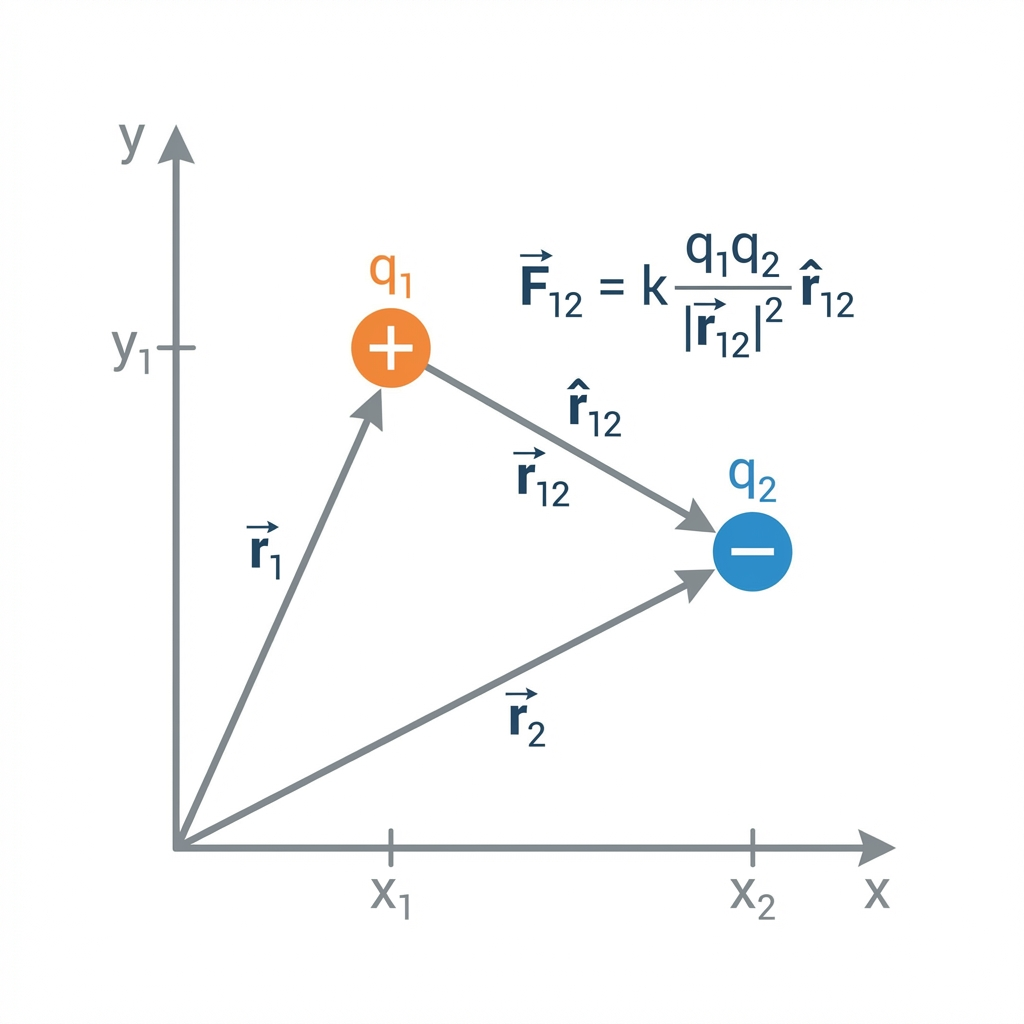
Consider two charges \(q_1\) and \(q_2\). The forces they exert on each other are \(\vec{F}_{12}\) (force on \(q_2\) by \(q_1\)) and \(\vec{F}_{21}\) (force on \(q_1\) by \(q_2\)). These forces are equal in magnitude and opposite in direction:
\[ \vec{F}_{12} = -\vec{F}_{21} \]
The electrostatic force between two point charges is given by:
\[ \vec{F}_{12} = \frac{1}{4 \pi \varepsilon_0} \frac{q_1 q_2}{r_{12}^2} \hat{r}_{12}, \quad \vec{F}_{12} = -\vec{F}_{21} \]
For multiple point charges, the resultant force is the vector sum of the individual forces:
\[ \vec{F} = \vec{F}_1 + \vec{F}_2 + \vec{F}_3 + \dots \]
By using the above formulas, it is possible to calculate the electrostatic forces among any number of point charges.
Limitations of Coulomb’s Law
Some important limitations of Coulomb’s Law are:
- The law applies only to point charges at rest.
- It cannot be directly applied to moving charges because the distance between them changes.
- It may not provide accurate results for large charged objects where charge distribution is not point-like.
Working of the Coulomb's Law Calculator:
The Force of attraction or repulsion between two charges can be measured by the Coulombs law calculator:
Input:
- Enter the charges.
- Enter the distance between the charges
- Hit the calculate button to find force.
Output: The coulomb's law calculator do the following calculations:
- It find the force of attraction or repulsion between to charges
- Display the step by step calculations.
FAQs:
Why do charges repel each other?
Like charges repel each other as their forces are directed against each other. This is the main reason the like charges produce repellent force to each other.The electrical force calculator finds the force of repulsion between the like charges.
What is the SI unit of electrostatic force?
The electrostatic force is measured in Newton(N).The other units of electrostatic force are (Kilo Newton) kN,(Milli Newton) mN, (Mega Newton) MN, (pounds-force) lbf, Giga Newton) GN, (Tera Newton) TN,(poundals) pdl
What is meant by esu and emu?
The "esu" denotes the “electrostatic unit” and it is also represented as prefix “stat”and read as statcoulomb. The emu denotes electromagnetic unit and is also given the prefix “ab” known as abcoulomb.
What is a common example of the electrostatic force?
The common example of the electrostatic force is when you run a comb in our dry hairs and attract the pieces of papers by it.
What does “Q” represent in the electric field?
We place the charge “Q” to check the sphere of the electric field and it is called the test charge in the electric field. We can find the strength of the electric field by the coulomb force calculator.We can find the electric field by the electric field calculator.
Conclusion:
The coulomb's law formula has great application in modern day life from the Xerox machines to the Laser printer, it is also utilized for the powder coating. In these machines charged particles are used in the printing process. The coulomb's law calculator is used to find the force of attraction or repulsion between two objects in installing them in various machines.
References:
From the source of Wikipedia: Coulomb, Definition From the source of Britannica:Charles-Augustin de Coulomb,Coulomb force
Related Tools