


Solar Panel Calculator
Enter a few required parameters into the following calculator and estimate the number of panels, solar array dimensions, and area required to install a solar system.
Use the solar panel calculator to estimate the panel size, required panels, and the solar panel array size needed for your home energy usage. With it, you can also calculate the solar power, the efficiency of the panels, and the area required for the installation of the solar panels.
Benefits of Solar Energy — Why Solar?
Solar energy allows you to produce electricity free of any pollution and pure. A huge public is following this modern trend of installing solar panels because of its diverse benefits such as:
- Contributes to improving the quality of the air
- Produces green energy that lowers your carbon footprints
- Allows you to enjoy cheap electricity
- If you install net metering, you can also sell extra free solar energy produced which is a benefit
- Installing solar panel systems may nullify the chances of any additional tax amounts
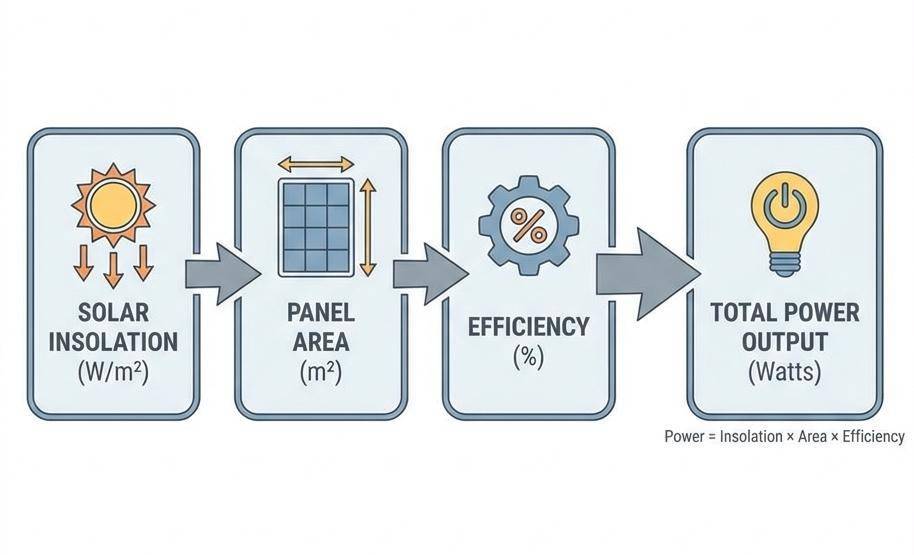
How Do I Calculate How Many Solar Panels I Need?
It is very important to know the exact number of solar panels because it helps you calculate the solar power needed to run the load you want. The number of solar panels depends on the following factors:
- Useable Roof Area
- Solar Panel Needs
- Solar Panel Size
- The Efficiency of Photovoltaic Cells
- Solar Panel Wattage
Use the following equation to find the number of panels you need:
\[ \text{Number of Panels} = \frac{\text{System Size}}{\text{Single Panel Size}} \]
The system size refers to the actual solar power output you want from the panels. Calculating the solar array output gives an idea of the units needed to achieve the desired electricity:
\[ \text{Solar Array Output} = \frac{\text{Electricity Consumption}}{365 \times \text{Solar Hours in a Day}} \]
\[ \text{Solar Array Size} = \text{Solar Array Output} \times \frac{\text{Bill Offset}}{\text{Environmental Factor}} \]
Now, calculate the exact number of panels to install on the roof:
\[ \text{Required Panels} = \frac{\text{Solar Array Size} \times 1000}{\text{Solar Hours Per Day} \times \text{Panel Output in Watts}} \]
Finally, calculate the area covered by the panels on your roof:
\[ \text{Required Area} = \text{Required Panels} \times \text{Panel Width} \times \text{Panel Length} \]
Solar Panel Cost Per Watt:
Today, solar panels are available in different sizes, and power ranges. Below we have discussed the prices for various types of solar panels. Let’s have a look at these!
Grid-Tie Solar System Costs:
The prices vary for every different type and model and solar panel dimensions. So whenever you make up your mind to invest in buying these, you must check and verify the prices of the panels you wish to buy. It will let you make a proper investment strategy. Grid Tie means that your home is connected to the utility company’s grid. By using it your home electricity consumption will remain the same but you will be able to cut down the electricity bill. You can do solar savings by investing in the batteries.
Off-Grid Solar System Costs:
These solar panels are considered the most reliable choice for a layman who wishes to install a proper system for his house. Off-grid solar systems require a charge controller (inverter) to convert the direct current(DC) to an alternative current(AC) so you can use it to power your electronic devices.
Solar Panel Installation Costs:
The Solar Panel Installation Costs range approximately from $0.75 to $1.25 per watt. With the help of a solar panel cost calculator, you can easily figure out the total cost that you will have to pay as a lump sum amount.
FAQ’s:
How To Figure Out Your Average Sun Hours Per Day?
All the parts of a country receive different amounts of sunlight in a day. To get to know the average solar hours per day in your location determine the peak hours of the sun. Here peak sun hours mean the time at which the light of the sun equals 1000 watts per square meter. In most parts of the United States, you will probably get six peak hours in a day. For more precise information on solar hours, use an insolation map or an insolation meter.
How Many kWh Can 1 Solar Panel?
On average, a single panel can produce a solar estimate of about 170 to 350 watts per every single hour. However, the solar panel efficiency also changes with varied climatic conditions like extensive hot summer or too much cold.
How Many Solar Panels Do I Need For 1000 kWh Per Month?
You need 24 to 25 solar panels kwh to get a solar panel output of 1000 kWh.
Related Tools