


Specific Heat Calculator
Select the parameter and enter the required values and then find the specific heat, heat energy, mass of substance, initial temperature, and final temperature of the substance.
What is Specific Heat?
It is the amount of heat that is required to change the temperature of a mass unit of any substance only by one degree. To find the specific heat capacity, we can say that it is a measure of the total energy that is needed to heat up 1 kilogram of any material to 1°Celcius or 1Kelvin. These phenomena should take place within a temperature range, where the substance doesn't change its state e.g. In the case of water, it shouldn’t get boiled.
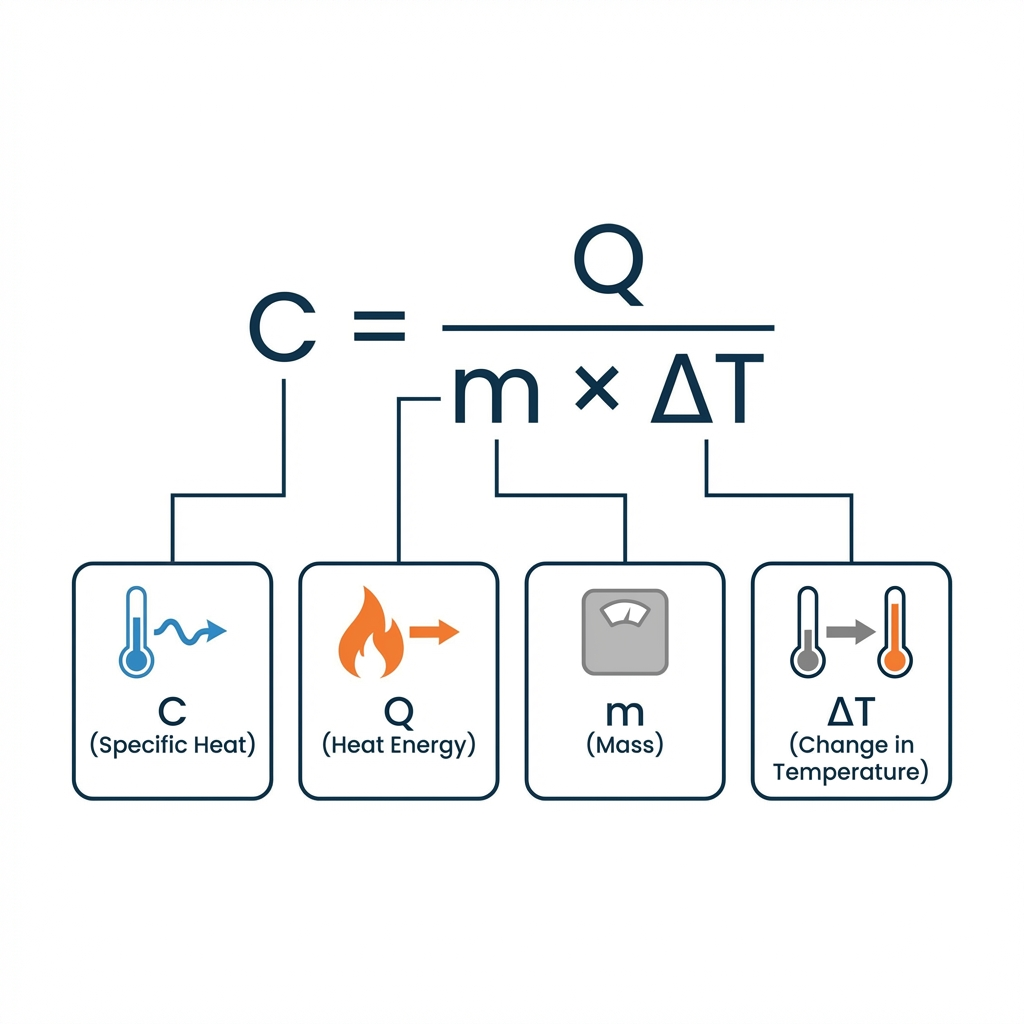
Specific Heat Formula:
The heat capacity formula is: $$ C = \frac {Q}{m\times\Delta T} $$
Whereas:
- \(C\) is representing the specific heat capacity
- \(Q\) is representing the induced thermal energy
- \(m\) is representing the mass
- \(\Delta T\) is the temperature difference
- \(J\) is Joule
- \(°C\) is degrees centigrade or Celsius
- \(K\) is Kelvin
Example:
If you have a \(15 \, \text{g}\) piece of any metal that absorbs \(134 \, \text{J}\) of heat while increasing in temperature from \(24.0^\circ \text{C}\) to \(62.7^\circ \text{C}\), you can calculate its specific heat as follows:
- Heat absorbed: \(q = 134 \, \text{J}\)
- Mass: \(m = 15.0 \, \text{g}\)
- Temperature change: \(\Delta T = 62.7 - 24.0 = 38.7 \, ^\circ\text{C}\)
To find the specific heat, use the formula:
\[ c = \frac{q}{m \cdot \Delta T} = \frac{134}{15 \cdot 38.7} \approx 0.231 \, \text{J/g°C} \]
You can also use a specific heat calculator to find this value easily without manual calculations.
How to Calculate Specific Heat?
Using the specific heat formula, calculating the specific heat is an easy process. Follow the steps below:
Step 1:
Determine whether you want to heat up or cool down the substance. Provide the energy supplied as a positive value. While cooling, give the energy as a negative value. For example, if we want to decrease the sample's thermal energy by 63,000 J, then:
\[ Q = -63{,}000 \, \text{J} \]
Step 2:
Decide the temperature change of the sample. Suppose:
\[ \Delta T = -3 \, \text{K}, \quad m = 5 \, \text{kg} \]
Step 3:
Use the specific heat formula:
\[ c = \frac{Q}{m \cdot \Delta T} \]
Substitute the values:
\[ c = \frac{-63{,}000 \, \text{J}}{5 \, \text{kg} \cdot (-3 \, \text{K})} = 4{,}200 \, \text{J/(kg·K)} \]
This is the typical heat capacity of water. You can also calculate it quickly using a specific heat calculator.
How to Use This Calculator?
The online specific heat capacity calculator is helps you to find heat capacity of different substances. Just follow these steps to get the exact results for substances:
Input:
- First of all, select the option either you want to find heat energy, specific heat, mass, initial temperature, final temperature of any substance
- Next, select an option wither you need to perform calculations by change of temperature \(ΔT)\) or initial & final temperature
- Now, you can add the values into the designated fields with respect to selected options
- Then, choose the substance like (water, soil, aluminum, asphalt or etc) for which you need to find the specific heat (this field is optional)
- Make a click on the ‘calculate’ button
Output: The specific heat calculator calculates:
- Either heat energy, specific heat, mass, initial temperature, or final temperature of a substance
- Specific heat for a given substance
- Formula for the selected option
- Step by step solution by using formula according to the selected option
Note: The specific heat capacity calculator supports different units to provides you the accurate results of substances.
FAQ’s:
Why is water's heat capacity so high?
High heat capacity of water is because of hydrogen bonding among its molecules. When heat is absorbed in water, bonds of hydrogen brakes and water molecules start moving freely. With the decrease in water temperature, the hydrogen bonds release a significant amount of energy.
How Much Heat is Required to Melt 200g of Ice?
Typically, the energy required to melt 200 g of ice can be calculated using the latent heat of fusion formula:
\[ Q = m \cdot L_f \]
Where:
- \(m = 200 \, \text{g} = 0.2 \, \text{kg}\)
- \(L_f = 334 \, \text{J/g} = 334{,}000 \, \text{J/kg}\) (latent heat of fusion of ice)
Substitute the values:
\[ Q = 200 \, \text{g} \times 334 \, \text{J/g} = 66{,}800 \, \text{J} \]
Thus, approximately 66.8 kJ of energy is required to melt 200 g of ice.
Energy Required to Melt Ice
To melt 1 g of ice at \(0^\circ \text{C}\), a total of 334 J of energy is required. This is known as the latent heat of melting. You can also use a specific heat or latent heat calculator to quickly find the energy needed for any mass of ice or other substances.
References:
From the informational source of Wikipedia: Specific heat capacity
Related Tools