


Dilution Calculator
The calculator will allow you to determine the actual solvent molarity that is required to prepare a solution of desired concentration and volume.
What is Dilution of Solutions?
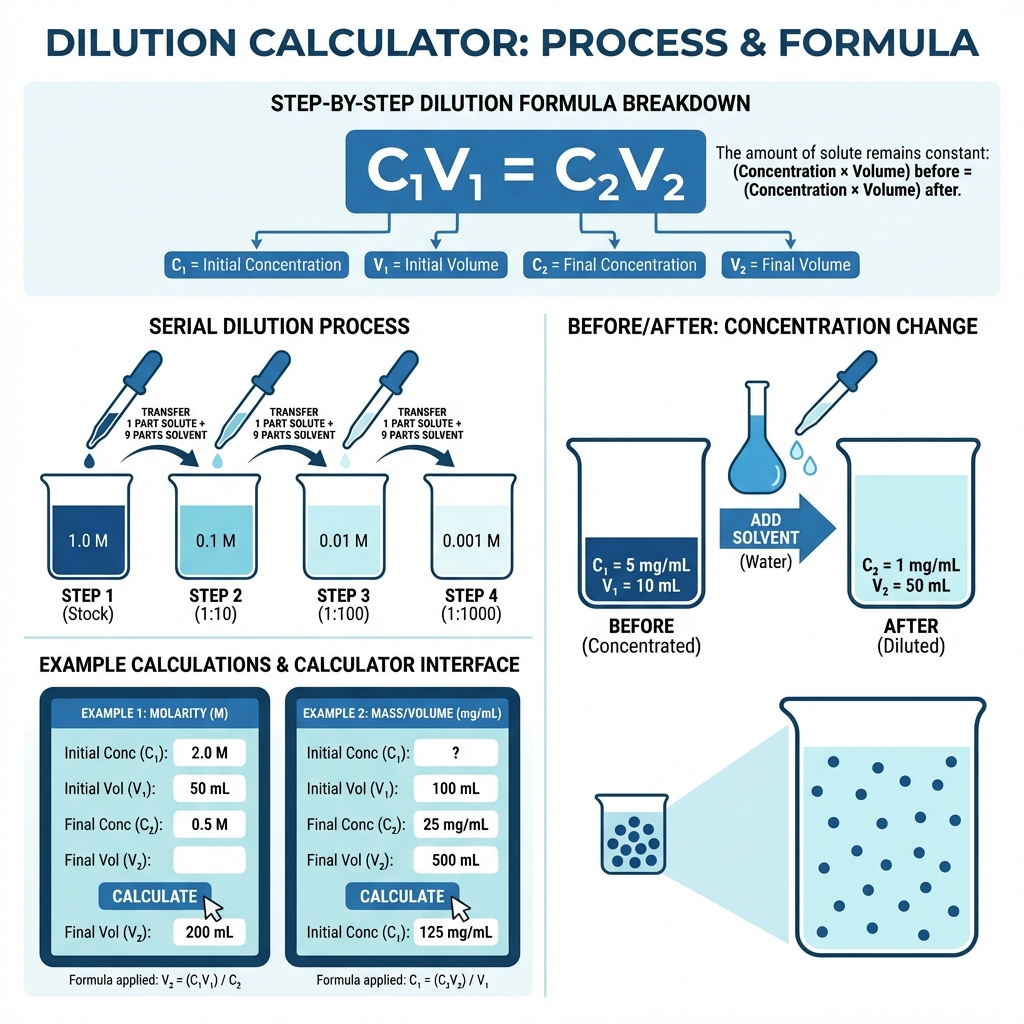
Dilution is the technique of reducing the concentration of solutes in a solution, normally just mixing it with more solvents, for example adding more water to the solution. Diluting a solution means adding more solvent without adding extra solute. Mix the resulting solution thoroughly to ensure that all parts of the solution are the identical.
Dilution is the process of adding a solvent to a solution in order to decrease its concentration. During dilution, the amount of solute remains constant, while the total volume of the solution increases, resulting in a lower final concentration.
Dilution can also occur by mixing a highly concentrated solution with the same solution at a lower concentration. This process is essential in laboratory work because stock solutions are typically prepared and stored at high concentrations. Before use, these solutions must be carefully diluted to achieve the required concentration for accurate experiments.
Dilution Equation:
The dilution calculation performed by the bleach dilution calculator is based on the following formula:
\[ C_1 V_1 = C_2 V_2 \]
Where:
\(C_1\) = Concentration (molarity) of the diluted solution
\(V_1\) = Volume taken from the concentrated solution
\(C_2\) = Final concentration of the stock solution
\(V_2\) = Final volume of the stock solution
An alternative notation for the dilution equation is:
\[ M_1 V_1 = M_2 V_2 \]
Here, molarity \(M\) is used instead of concentration \(C\).
However, a Percent Yield Calculator allows you to compute the percent yield by entering the theoretical and actual yield values.
Units of Concentration:
Molar concentration \(c\) represents the amount of substance dissolved in a given volume of solution. It is expressed in moles per liter (M), where:
\[ 1 \, M = 1 \, \text{mol/L} \]
Mass concentration \(\rho\) is defined as the mass of a substance (in grams) per unit volume and is expressed in grams per liter (g/L).
To calculate mass concentration from molar concentration, use:
\[ \rho = c \times M \]
where \(M\) is the molar mass of the substance (kg/mol).
Dilutions of Stock (or Standard) Solutions:
Imagine that we have a certain concentration of salt solution, which means that we dissolve a certain amount of salt (a certain mass or number of moles) in a certain volume of the solution. Next, we will dilute this solution. Therefore, when we use a solution dilution calculator, it tells adding more water instead of salt, then we will get:
The molarity of solution 1 is
M1 = moles1 / liter1
and the molarity of solution 2 is
M2 = moles2 / liter2
Now, rearrange the particular equations to determine moles:
moles1 = M1 liter1 and moles2 = M2 liter2
What remains the same and what has changed between the two solutions? By substituting more water, we changed the volume of the solution; at the same time, its concentration changed; however, the number of moles of solute did not change. So,
moles1 = moles2
Therefore
M1V1 = M2V2
Where,
M1 and M2 are the concentrations of the diluted solutions
V1 and V2 are the volumes of the solutions
The preparation of diluents is common in chemical laboratories and other places. Once the above relationship is understood, the calculation is easy. Suppose you have 700 milliliters of 2.0 M HCl solution. Add water to make the diluted solution volume 900 ml. The new molarity can be easily calculated by the solution dilution calculator and solved for M2 using the above equation.
M2 = (M1 × V1) / V2
M2 = (2.0M × 700mL) / 900mL = 1.56 M HCl
Thus, the solution is diluted due to the new volume that is five times extra then the original volume.
How to Calculate Dilution?
Here are some examples for better understanding the dilutions calculation:
Example 1:
232 ml of 1.5 M aqueous solution of Lithium Chloride (LiCl) was diluted with water to a final volume of 2.0 Liter. What is the final concentration of the stock solution?
Solution:
$$ C_1V_1=C_2V_2 $$
$$ M_2 x (1000 mL) = (1.6 M x 175 mL) $$
$$ M_2 = (1.5) (232) / 2000 $$
$$ M_2 = 0.14 M $$
However, you can use an Titration Calculator that will help you to identify the different properties of a solution during an experiment.
Example: Diluting Nitric Acid:
232 ml of 1.5 M aqueous solution of Lithium Chloride (LiCl) was diluted with water to a final volume of 2.0 Liter. What is the final concentration of the stock solution?
Solution:
$$ C_1V_1=C_2V_2 $$
$$ M_2 x (1000 mL) = (1.6 M x 175 mL) $$
$$ M_2 = (1.5) (232) / 2000 $$
$$ M_2 = 0.14 M $$
How does Dilution Calculator Works?
An Technical calculator determines the volume and concentrates to add to achieve the specified molarity and volume by following these steps:
Input:
- First, choose the molarity or volume to calculating from the drop-down list.
- Now, put the given values in all fields accordingly.
- Hit the “Calculate Dilution” button.
Output:
- The concentration dilution calculator provides the unknown volume and concentration.
FAQ:
What is the dilution rate?
In chemistry, the dilution ratio is the factor of dissolved substances to solvents. For example, a 3:8 dilution with a 3 : 8 dilution ratio involves combining 3 unit volume of solute with an 8 unit volume of solvent to form 6 total volume units.
How is Dilution Used in Daily Life?
Dilution is a process in which a solvent is added to increase the volume of a solution and reduce its concentration. This concept is commonly used in everyday life. For example, if your coffee tastes too strong, you can dilute it with water to make the flavor milder and more enjoyable.
What Is Serial Dilution?
Serial dilution involves repeatedly diluting a stock or standard solution in a step-by-step manner. Typically, the dilution factor remains constant at each step, resulting in an exponential decrease in the solution’s concentration.
Conclusion:
This technical dilution calculator allows you to select different concentration (molarity) and volume units, providing an easy and accurate way to dilute a stock solution of known concentration. Our free technical calculator delivers precise values to help prepare solutions of a desired concentration based on the specified volume.
Reference:
From the source of Wikipedia: Basic room purge equation, Dilution ventilation equation, Dilution (equation).
From the source of Lumen Learning: Concentration of a diluted solution, Dilutiona solution, Serial Dilutions, Solving Dilution Problems.
From the source of Libre Text: Stock Solutions, Dilutions of Stock (or Standard) Solutions, Diluting and Mixing Solutions.
Related Tools