


Titration Calculator
Choose what you need to calculate, enter the values accordingly, and click on the “Calculate”.
Titration Calculator:
This titration calculator is used to calculate the unknown molarity (concentration) of an acid or base solution using the data from a titration experiment. Also, it allows to find the volume of titrants, and the moles of H+ and OH- involved in the chemical reaction. By calculating these values, it is easy to understand how strong or weak an acid or base is in a solution.
What is Titration?
"The process of chemical analysis in which a solution of known concentration (titrant) is slowly added to a solution of unknown concentration (analyte) until the reaction reaches a neutral point"
The known volume of titrant is added until a solution reaches a pH ratio of 1:1. When a base or acid is dissolved in water, its H⁺ or OH- ions will dissociate, which will change the natural self-ionization balance of water:
2H₂O ⇌ OH⁻ + H₃O⁺
It will become more stronger acid-base titration solution. At pH 7, the concentration of H₃O⁺ ion and OH⁻ ion is 1:1 (titration equivalence point).
Titration Formula:
This formula for titration determines the unknown concentration of a solution (analyte) reacting with a solution of known concentration (titrant).
nH+ . Va . Ma = nOH- . Mb . Vb
Where:
- nH+ = Number of moles of H+ ions
- Va = Volume of an acid
- Ma = Molarity of an acid
- nOH- = Number of moles of OH- ions
- Mb = Molarity of a base
- Vb = Volume of a base
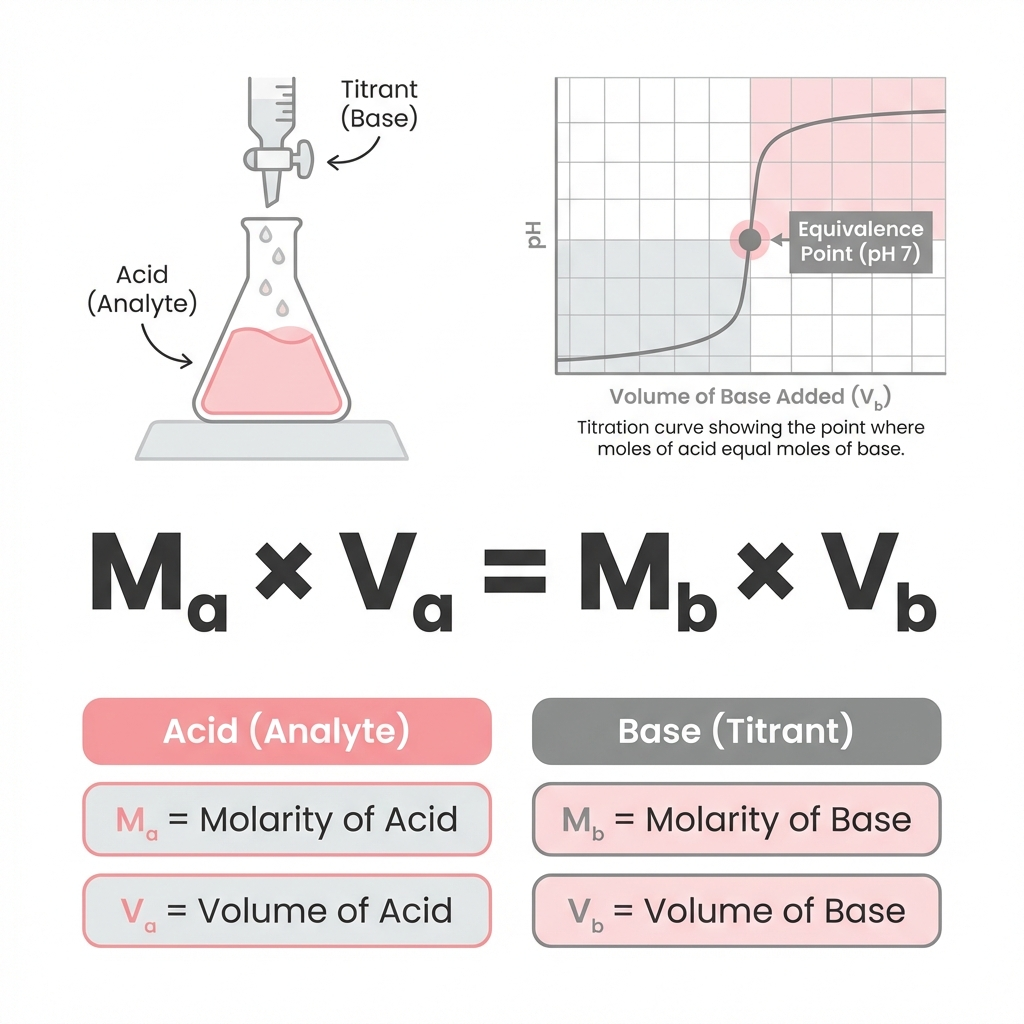
Method of Acid-Base Titration:
Preparation:
- Dissolve unknown acid/base in water
- Make a titrant solution and fill in the burette
- In a flask of analyte solution add an indicator
Titration:
- Slowly add titrant to the analyte solution until the color changes
Endpoint:
- Stop the addition of titrant when the indicator shows a change of color
How to Calculate Titration?
Record the Volume:
Note the initial volume of the titrant in the burette and the volume of the analyte from the flask.
Perform the Titration:
Add the titrant to the analyte until the indicator shows a certain change in color and then record the final volume
Calculate the Volume of Titrant Used:
Calculate the volume of the titrant by using the formula below:
Volume of titrant used = Final volume − Initial volume
Solve the Unknown Concentration and Know Titration Value:
By using the formula for calculating titration the unknown concentration (molarity) is calculated. Look at the below example that uses the same process step-by-step.
The method is a valuable addition when your experiment involves manual determination, to automate the process you can use the online titration calculator.
Example (Solved):
Find the concentration of acetic acid in vinegar having a 0.100 M solution of NaOH. We used 25.00 mL of the NaOH solution to titrate to the equivalence point of 10.00 mL of vinegar solution.
CH3COOH + NaOH → CH3COONa (aq) + H2O
Solution:
Calculate the millimoles (mmol) of NaOH used:
mmol NaOH = Moles of NaOH * Volume of NaOH
= 0.100 M * 25.00 mL
= 2.50 mmol
Since the reaction between acetic acid and NaOH is 1:1, the millimoles of acetic acid used equal the millimoles of NaOH used.
mmol of CH3COOH = 2.50 mmol
Calculate the concentration (molarity) of the acetic acid solution (M CH3COOH):
Molarity of CH3COOH = mmol of CH3COOH Volume of CH3COOH
Molarity of CH3COOH = 2.50 mmol 10.00 mL
Molarity of CH3COOH = 0.250 M
Therefore, the concentration of acetic acid in the vinegar solution is 0.250 M.
Estimating the Equivalence Point’s pH:
The pH value of the solution obtained at the equivalence point depends on the relative concentration of acid and base. You can estimate the pH value of the equivalence point according to the following rule:
- Strong acid reacts with a weak base to form a solution (pH < 7)
- Strong acid reacts with a strong base to form a solution (pH = 7)
- Weak acid reacts with a strong base to form a solution (pH > 7
If the base is stronger than the acid, the solution will be alkaline and if the acid is stronger than the base, the solution will be acidic. If the weak acid and weak base have equal strengths and concentrations, the resulting solution will be neutral having a pH equal to 7. Therefore, it is difficult to titrate with a weak acid and base because there is no change in color.
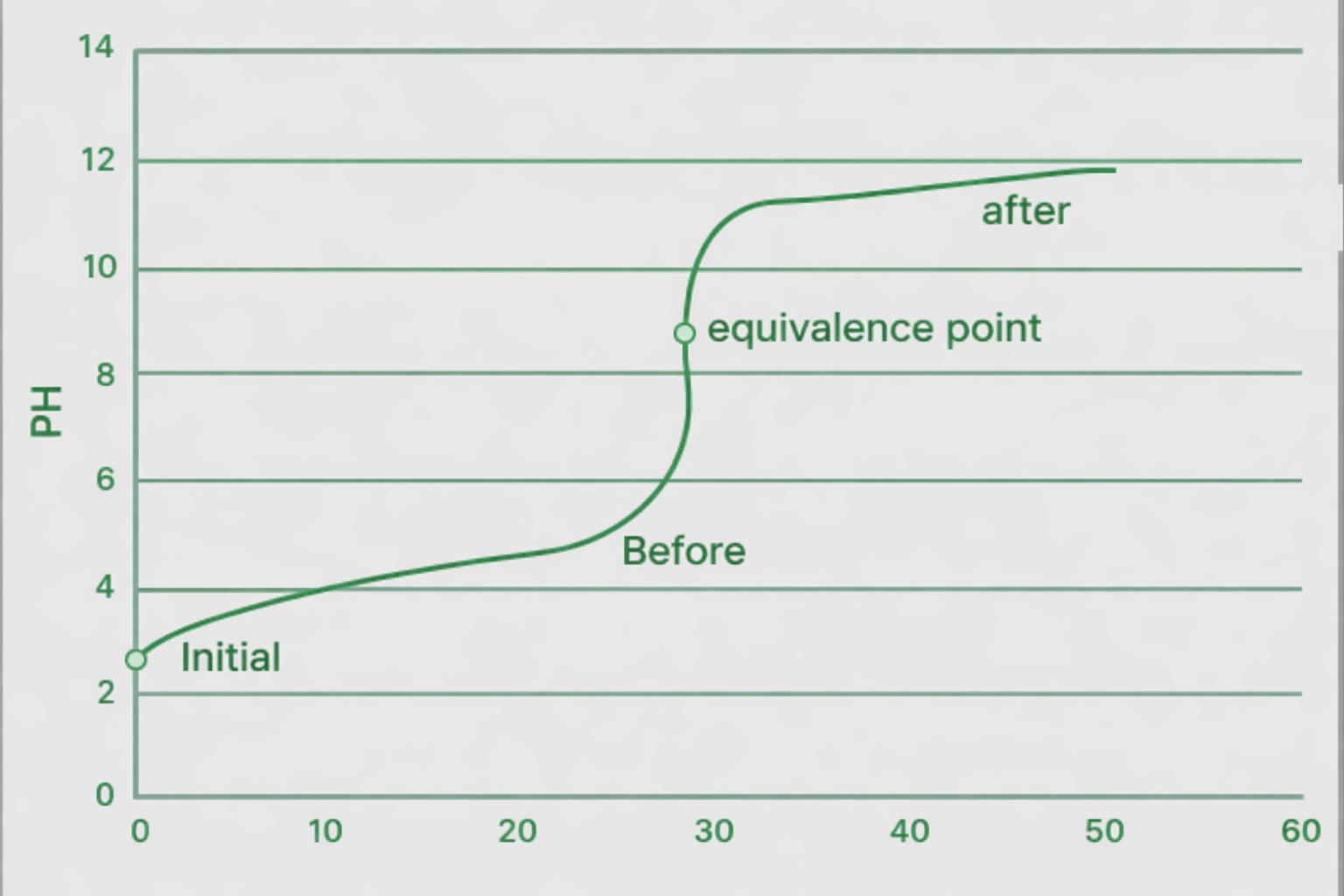
Table of Common Bases & Acids & Their Strengths:
Base:
| Formula | Name | Strength |
| NaOH | Sodium hydroxide | Strong |
| KOH | Potassium hydroxide | Strong |
| Ca(OH)2 | Calcium hydroxide | Strong |
| Ba(OH)2 | Barium hydroxide | Strong |
| NH3 | Ammonia | Weak |
| CH3NH2 | Methylamine | Weak |
| C5H5N | Pyridine | Weak |
Acid:
| Formula | Name | Strength |
| HCl | Hydrochloric acid | Strong |
| HNO3 | Nitric acid | Strong |
| H2SO4 | Sulfuric acid | Strong |
| HBr | Hydrobromic acid | Strong |
| HI | Hydroiodic acid | Strong |
| HClO4 | Perchloric acid | Strong |
| HClO3 | Chloric acid | Strong |
| HCOOH | Formic acid | Weak |
| CH3COOH | Acetic acid | Weak |
| C6H5COOH | Benzoic acid | Weak |
| HF | Hydrofluoric acid | Weak |
| HNO2 | Nitrous acid | Weak |
| H3PO4 | Phosphoric acid | Weak |
Related Tools