


Probability Density Function Calculator
What Is The Probability Density Function?
In the light of statistical context:
“A particular probability function that shows the density of any random variable within a certain range of values is called a probability density function”
This function is also called the probability distribution function.
Note: One thing that you must keep in mind is that the integral of a pdf over an entire space area is always equal to 1.
Probability Density Curve:
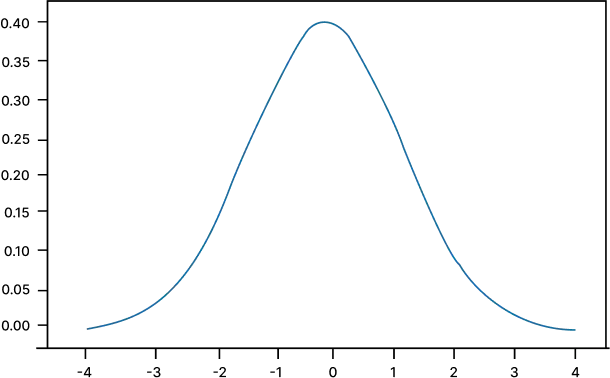
The given plot can easily be sketched if you determine the densities of the given function by using this free joint density function calculator.
Probability Density Function Formula:
For different statistical operations, the probability density formula differs too. But whatever the condition is, this free probability density calculator will figure that out in seconds to display precise results on your device screen. Okay, let’s get back and have a look at these formulas:
Beta Function:
It is a probability distribution function that represents the possible values of probability. The integral of the probability distribution function over the entire space must be equal to 1. Below is the probability density function (PDF) of the Beta distribution:
$$ B(a, b) = \int_{0}^{1} t^{a-1} (1 - t)^{b-1} \, dt $$ $$ f(x; a, b) = \frac{1}{B(a, b)} x^{a-1} (1-x)^{b-1}, \quad 0 \le x \le 1 $$
Where;
a and b = shape parameters
B = beta function
Chi Square:
A specific test that displays the association between two categorical variables is called the Chi-square test. The probability density function (PDF) of the Chi-square distribution is given below:
$$ f(x; k) = \frac{1}{2^{\frac{k}{2}} \Gamma\!\left(\frac{k}{2}\right)} x^{\frac{k}{2}-1} e^{-\frac{x}{2}}, \quad x \ge 0 $$
k = degrees of freedom
Γ = gamma function
Our best probability density function calculator also works on the same formulas to compute accurate estimations of pdf.
F-Distribution:
In statistics, the F-distribution is used to compare the variances of two populations. The probability density function (PDF) of the F-distribution is given below:
$$ f(x; d_1, d_2) = \frac{ \left(\frac{d_1}{d_2}\right)^{\frac{d_1}{2}} x^{\frac{d_1}{2}-1} }{ B\!\left(\frac{d_1}{2}, \frac{d_2}{2}\right) \left(1 + \frac{d_1}{d_2}x\right)^{\frac{d_1 + d_2}{2}} }, \quad x > 0 $$
Where;
d1 and d2 = the degrees of freedom
B = beta function
Continuous Uniform Distribution:
It is the probability of symmetric probability distributions that can swiftly be determined with the assistance of this free probability density function calculator. But when it comes to the manual computations, you need to pay heed to the following formula:
$$ f(x) = \begin{cases} \dfrac{1}{b-a}, & \text{for } a \le x \le b \\ 0, & \text{for } x < a \text{ or } x> b \end{cases} $$
Where;
a = lower boundary for the distribution
b = upper boundary for the distribution
x = point at which to evaluate the function
T-Distribution Function:
Whenever the population variance is unknown, the t-distribution is used for statistical inference. The Gamma function and the probability density function (PDF) of the t-distribution are given below:
$$ \Gamma(z) = \int_{0}^{\infty} t^{z-1} e^{-t} \, dt $$ $$ f(t) = \frac{ \Gamma\!\left(\frac{v+1}{2}\right) }{ \sqrt{v\pi}\,\Gamma\!\left(\frac{v}{2}\right) } \left(1+\frac{t^{2}}{v}\right)^{-\frac{v+1}{2}} $$
Where;
v = degrees of freedom
Γ = gamma function
Standard Normal Distribution:
A special type of distribution in which the mean is 0 and the standard deviation is 1 is known as the standard normal distribution. The probability density function (PDF) of the standard normal distribution is given below:
$$ \phi(x) = \frac{1}{\sqrt{2\pi}} e^{-\frac{x^{2}}{2}} $$
Noncentral t-Distribution:
This is a further generalisation of the student's t test. The following probability density formula is used to estimate the probability of this function test:
Where;
μ = noncentrality parameter
v = degrees of freedom
Γ = gamma function
Normal Distribution Function:
The probability density function (PDF) of the normal distribution with mean μ and standard deviation σ is given below:
$$ f(x) = \frac{1}{\sqrt{2\pi\sigma^{2}}} \exp\!\left(-\frac{(x-\mu)^{2}}{2\sigma^{2}}\right) $$
Where;
μ = mean
σ = standard deviation
The interesting fact here is that our online probability density function calculator also works on all of these formulas to calculate pdf for the respective functions.
How To Calculate Probability Density Function?
We think that resolving an example will clear your mind map regarding the topic. So let’s go for it together!
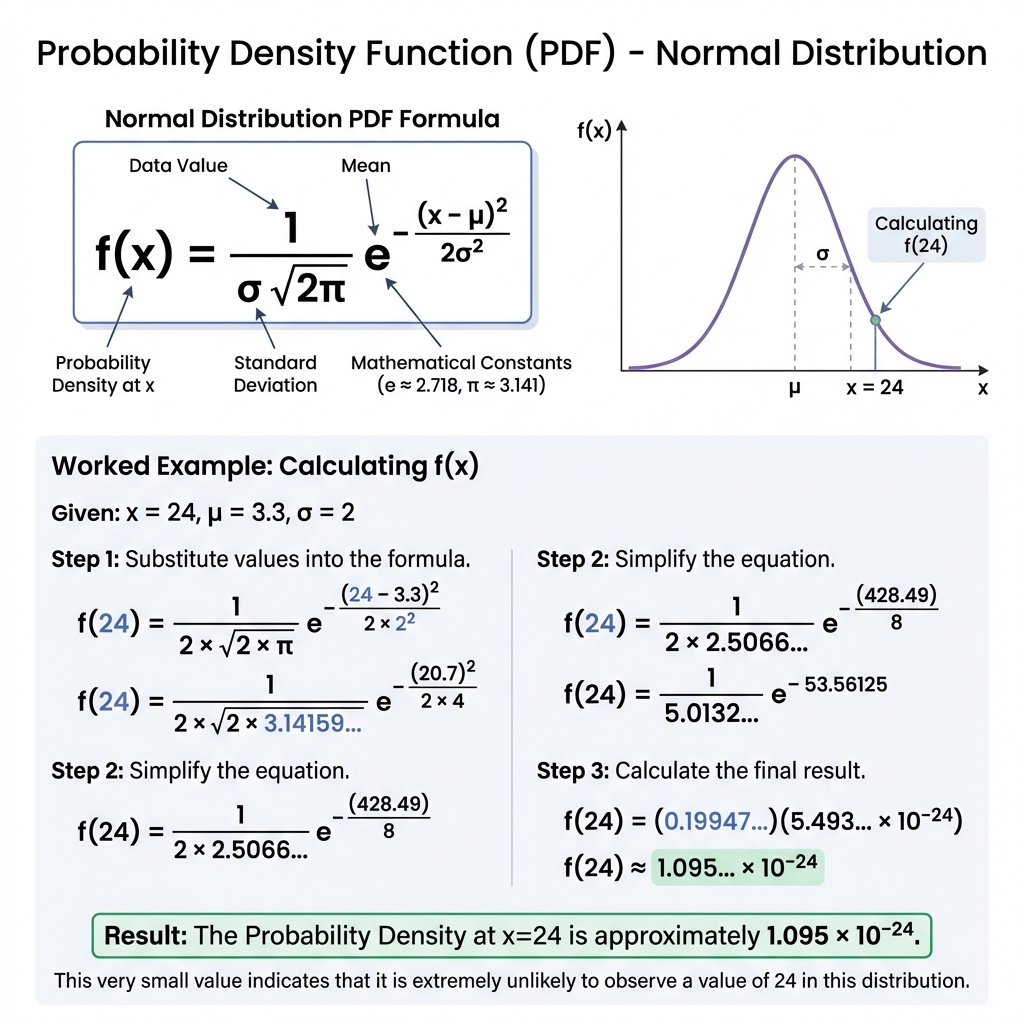
Example # 01:
How to find probability density function for the normal distribution with given parameters as follows:
x = 24
μ = 3.3
σ = 2
Solution:
Here we have the probability density function (PDF) of the normal distribution:
$$ f(x) = \frac{1}{\sqrt{2\pi\sigma^{2}}} e^{-\frac{(x-\mu)^{2}}{2\sigma^{2}}} $$
Now substituting the values: \( x = 24 \), \( \mu = 3.3 \), \( \sigma = 2 \)
$$ f(x) = \frac{1}{\sqrt{2\pi(2)^2}} e^{-\frac{(24-3.3)^2}{2(2)^2}} $$ $$ = \frac{1}{\sqrt{8\pi}} e^{-\frac{(20.7)^2}{8}} $$ $$ = \frac{1}{\sqrt{25.133}} e^{-53.56125} $$ $$ = \frac{1}{5.013} \times e^{-53.56125} $$ $$ \approx 0.1995 \times 5.4783 \times 10^{-24} $$ $$ \approx 1.09 \times 10^{-24} $$
How Probability Density Function Calculator Works?
Speed up your pdf calculations by using this free joint pdf calculator. Anxious to know how it could be done? Let’s tell you!
Input:
- From the first drop-down list, select the statistical test type for which you wish to determine the probability density function
- After you do that, enter the required parameters in their designated fields
- At last, tap the calculate button
Output: The free probability distribution function calculator determines:
- Pdf value for the chosen test type
FAQ’s:
What is the basic difference between PDF and CDF?
| Cumulative Distribution Function | Probability Distribution Function |
| It corresponds to the probability being either less or equal to the random variable x | It corresponds to the probability of an event exactly equal to the random variable x |
What is k in probability?
k is referred to as the binomial coefficient and itr represents the possible ways to choose k successes from n observations. For the rest of the details, you can go through our best binomial distribution function calculator.
What is the difference between probability and probability density?
A probability represents the area that lies under a probability density curve and could easily be determined by using our free probability calculator. While on the other hand, the probability density displays the number of the chances that could lie in a given range.
What is Normdist function in Excel?
In excel, Normdist is an inbuilt statistical function that helps you in calculating the normal distribution of a data set for which mean and standard deviation are given. Moreover, this free probability density function calculator also determines the probabilities lying under this normal data distribution curve.
What does 1.96 mean in statistics?
In statistical analysis, 1.96 represents the approximate value of the 97.5th percentile point for standard normal distribution. To better check the percentile, you can tap the percentile calculator that is specifically designed for the said purpose.
Conclusion:
Probability distribution is a statistical measure used to gauge the likely outcome of a discrete value. It allows you to analyse the exact position of the mean value and the standard deviation within a data set. This is why this free probability density function calculator is the method of determining the dispersion chances for a data values set.
References:
From the source of Wikipedia: Probability density function, Example, Absolutely continuous univariate distributions, Formal definition, Further details, Link between discrete and continuous distributions, Famili of densities, Densities associated with multiple variables, Sums of independent random variables, Products and quotients of independent random variables Form the source of Khan Academy: Probability density functions From the source of Lumen Learning: Continuous Probability Functions, Concept Review, Formula Review
Related Tools