


Reynolds Number Calculator
Enter the Fluid Density, Viscosity, and Linear Dimension in the Reynolds Number Calculator to find the Reynolds Number of a liquid.
The Reynolds Number:
The Reynolds Number is the dimensionless value and the ratio between the inertia and viscosity of the liquid. It describes the degree of the laminar and turbulent flow rate. The Reynolds Number remains constant and has the same characteristics if the liquid speed and length vary.
The Reynolds Number Formula:
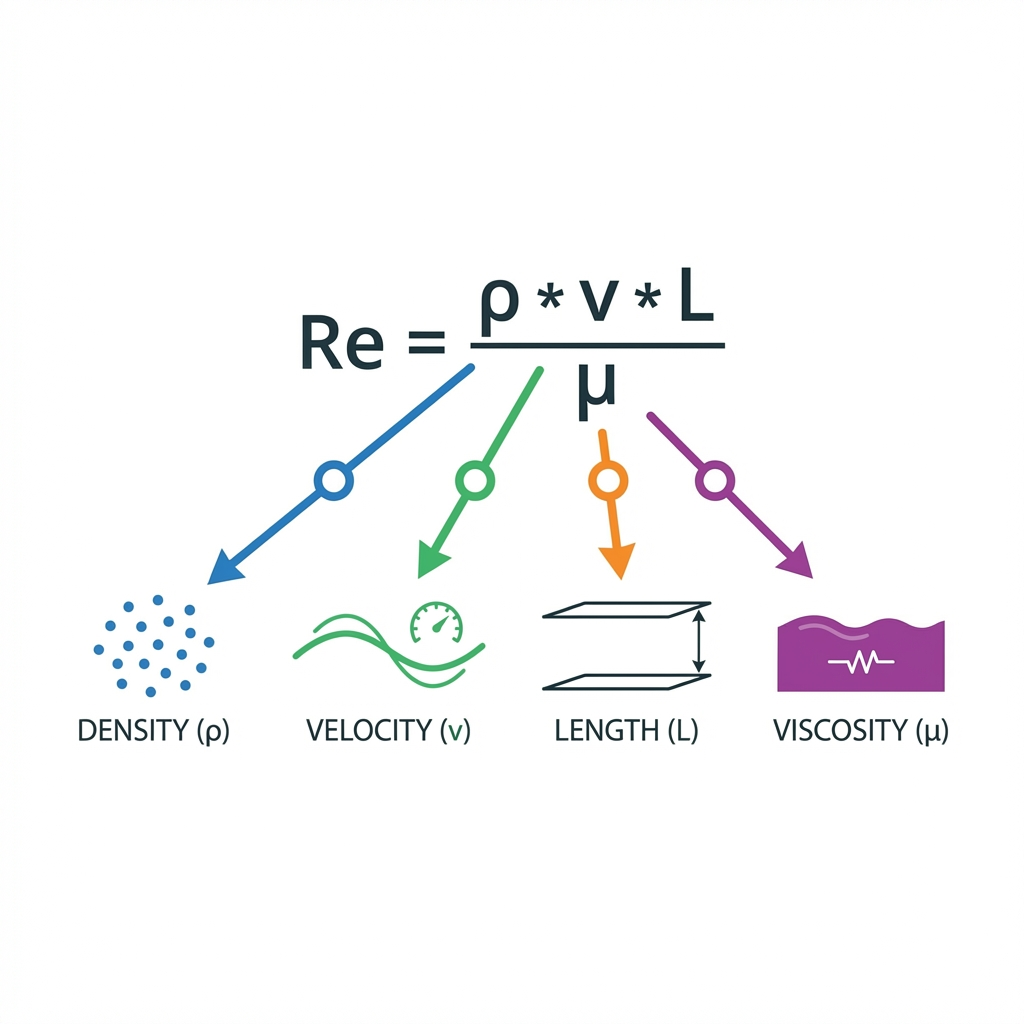
The Reynolds number calculation is the same for all the liquids, you need to enter the specific parameter for each liquid. You can calculate Reynolds number by the following formula:
Re = \(\frac{\rho \, u \, L}{\mu}\)
Now, the kinematic viscosity of a liquid \(\nu = \frac{\mu}{\rho}\), so:
Re = \(\frac{u \, L}{\nu}\)
Where:
- Re is the Reynolds Number
- \(\rho\) is the density of liquid (Check the density of air at a given temperature by air density calculator)
- u is the velocity of the object relative to the fluid
- L is the characteristic linear dimension of the object/liquid
- \(\mu\) is the dynamic viscosity of the fluid
- \(\nu\) is the kinematic viscosity of the fluid (\(\nu = \mu / \rho\))
How to Calculate Reynolds Number Online?
When calculating Reynolds Number by using the online Reynolds Number Calculator, there can be two possibilities. Once you enter a new substance, you need to enter all the parameters like density, viscosity etc. Second, if you are selecting the substances like air, water, ethanol etc. You would see a specific viscosity and density at a given temperature.
- For example, the Reynolds number of water at 10 degrees centigrade is 764297, if you are taking fluid velocity and characteristic dimension as unity. All the remaining values are pre-measured.
- The water Reynolds number at 50 degrees centigrade is 1805886, keeping the same values as above.
The Viscosity and Reynolds Number:
The Reynolds number formula depends upon two different types of viscosity. You need to distinguish types the two types of viscosity.
Dynamic Viscosity (\(\mu\)):
Dynamic viscosity (\(\mu\)) measures the internal friction in a fluid. Its units are Pa·s, N/(m²·s), or kg/(m·s).
Kinematic Viscosity (\(\nu\)):
Kinematic viscosity (\(\nu\)) is obtained by dividing the dynamic viscosity (\(\mu\)) by the fluid density (\(\rho\)):
\(\nu = \frac{\mu}{\rho}\)
It represents the dynamic viscosity per unit density and is expressed in m²/s.
Reynolds Number Example:
Find the Reynolds number for water flowing through a pipe with L = 2.5 cm. The velocity of water is u = 1.7 m/s and the temperature is 10°C.
Given:
- Water flow dimension: L = 2.5 cm = 0.025 m
- Velocity: u = 1.7 m/s
- Temperature: T = 10 °C
Solution:
- Density of water at 10 °C: \(\rho = 999.7 \, \text{kg/m³}\)
- Dynamic viscosity: \(\mu = 0.001308 \, \text{kg/(m·s)}\)
- Kinematic viscosity: \(\nu = \frac{\mu}{\rho} = 1.308 \times 10^{-6} \, \text{m²/s}\)
The Reynolds number formula is:
Re = \(\frac{\rho \, u \, L}{\mu}\)
or equivalently using kinematic viscosity:
Re = \(\frac{u \, L}{\nu}\)
Substitute the values:
Re = \(\frac{1.7 \cdot 0.025}{1.308 \times 10^{-6}} \approx 32483\)
Hence, the Reynolds number for the water flow is approximately Re = 32,483.
How Does the Reynolds Number Calculator Work?
This calculator can be operated easily you need to follow the steps given below:
Input:
- Add the Fluid Velocity and Linear Dimensions
- Enter the fluid parameters for liquid(Common substances have fixed parameters)
- Hit the calculate Button
Output:
- The Kinematics Viscosity
- Reynolds Number of Liquid
References:
From the source of Wikipedia: Reynolds Number, Definition From the source of Vedantu.com: Reynolds NumberFormula, What is Reynolds Number?
Related Tools