


Water Viscosity Calculator
Enter the water temperature and the calculator will readily calculate the dynamic and kinematic viscosity along with density and graphical interpretation being displayed.
What is the Viscosity of Water?
In physics, the viscosity of water can be defined as the resistance of a water to flow. In other words, viscosity is a physical property of a fluid that refers to the thickness of a liquid like water. At the molecular level, it is the interaction between different molecules in the water. Generally, viscosity is measured in Newton Second per meter square or Pascal Second (Pa s). Remember that the water viscosity is always inversely proportional to the temperature. When the temperature increases, the viscosity of water decreases; conversely, if the temperature decreases, then the water viscosity increases. Mostly, the water viscosity is used as a benchmark for all liquids because all fluids have particular values of viscosity and density; for liquids, it is generally considered low or high.
Viscosity Formula:
The viscosity of a fluid (e.g., water) can be determined using the formula:
\(\eta = \frac{2 g a^2 (\Delta \rho)}{v}\)
Where:
- \(\eta\) = viscosity of the fluid (Pa·s)
- v = velocity of the sphere (m/s)
- g = acceleration due to gravity (m/s²)
- a = radius of the sphere (m)
- \(\Delta \rho\) = difference in density between the sphere and the fluid (kg/m³)
You can also use an online Density Calculator to determine the density of a substance, which is its mass per unit volume.
Example:
Find the viscosity of water at 20°C.
Solution:
Using the dynamic viscosity calculator, the properties of water at 20°C are:
- Dynamic viscosity: \( \eta = 1.0016 \ \text{mPa·s} \)
- Kinematic viscosity: \( \nu = 1.0034 \ \text{mm²/s} \)
- Density: \( \rho = 0.9982 \ \text{g/cm³} \)
These values can be directly used in fluid dynamics calculations for water at 20°C.
The viscosity of Water at Different Temperature:
| Temperature [°C] |
Viscosity [mPa·s] |
| 10 | 1.308 |
| 20 | 1.002 |
| 30 | 0.7978 |
| 40 | 0.6531 |
| 50 | 0.5471 |
| 60 | 0.4658 |
| 70 | 0.4044 |
| 80 | 0.3550 |
| 90 | 0.3150 |
| 100 | 0.2822 |
Kinematic and Dynamic Viscosity of Water in SI Units:
| Temperature - t - (°C) | Dynamic Viscosity - µ - (N s/m2) x 10-3 | Kinematic Viscosity -ν - (m2/s) x 10-6 |
| 0 | 1.787 | 1.787 |
| 5 | 1.519 | 1.519 |
| 10 | 1.307 | 1.307 |
| 20 | 1.002 | 1.004 |
| 30 | 0.798 | 0.801 |
| 40 | 0.653 | 0.658 |
| 50 | 0.547 | 0.553 |
| 60 | 0.467 | 0.475 |
| 70 | 0.404 | 0.413 |
| 80 | 0.355 | 0.365 |
| 90 | 0.315 | 0.326 |
| 100 | 0.282 | 0.294 |
Why should I Measure the Viscosity?
Calculating the viscosity data of the given materials will helps the manufacturers to predict how the elements behave in the real world. For example, if the toothpastes do not have the true value of viscosity, then it will be too difficult to pump out the toothpaste from the tube. If you know the exact value of viscosity of any material, then you design the transportation and product process precisely.
However, an online Specific Heat Calculator helps to find the heat energy, specific heat, mass of substance, initial, and final temperature of any element.
Types of Viscosity:
The viscosity is the friction between the molecules of fluid in motion. There are two different techniques to measure the liquid viscosity as follow:
- Kinematic Viscosity
- Dynamic Viscosity
Kinematic Viscosity:
The kinematic viscosity of fluids is the value of internal resistance of liquids during the flow under the force of gravitation. An online kinematic viscosity calculator measured it by determining the time in seconds that is required for the fixed volume of liquids to flow a known distance by the gravity through the capillaries within the viscometer at a particular temperature.
Dynamic Viscosity:
The dynamic viscosity is the tangential force per unit area needed to move the liquids in the horizontal plane with the unit viscosity. Dynamic viscosity is also known as the absolute viscosity of liquids.
Different techniques and Tools to Measure Viscosity:
First viscosity measurements were made in 1800s using the capillary tube methods. Here are some different instruments and techniques that are used to measure the viscosity.
- Capillary Viscometer
- Zahn Cup
- Falling Sphere Viscometer
- Vibrational Viscometer
- Rotational Viscometer
What is the Weight and Density of Water at Known Temperature?
| Temperature | Density | Weight | |
| °F | grams/cm3 | pounds/ft3 | kilograms/liter |
| 32° | 0.99987 | 62.416 | 0.999808 |
| 39.2° | 1.00000 | 62.424 | 0.999937 |
| 40° | 0.99999 | 62.423 | 0.999921 |
| 50° | 0.99975 | 62.408 | 0.999681 |
| 60° | 0.99907 | 62.366 | 0.999007 |
| 70° | 0.99802 | 62.300 | 0.997950 |
| 80° | 0.99669 | 62.217 | 0.996621 |
| 90° | 0.99510 | 62.118 | 0.995035 |
| 100° | 0.99318 | 61.998 | 0.993112 |
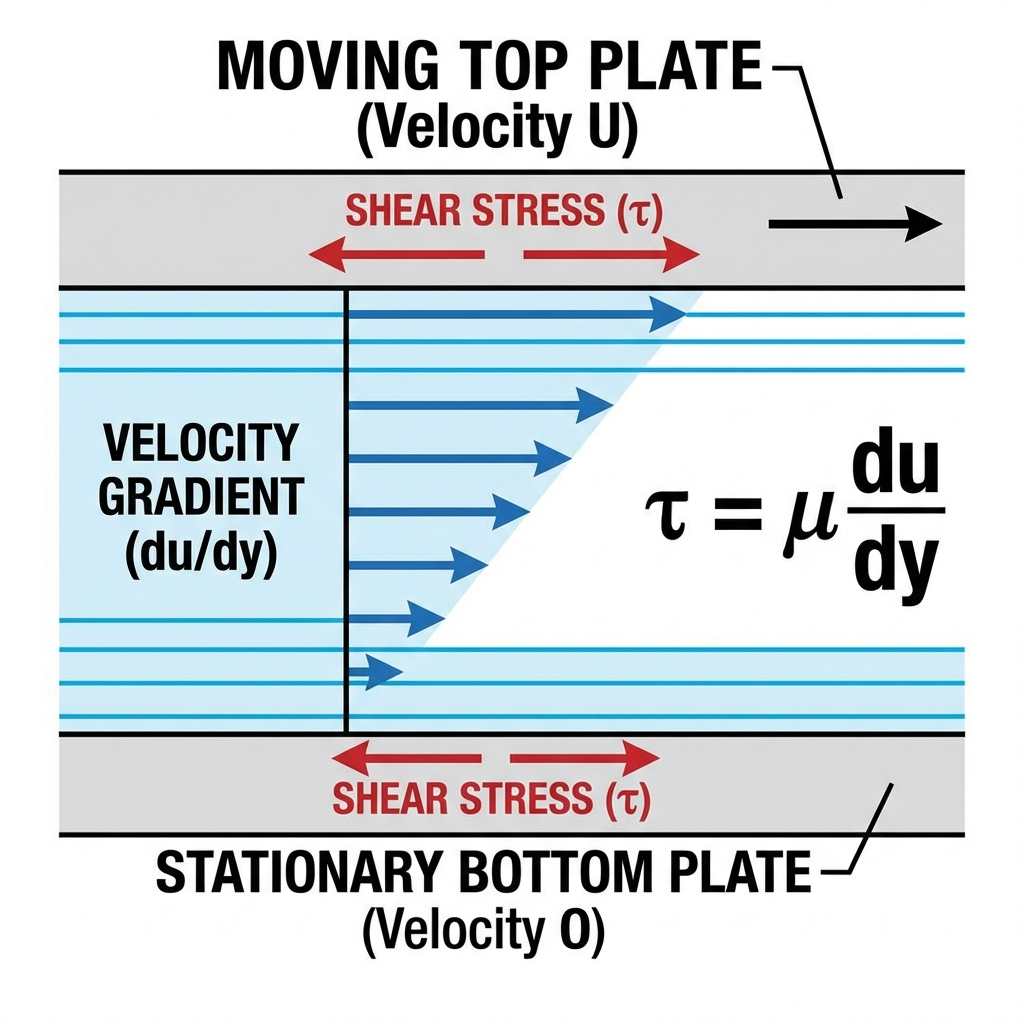
Newton’s Law of Viscosity:
According to Newton’s law of viscosity, the shear stress between adjacent layers of a liquid is directly proportional to the velocity gradient between the two layers of fluid.
Mathematical Expression:
\( \tau = \eta \frac{du}{dy} \)
Where:
- \( \eta \) = Dynamic viscosity of the fluid
- \( \tau \) = Shear stress between layers
- \( \frac{du}{dy} \) = Rate of shear deformation (velocity gradient)
Newtonian Fluid:
A Newtonian fluid is a liquid whose viscosity remains constant regardless of the applied shear rate. In other words, it obeys Newton’s law of viscosity. Examples include water, air, and most common oils.
Non-Newtonian Fluid:
A Non-Newtonian fluid is a liquid whose viscosity changes with the applied shear rate. These fluids do not follow Newton’s law of viscosity. Examples include ketchup, toothpaste, and cornstarch in water.
How to Use Water Viscosity Calculator?
An online viscosity calculator will compute the thickness of water at any temperature, even those above the 300 Celsius by following steps:
Input:
- First, enter the temperature of water.
- Now, select the temperature unit for determining the viscosity.
- Hit the “Calculate Viscosity” button.
Output:
- The calculator provides the density, dynamic, and kinematic viscosity of water at given temperature with water viscosity and temperature chart.
FAQs:
Is viscosity directly proportional to density?
There is no direct relationship between density and viscosity. However, both density and viscosity are affected by the temperature of liquid.
What is the thinnest fluid in the world?
The graphene is the thinnest fluid that conducts the electricity well and interact with the water in unique ways.
Is viscosity dependent on pressure?
Viscosity is pressure independent, but liquids under the extreme pressure often experience an increase in the viscosity of liquids.
Is water basic or acidic?
Water is neither basic nor acidic in the nature. It has 7 PH, that makes it a neutral substance.
What is viscosity of water at 25 Celsius?
The water viscosity at the 25 degrees Celsius is roughly equal to \( 10^-3 \) Pascal Second or 0.01 Poise.
What is the kinematic viscosity of water at 22c?
The kinematic viscosity of water (ν) at 22 degrees Celsius is 0.9565 Milimeter square per second (mm^2 / s).
What are the three states of the water?
- At the temperature of 100 degrees Celsius, the water reaches at its boiling point and converted into the gaseous state of water.
- The water freezes at the temperature of zero degrees Celsius, which is the solid-state of water.
- The water is in the liquid state at the temperature between 0 to 100 degrees Celsius.
Why water is a universal solvent?
Water is the universal solvent because it has the ability to dissolve most elements, including sugar, salt, gases, bases, and acids.
Conclusion:
Use this water viscosity calculator for determining the viscosities and densities of water at a given temperature. You can also use the water viscosity vs temperature chart or table for finding the effects of temperature on the water viscosity.
Reference:
From the source of Wikipedia: Viscosity, Kinematic viscosity, Momentum transport, Newtonian and non-Newtonian fluids, Molecular origins, Chapman–Enskog theory.
From the source of Physics Info: Factors affecting viscosity, motor oil, low-temperature specifications, high temperature specifications, capillary viscometer, falling sphere.
From the source of Science Direct: Dynamic Viscosity, Oil Characteristics, Kinematic viscosity, viscous force, inertial force, Dynamic viscosity for liquid fuels, kinematic viscosity for gas turbine liquid fuels.
Related Tools