


Enthalpy Calculator
Enter the values to calculate the enthalpy change using the formula or chemical reaction scheme.
Enthalpy Calculator
This enthalpy calculator calculates the enthalpy change (ΔH) involved in a process along with the initial and final enthalpy values using Hess's Law or standard enthalpies of formation. It provides valuable insights into chemical reactions to help you analyze energy variations and understand the thermodynamics of the system.
What Is Enthalpy?
Enthalpy measures the total energy released or absorbed in a thermodynamic system. It is the sum of the total internal energy and the product of pressure and volume.
Whenever a system changes its state from solid to liquid or liquid to gas, it requires sufficient energy intake. It is called the latent heat of fusion or vaporization, respectively. The latent heat of fusion and vaporization are specific examples of enthalpy changes associated with phase transitions.
$$ H = U + PV $$
Where:
- \(H\) = Enthalpy
- \(U\) = Internal energy
- \(P\) = Pressure
- \(V\) = Volume
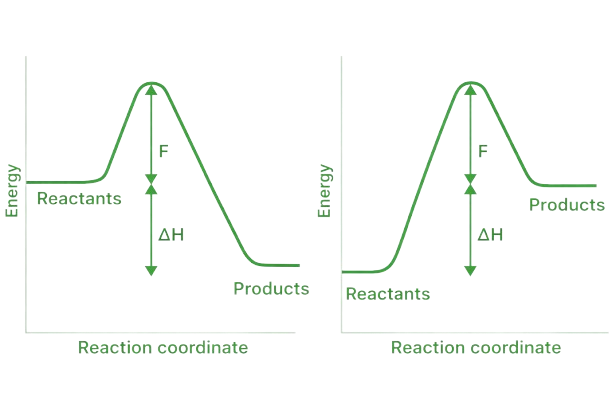
According to System International (SI), the enthalpy is expressed in joules (J) or kilojoules (kJ). As it's not possible to directly calculate the total enthalpy of a chemical reaction, the change in enthalpy is calculated. This change indicates the amount of heat absorbed or released during the reaction. There are two types of reactions:
- Exothermic: In these reactions, the heat is released to the surroundings and the value of enthalpy change (ΔH) is negative
- Endothermic: These reactions absorb heat and the enthalpy change (ΔH) is positive
Enthalpy Change Equation:
$$ \Delta H = \Delta Q + P \times \Delta V $$
Where:
- \(\Delta H\) = Change in enthalpy of the system
- \(\Delta Q\) = Change in internal energy of the system
- \(P\) = Pressure exerted on the system by surroundings
- \(\Delta V\) = Change in volume of the system
For a General Reaction:
$$ a_nA + b_nB + c_nC \rightarrow d_nD + e_nE + f_nF $$
The formula for standard enthalpy change of reaction is:
$$ \Delta H^\circ_{\text{reaction}} = \sum \Delta H_f^\circ(\text{products}) - \sum \Delta H_f^\circ(\text{reactants}) $$
Where:
- \(A, B, C\) = Reactants
- \(D, E, F\) = Products
- \(a_n, b_n, c_n\) = Stoichiometric coefficients of reactants
- \(d_n, e_n, f_n\) = Stoichiometric coefficients of products
- \(\sum \Delta H_f^\circ(\text{products})\) = Sum of enthalpies of formation of products
- \(\sum \Delta H_f^\circ(\text{reactants})\) = Sum of enthalpies of formation of reactants
Example (Enthalpy Change):
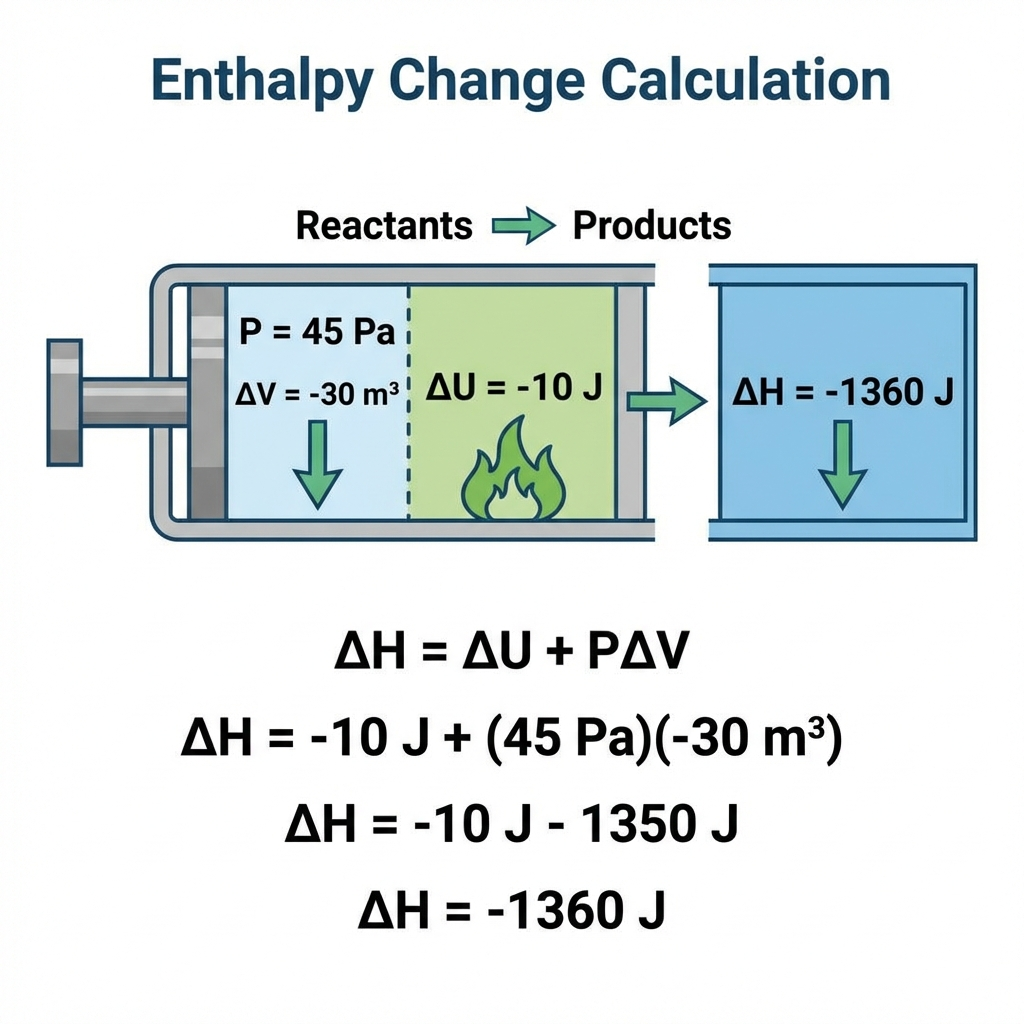
Suppose a chemical reaction occurs at a constant pressure of \(45 \text{ Pa}\). The reactants have an internal energy of \(55 \text{ J}\) and a volume of \(65 \text{ m}^3\). The products have an internal energy of \(45 \text{ J}\) and occupy a volume of \(35 \text{ m}^3\). Calculate the initial enthalpy, final enthalpy, and enthalpy change.
Solution:
Given:
- Internal energy of reactants, \(U_r = 55 \text{ J}\)
- Internal energy of products, \(U_p = 45 \text{ J}\)
- Volume of reactants, \(V_r = 65 \text{ m}^3\)
- Volume of products, \(V_p = 35 \text{ m}^3\)
- Constant pressure, \(P = 45 \text{ Pa}\)
Step 1: Calculate change in internal energy
$$ \Delta U = U_p - U_r $$
$$ \Delta U = 45 - 55 = -10 \text{ J} $$
Step 2: Calculate change in volume
$$ \Delta V = V_p - V_r $$
$$ \Delta V = 35 - 65 = -30 \text{ m}^3 $$
Step 3: Calculate \(P\Delta V\)
$$ P\Delta V = 45 \times (-30) = -1350 \text{ J} $$
Step 4: Calculate enthalpy change
$$ \Delta H = \Delta U + P\Delta V $$
$$ \Delta H = -10 + (-1350) = -1360 \text{ J} $$
Enthalpy change: \( \Delta H = -1360 \text{ J} \)
Step 5: Calculate initial enthalpy
$$ H_{\text{initial}} = U_r + PV_r $$
$$ PV_r = 45 \times 65 = 2925 \text{ J} $$
$$ H_{\text{initial}} = 55 + 2925 = 2980 \text{ J} $$
Step 6: Calculate final enthalpy
$$ H_{\text{final}} = U_p + PV_p $$
$$ PV_p = 45 \times 35 = 1575 \text{ J} $$
$$ H_{\text{final}} = 45 + 1575 = 1620 \text{ J} $$
Conclusion: The negative value of \( \Delta H \) indicates that the reaction is exothermic. Using an online enthalpy calculator can make these calculations faster by providing instant step-by-step results.
The Enthalpy Table:
|
Sr No. |
Name of Substance |
Symbolic Formula |
Standard Enthalpy of Formation ‘ΔH’ |
|
1. |
Potassium Chloride |
KCl(s) |
-435.9 |
|
2. |
Potassium Chlorate |
KClO3(s) |
-391.4 |
|
3. |
Sodium Chloride |
NaCl(s) |
-411.0 |
|
4. |
Sodium Hydroxide |
NaOH(s) |
-426.7 |
|
5. |
Zinc Sulphide |
ZnS(s) |
-202.9 |
|
6. |
Zinc Oxide |
ZnO(s) |
-348.0 |
|
7. |
Copper Sulphate |
CuSO4(s) |
-769.9 |
|
8. |
Copper Oxide |
CuO(s) |
-155.2 |
|
9. |
Calcium Dioxide |
Ca(OH)2(s) |
-986.6 |
|
10. |
Water |
H2O(l) |
-285.8 |
|
11. |
Chloroform |
CHCl3(l) |
-131.8 |
|
12. |
Carbon Dioxide |
CO2(g) |
-393.5 |
|
13. |
Hydrogen Sulphide |
H2S(g) |
-20.1 |
|
14. |
Ammonia |
NH3(g) |
-46.2 |
|
15. |
Sulphur Trioxide |
So3(g) |
-395.2 |
|
16. |
Hydrochloric Acid |
HCl(g) |
-92.3 |
|
17. |
Nitrogen Oxide |
NO(g) |
+90.4 |
|
18. |
Nitrogen Dioxide |
NO2(g) |
+33.9 |
|
19. |
Phosphorus Pentachloride |
PCl5(g) |
-398.9 |
|
20. |
Phosphorus Trichloride |
PCl3(g) |
-306.4 |
|
21. |
Sulphur Dioxide |
SO2(g) |
-296.1 |
FAQ’s:
What Are The Three Ways For Calculating Enthalpy Change?
- Hess’s Law
- Standard Enthalpies of Formation (ΔHf°)
- Bond Enthalpies
What Is The Hess Law of Enthalpy?
The Hess law states, "No matter whether the reaction happens in one step or multiple steps, the energy released or absorbed during the chemical reaction is the same”.
Why is Calculating Enthalpy Important?
Determining the enthalpy is important for various reasons including:
- Understanding energy changes
- Predicting whether a reaction is endothermic or exothermic
- Optimize the usage of energy
- Designing and optimizing the industrial processes
- Assessing the environmental impact of various processes
Is Enthalpy Higher In Solid or Liquid?
Liquids have higher enthalpy as compared to the solids because of:
- Increased particle movement
- Weaker intermolecular forces
Can I Calculate Enthalpy For A Mixture of Substances?
Yes, it can be calculated but it's complex because the interaction of substances with different components can affect the enthalpy
References:
From the source of Wikipedia: Enthalpy.
Related Tools