


Vapor Pressure Calculator
Find the vapor pressure of liquids and mixtures by entering the required inputs in the following calculator.
Use the vapor pressure calculator to determine the precise vapor pressure of a substance or a mixture for your chemistry experiments.
What Is Meant By Vapor Pressure?
This is the pressure exerted by the molecules of a substance that is placed inside a closed system. It occurs when the vaporization and condensation are happening at the same time.
Vapor Pressure is an essential property that is widely used in the field of chemistry because it allows predicting the behavior of substances under various types of conditions.
The three main factors that affect vapor pressure are:
- Temperature
- Surface area
- Intermolecular Force
Vapor Pressure Formula:
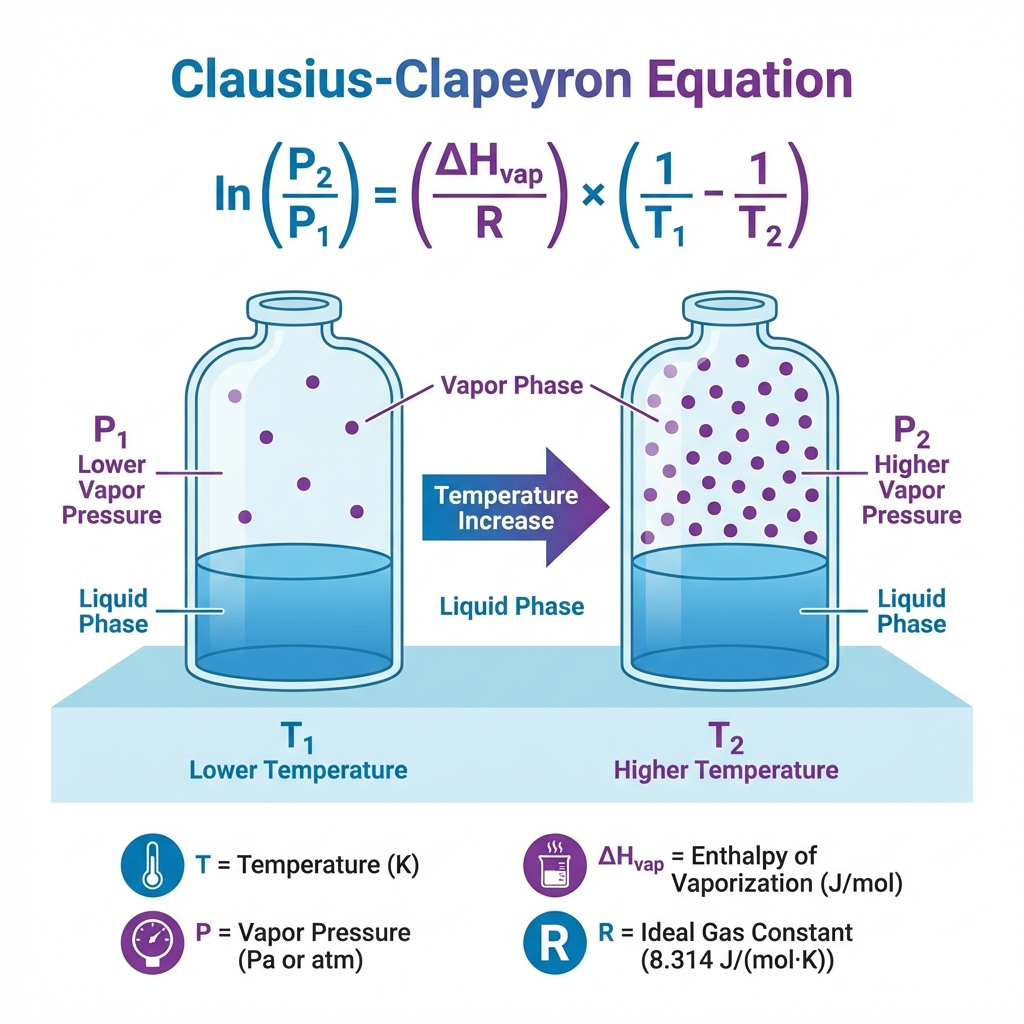
Use the below-mentioned Clausius-Clapeyron equation to find the vapor pressure at a specific temperature:
ln(P1/P2) = (ΔHvap/R)((1/T2) - (1/T1))
Where
- T1 is the Initial temperature measured in Kelvin
- T2 represents the final temperature
- P1 is the Initial pressure
- P2 is the final pressure
- ΔH is the Molar enthalpy of vaporization
- R is the Gas constant which is equal to 8.3145 J/mol⋅K
You can also use Raoult's Law to find the vapor pressure:
P_solution = P_solvent X_solvent
Where
- P_solution is the vapor pressure of a solution
- P_Solvent represents the solvent vapor pressure
- X_solvent is the mole fraction of the solvent
How To Calculate Vapor Pressure?
Clausius Clapeyron Equation:
Follow the below-mentioned steps to calculate the vapor pressure:
- First of all, determine the value of the temperature at which you want to find the pressure
- Get the value of the initial pressure
- Determine the value of heat of vaporization (∆H_vap) of the specific substance
- Now convert the temperature to kelvin by adding 273.15 to the value of temperature, if your temperature is in Celsius
- Add these values to the above-mentioned vapor pressure formula and you will get the value of vapor pressure
Raoult's Law:
- Determine the mole fractions of the components that are available in a mixture
- Find the vapor pressure (P) of the component
- If the mixture has multiple components then find the vapor pressure of each component
- Sum the vapor pressures of all components to get the total vapor pressure
Vapor Pressure Example:
Suppose you have a solution that has a solute mole fraction of 0.6. The vapor pressure of water is 16.358 mmHg at 23 °C. How to find vapor pressure of the solution.
Solution:
X_solvent = 1.0000 − 0.6 = 0.4
Put the values in the vapor pressure equation of Raoult’s Law:
P_solution = (X_solvent) (P_solvent)
x = (0.4) (16.358)
x = 6.5432 mmHg
Common Substances:
In the following table we have mentioned various compounds, their boiling point, normal temperature and heat of vaporization.
| Compound | Boiling point, at normal pressure | Heat of vaporization | |||
| (K) | (°C) | (°F) | (kJ/mol) | (J/g) | |
| Acetone | 329 | 56 | 133 | 31.300 | 538.9 |
| Aluminium | 2792 | 2519 | 4566 | 294.0 | 10500 |
| Ammonia | 240 | −33.34 | −28 | 23.35 | 1371 |
| Butane | 272–274 | −1 | 30–34 | 21.0 | 320 |
| Diethyl ether | 307.8 | 34.6 | 94.3 | 26.17 | 353.1 |
| Ethanol | 352 | 78.37 | 173 | 38.6 | 841 |
| Hydrogen (parahydrogen) | 20.271 | −252.879 | −423.182 | 0.8992 | 446.1 |
| Iron | 3134 | 2862 | 5182 | 340 | 6090 |
| Isopropyl alcohol | 356 | 82.6 | 181 | 44 | 732.2 |
| Methane | 112 | −161 | −259 | 8.170 | 480.6 |
| Methanol | 338 | 64.7 | 148 | 35.2 | 1104 |
| Propane | 231 | −42 | −44 | 15.7 | 356 |
| Phosphine | 185 | −87.7 | −126 | 14.6 | 429.4 |
| Water | 373.15 | 100 | 212 | 40.66 | 2257 |
Related Tools