


Bond Order Calculator
Enter the bonding and antibonding electrons in the tool and the calculator will find out the bonding order.
What is Bond Order in Chemistry?
“The bond order is the number of bonded electron pairs between two atoms”
The bond order is the main reason for the stability of a molecule or ion. The higher the bond order, the stronger the bond energy would be. For diatomic molecules like hydrogen and oxygen, the more significant bond order means the shorter bond length. The bond order calculator calculates the binding force between the atoms and explains how stable the molecules are, as the higher-order binding force means higher bonding order.
How to Calculate Bond Order?
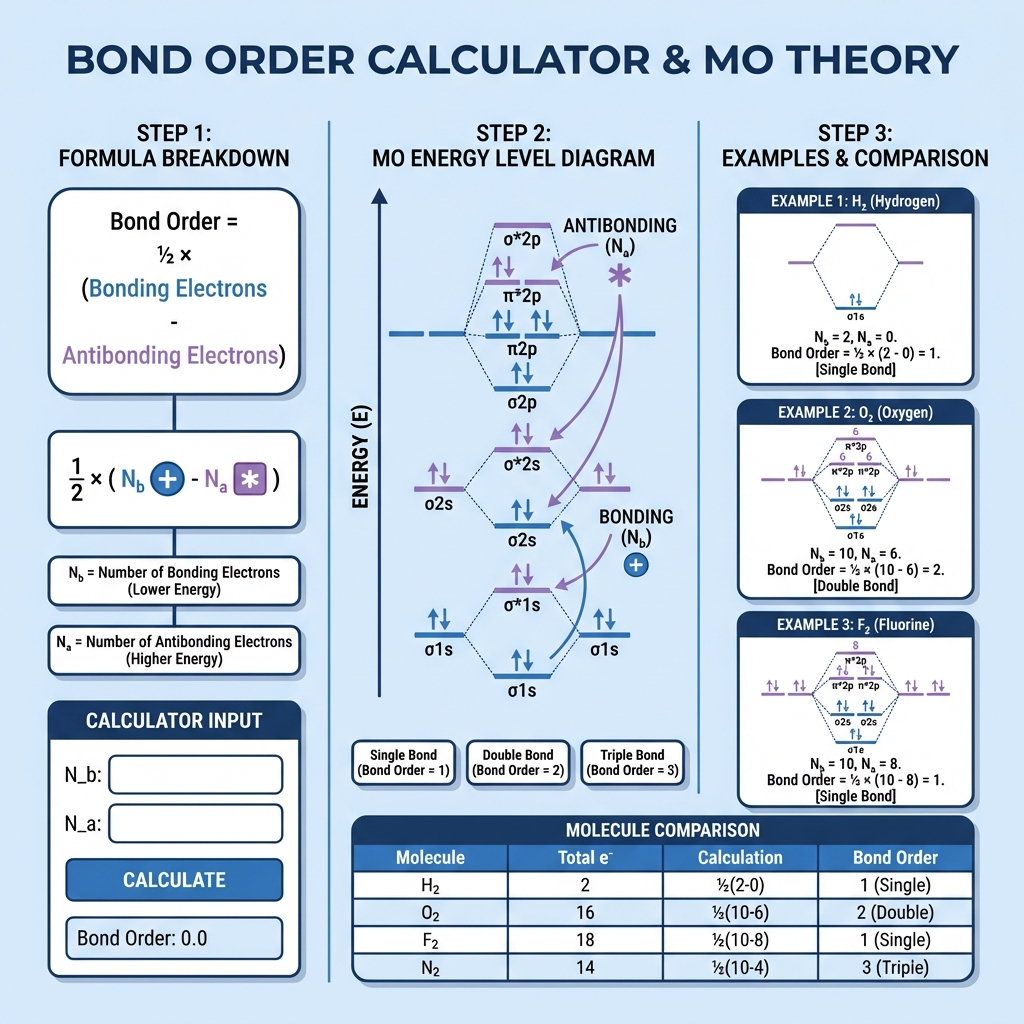
The Bonding order can be derived by the difference in the number of electrons in the bonding orbitals and antibonding orbitals and by dividing the answer by 2.
The bond order formula is given below:
Bond Order = (Number of bonding electrons - Number of antibonding electrons) / 2
Practical Example:
Let's suppose the bonding electrons in a molecule are “10” and antibonding electrons are 6. Then what is the bond order of the molecule?
Given:
Bonding Electrons (Be) = 10
Antibonding Electrons (Ae) = 6
Solution
The bond order equation can be written as:
Bond order formula= 1/2 * (Be - Ae)
Bo = 0.5 * (10 - 6)
Bo = 2
Working of Bond Order Calculator:
The simple procedure of the bond order calculator is straightforward and given below. Let’s see how?
Input:
- Enter the bonding and antibonding electron
- Tap the Calculate
Output:
- Bond order
- Step-by-step calculation
Bonding Order of Various Elements:
| Species (molecule or ion) | Total number of bonding electrons | Total number of anti-bonding electrons | Bond order |
| Hydrogen (H2) | 2 | 0 | 1 |
| Oxygen (O2) | 10 | 6 | 2 |
| Fluorine (F2) | 10 | 8 | 1 |
| Dicarbon (C2) | 8 | 4 | 2 |
| Diboron (B2) | 6 | 4 | 1 |
| Dilithium (Li2) | 2 | 0 | 1 |
| Diberyllium (Be2) | 4 | 4 | 0 |
| Cyanide (CN–) | 10 | 4 | 3 |
FAQs:
What is the Bond Order of CH4?
The bond order of methane (CH4) is 1 for each C–H bond. Carbon has 4 valence electrons, each forming a single covalent bond with a hydrogen atom, resulting in a total of 4 bonds.
References:
From the source wikihow.com: Bond order, how to determine bond order?
From the source chemistry.stackexchange.com: Water bond
Related Tools