


Entropy Calculator
Calculate the entropy change, and find whether a reaction is spontaneous or not through the following calculator by adding the required inputs.
The entropy calculator helps to estimate the entropy change of a chemical reaction in seconds. You can also determine the Gibbs free energy and isothermal entropy change of an ideal gas.
What Is Entropy In Chemistry?
“It is a measurable physical property that is most commonly associated with uncertainty”
In simple words, it’s the degree of disorder or uncertainty in a system. According to the second law of thermodynamics, the disorder of a system always increases. Entropy is the measure of this disorder.
Entropy is very helpful in determining the spontaneity of a reaction. A spontaneous reaction does not involve any outside energy to happen and on the other hand, a non-spontaneous requires some energy from the outside source.
By using the entropy change and the Gibbs free energy you can determine the spontaneity of the chemical reactions.
Entropy Formula:
The equation for entropy is outlined below:
ΔSreaction = ΔSproducts − ΔSreactants
Standard Entropy Values:
In the following table, we have mentioned some substances and their corresponding entropy values. Let’s take a look:
| Substance | S° (J/mol·K) |
| Hydrogen (H2) | 130.7 |
| Oxygen (O2) | 205.0 |
| Carbon (C, graphite) | 5.74 |
| Water (H2O, liquid) | 69.91 |
| Water (H2O, vapor) | 188.8 |
| Methane (CH4) | 186.3 |
| Ethanol (C2H5OH) | 160.7 |
| Sodium chloride (NaCl) | 72.1 |
| Nitrogen (N2) | 191.6 |
| Carbon dioxide (CO2) | 213.7 |
Gibbs Free Energy Formula:
ΔG = ΔH - (T * ΔS)
- IF ΔG < 0 then it's a spontaneous process
- When ΔG = 0 it means the system is in equilibrium
- IF ΔG > 0 it is a nonspontaneous process, you will have to provide additional energy for the happening of the process.
Where
- ΔG shows the change in Gibbs free energy
- ΔH represents a change in enthalpy
- T is the temperature
- ΔS is the representative of change in entropy.
Isothermal Entropy Change Formula:
For Volume:
ΔS = n * R * ln(V2/V1)
For Pressure:
ΔS = n * R * ln(P2/P1)
Where
- n shows the number of moles.
- R represents the gas constant, which is 8.3145 J/mol*K
- V2, V1 is the final and initial volume
- P2, P1 represent the final and initial pressure.
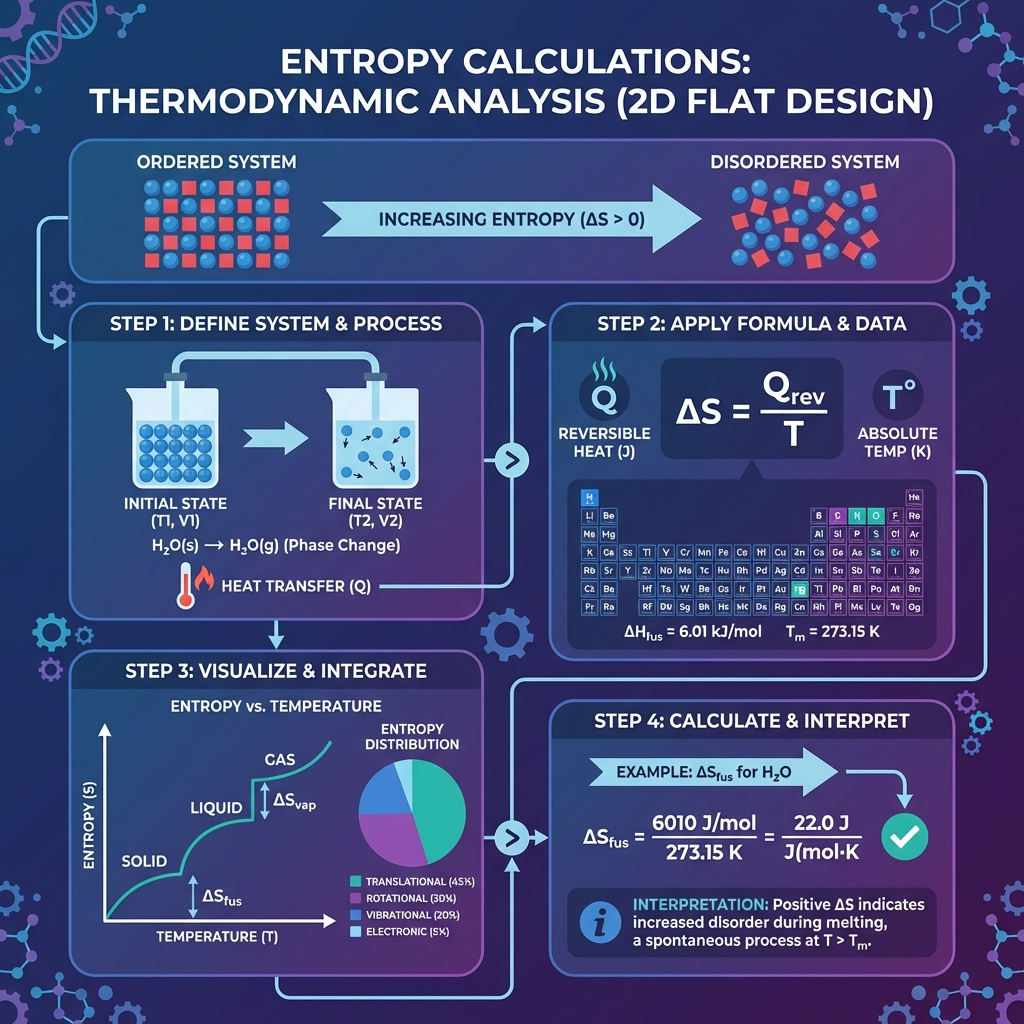
How To Calculate Entropy Change?
Follow the below outlined steps:
- Determine the initial and final states of the system. These states revolve around the temperature, volume, pressure, or other related parameters
- Put the values of initial and final states in the entropy change equation as we have done below
Entropy Change Example:
Calculate Entropy change for a reaction
where,
ΔSproducts = Total entropy of products = 20 J/mol*K
ΔSreactants = Total entropy of reactants = 30 J/mol*K
Solution:
ΔSreaction = ΔSproducts − ΔSreactants
ΔSreaction = 20 − 30
ΔSreaction = -10
Final Summary
Entropy is a key concept in thermodynamics that measures disorder in a system. With the help of an Entropy Calculator, you can quickly solve entropy change problems, understand reaction behavior, and apply formulas like Gibbs free energy and isothermal entropy change more efficiently.
Related Tools