


Newton's Law of Cooling Calculator
Use the given tool to determine the rate at which an object cools in a surrounding environment according to Newton’s Law of Cooling.
Newton's Law of Cooling Calculator helps you calculate how an object cools over time based on temperature change. It is useful for solving physics problems, thermodynamics, and heat transfer analysis.
What Is Normal Force?
The normal force is exerted on an object by a surface. For instance, you have a glass and you put it on a table, and the gravitational force pulls the glass downward. To stop the glass from going down the table exerts a force on it. This force that is exerted by the table is known as the normal force. It is denoted by \(F_N\) or N and the unit that is used for the normal force is Newton. This normal force follows the principle of Newton's Third Law of Motion.
How To Calculate Normal Force On Incline & Flat Surfaces?
Normal force acts perpendicular to the surface and it changes on whether the object is on an incline or a flat surface.
Normal Force Formula:
The formula used to calculate the normal force on an object placed on a horizontal surface is: \(F_N = m \cdot g\)
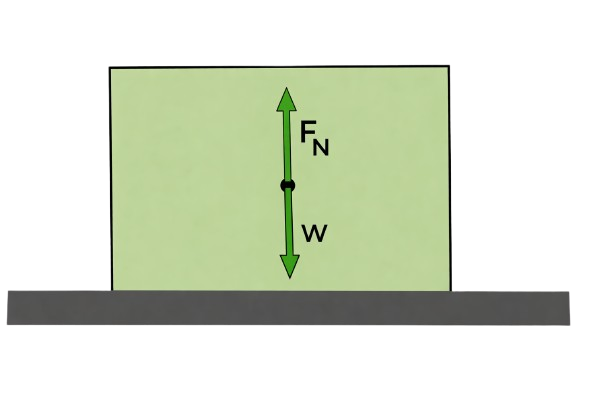
Where,
- m is representative of the mass of an object
- g is the gravitational acceleration
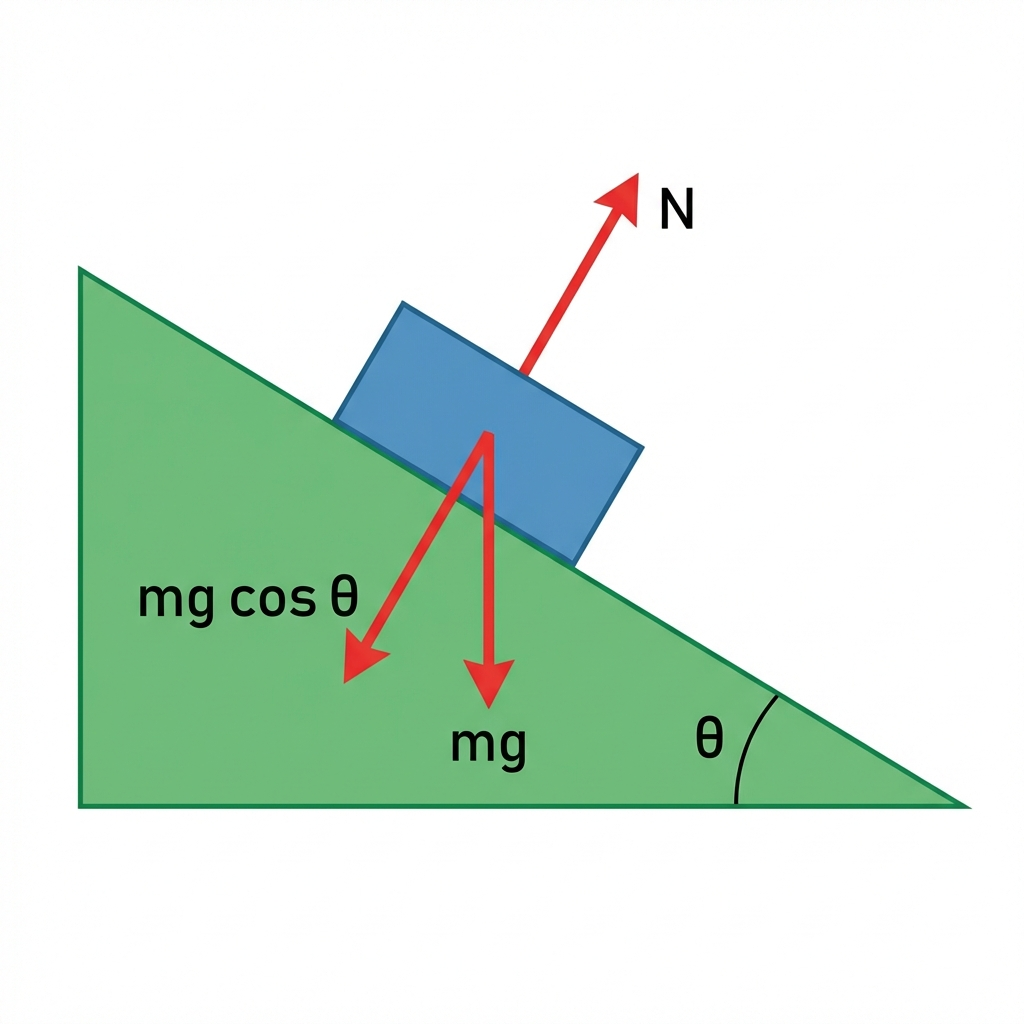
If the object is placed on an inclined surface, the normal force on the incline is: \(F_N = m \cdot g \cdot \cos\theta\)
Where,
- a is the surface inclination angle
When an object is placed on a horizontal surface and an external force acts on it in an upward direction, the normal force is calculated as: \(F_N = m \cdot g - F \cdot \sin\theta\)
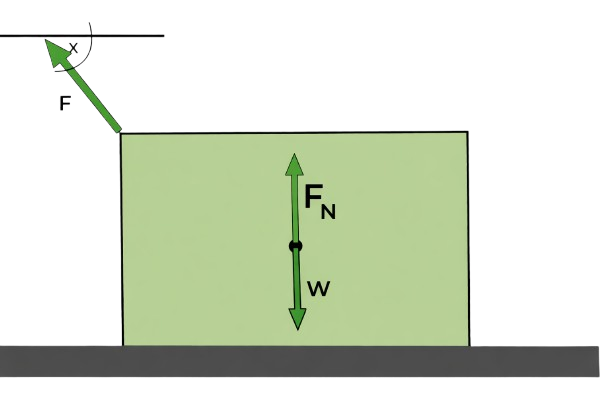
Where,
- F is the external force that acts on the object
- x is the angle between the outward force and the surface
If the object is on a horizontal surface and an external force acts on it in the downward direction, the normal force is calculated as: \(F_N = m \cdot g + F \cdot \sin\theta\)
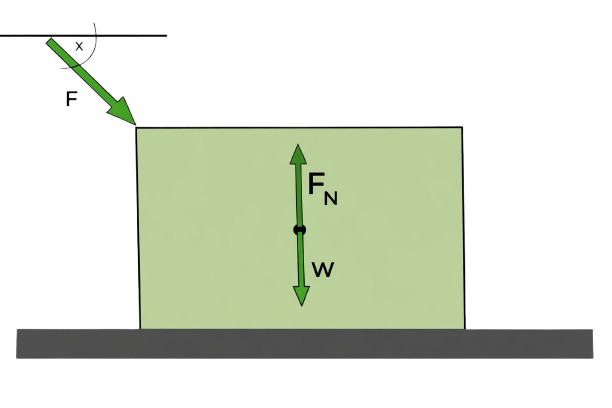
Normal Force Examples:
-
Suppose an object of mass 1 kg is placed on a table inclined at an angle of 45°. Find the normal force.
Solution:
Mass: \(m = 1 \, \text{kg}\)
Angle of inclination: \(\theta = 45^\circ\)
Normal force formula on an inclined plane:
\(F_N = m \cdot g \cdot \cos\theta\)
Substitute the values:
\(F_N = 1 \cdot 9.8 \cdot \cos 45^\circ\)
\(F_N \approx 6.93 \, \text{N}\)
-
Suppose an object of mass 20 kg is sliding down a slanted surface under a force of 200 N at an angle of 30°. Calculate the normal force on it.
Solution:
Given:
\(F = 200 \, \text{N}\)
\(m = 20 \, \text{kg}\)
\(g = 9.8 \, \text{m/s²}\), \(\theta = 30^\circ\)
Normal force formula when an additional force acts downward along the incline:
\(F_N = m \cdot g + F \cdot \sin\theta\)
Substitute the values:
\(F_N = 20 \cdot 9.8 + 200 \cdot \sin 30^\circ\)
\(F_N = 196 + 200 \cdot 0.5\)
\(F_N = 196 + 100\)
\(F_N = 296 \, \text{N}\)
Related Tools